Meditation
Maitri has been fussed while construction prevents her from going outside on the catio. This morning, she went into the yoga practice room, went into a trance, and projected herself astrally into the garden.
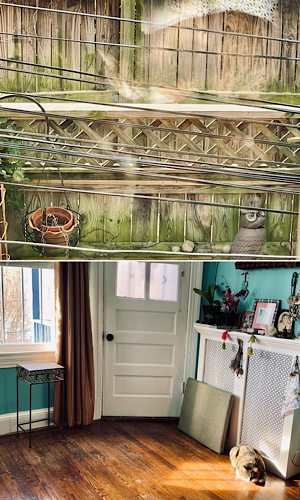
Maitri has been fussed while construction prevents her from going outside on the catio. This morning, she went into the yoga practice room, went into a trance, and projected herself astrally into the garden.
Where in your body might you be carrying your fear? Your rage? Your grief?
Are you able to pause and soften and give some love and support to those places?
Be safe out there. And be loud when you can.
Yesterday the mysterious beeping was beeping again in Studio 1B. I have all sorts of approaches to teaching with the beeping. One of them is to switch the attention of the ears to music. We flowed to Now by Bhagavan Das (because it was already in the CD player and I like it well enough) and listened to selections from Love Reigns by Diana Rogers during final relaxation. Monty asked me after class to give a list of some good music for home practice. Here are some of my favorite “yoga” cds in no particular order:
Krishna Das — Live on Earth; Faith of the Heart
Wah! — Hidden in the Name; Jai, Jai, Jai
Jai Uttal — Kirtan (this double CD also has a useful spoken background piece on what is kirtan)
Deva Premal — Love is Space; The Embrace
Ragani — Best of Both Worlds
Dave Stringer — Mala; Japa; Divas and Devis
Shantala — Sri; The Love Window
Many of these are available at the Willow Street Yoga Center shops. Most should be available on-line directly from the artists. Dave Stringer also has other music available for download. The rest can be obtained from Amazon. Also great listening is Invocation, which was put together by Ty Burhow. It is a collection of different artists offering versions of the Anusara invocation. Willow Street work studies are raving about MC Yogi’s Elephant Power, which is rap music telling the stories of various deities — funny and delightful.
Mostly, I prefer to teach and practice without music, but I was a dancer and find music helps to lead me into heart and body simultaneously. I find bringing music into a practice session especially helpful when I am having trouble getting settled on my mat. I do not just play “yoga” music, but play whatever gets me into the spirit of play or relaxation and contemplation as I am moved. My bias is towards chamber music (especially Bach) and Indian classical music for a late evening quiet practice and for an upbeat daytime practice anything that would go with being outside on a grassy field on a bright sunny day with frisbee players around. Alice Coltrane is also wonderful if you haven’t discovered yet her discography.
Play what enhances rather than what distracts. Also, check out the artists when they come to town: Wah!, Dave Stringer, and Shantala (Heather and Benji Wertheimer) all come to town. Enjoy!
The shiva-shakti tattvas, the two highest tattvas, are completely subjective. The shiva tattva is, according to the philosophy, the ultimate reality, the pure “I,” undiminished and undifferentiated consciousness. As something purely subjective, it is both everywhere and nowhere, in every being and simultaneously beyond them. It is not dissimilar to Hegel’s Absolute (though I believe Douglas Brooks, who knows far more than I in this area, might disagree with me on this one), which “is and is not,” or Kant’s “unmoved mover.”
Shakti tattva is power — the power to tranform, create, manifest, diversify, cloak. Shakti is the power to become embodied in objective form. Shiva and shakti tattvas are thus inseparable. Ultimate unbounded consciousness and freedom (shiva) only has meaning to the extent the power to move, create, and diversify (shakti) pulses and transforms the subjective into the objective, the unimaginable to the observable.
In our yoga practice and meditation, we seek to use the practices to reveal to ourselves the ultimate pulsation (spanda) between the objective and subjective, the observable and the unknowable, the individual and the completely universal. One way I experience the first principle of Anusara yoga (open to grace), is taking the mat or my seat with an openness to sense and experience this ultimate pulsation (spanda) and play (lila), so that by using my body, mind, and will, I can better recognize the spirit that shines in all of us and use that recognition to inform how I relate to myself, society, and all beings.