Found Exhortation


During last night’s yoga practice, we were exploring how advanced yoga postures such as headstand drop-overs could have therapeutic applications. If the practitioner is able to do the poses preparatory to the pose (for headstand drop-over to be accessible in a healthy way, the yogi should be able to do dwi pada vipariti dandasana and, of course, sirsasana, in good, easeful, steady alignment), then the pose can be integrating and healing for the shoulders and strengthening for the neck. For those with little cervical curve, really working to lengthen the side body, integrate the shoulders, and radically melt the heart (which is what is necessary to get into the pose), can help develop the cervical curve. Done out of alignment, the headstand drop-over risks the shoulders and neck–the very parts of the body that would be healed and strengthened if the pose were done in alignment–are at risk of injury.
Four or five years ago, I was at an advanced intensive with John Friend where he likened advanced asana practice to digitalis. Digitalis, which is a beautiful flower, is one of the most poisonous plants in the garden. Taken the wrong way, it can make you very sick indeed. Properly distilled and administered in just the right dose, digitalis is one of the most powerful and curative heart medicines available.
When we approach asana, especially the more physically challenging postures, with great respect, care, and discernment, we can not only benefit from its extraordinary healing and life-expanding powers, but revel and delight in dancing in our bodies. If we approach asana without honoring ourselves and the power of the practice, however, we put ourselves at risk and we fail to realize the benefits that are possible.
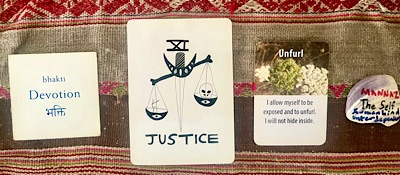
I adore having a library and will rarely say no to a philosophy text or a book about anatomy, therapeutics, or yoga methodology. I am less interested in “self help” types of books or gadgets. Every once and a while though, I come across something that truly supports my practice and my teaching. When I first went to Inner Harmony to study with John Friend in mid-2003, there was an altar in the corner of the practice room, just at the entrance. On the altar was a set of cards (a little smaller than 2″x2″). Each card had a word in English, the devanagari, and the sanskrit of the word transliterated into our alphabet. Following the lead of others who had been to Inner Harmony for previous retreats, at the beginning of the day, I would select a card and think about how the word on the card might inform my practice and intention.
At that time, I was first starting to use Anusara’s “heart-oriented posturing language,” using a theme for class that was designed to lead the students into a deeper place in their hearts through their asana practice, and I found that the cards were an excellent source of inspiration.
Even though I first bought the cards in 2003 to serve as a basic class preparation aid, I have continued to use them regularly for my own practice and contemplation. Often, the word that appears resonates with something that is of immediate concern. The day after Becky (my beloved cat who lived to be 21) left her body last year, I went to the set of cards, which I’d not used in a couple of months. The card that I selected at random (like picking a card from a deck when someone is showing you card tricks) was moksha — liberation, and in classic yoga, literally liberation from the body. I was moved to tears.
This summer, with myself and my students, we have been working on manifesting intention. As I’ve blogged about previously, I invited us to think about an intention. Whether an intention is something basic with the body or mind or something more universal, whenever we seek to manifest an intention, ultimately it is because we want to be more blissful, more open, and more at peace with ourselves and others. The question becomes how do we use our practice both to discover an intention and to seek to make it manifest. To help me with the contemplation of this question, I have gone again to the cards as a source of inspiration. This week, the card that turned itself up was racanatmakata — creativity. “Perfect,” I thought, when I saw the word. Creativity is a human reflection of the wild, pulsing, diverse and ever-extraordinary dance of all being. When we open to our creative impulse to allow things to unfold, we can witness the fullest range of possibilities and the variety of paths to manifestation.