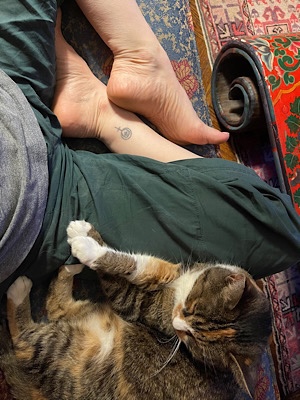
On the Way to William Penn House for Tuesday Night Yoga Practice


What are some of your ideas?
Surely that’s what life was all about? Opening doors and peering through them–perhaps even finding the rose gardens there… (Colin Dexter, The Dead of Jericho)
The good murder mysteries — the ones that teach much about human nature and do not dwell graphically on gore and violence — can teach us much about the power of sadhana (yoga practice). The best mysteries are ones in which the protagonist teaches us by his or her investigation into the mystery that with careful, steady discipline, the application of well-developed technique and study, consistent effort, and an openness to trust intuition tempered by discrimination, we can reveal to ourselves the truth of the matter. The truth revealed is not just the identity, means, and motive of the murderer (mystery solved), but the knowledge of the extraordinariness of human being in all of its manifestations, both good and evil.
It was hard to hold the incongruity of setting off on a beautiful morning to go to a child’s birthday at the Zoo, followed by a leisurely walk to Dupont Circle to get a haircut, with the news of devastation from too many places at once and my concern for friends and acquaintances and their families and for those who will be impacted the most severely.
The Zoo is doing a good job educating about animals that are threatened with extinction, how human civilization is contributing, and how we can shift behavior to co-habit more gracefully with other species, which made visiting the Zoo less unequivocally uncomfortable.
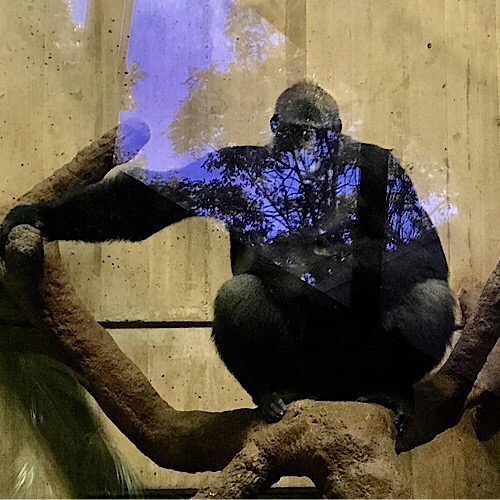
I got to the Zoo early, so I could walk around. I went into the great ape house for the first time in a decade, possibly two. One of the apes had figured out that if he leapt at the dividing glass with a thump, the humans right on the other side would squeal and jump. One little boy stood still, calmly holding his hand, with fingers spread open, on the glass, reaching and waiting to see.
There were two bald eagles that had damaged wings. There was no roof over their space. They seemed happy enough to be in a place with excellent, regular meals.

Martin Luther King, Jr. said: “A true revolution of values will lay hand on the world order and say of war, “This way of settling differences is not just. …A nation that continues year after year to spend more money on military defense than on programs of social uplift is approaching spiritual death.” Still, the Pentagon suggests that Martin Luther King “might” have supported the war in Afghanistan. Not sure on what basis.
Last night at the Willow Street Book Club, where we were reading Ram Dass’s Paths to God–Living the Bhagavad Gita, one of my fellows raised the question of how we could read as a spiritual guide a book whose context is war. Another asked a similar question from the perspective of a feminist. It was a fabulous, engaged, lively discussion, and I hope to see more next month.
It would be an injustice to the text and the historical context to read entirely out of the Bhagavad Gita the duty of a warrior to kill, a wife to practice suttee, and persons born into each caste to accept their lot in life in a society structured on the caste system. There is much richness in the text, though, that can provide guidance for a feminist, pacifist, who believes that “all men are created equal.”
We have reread “men” in the Declaration of Independence to include women and those of all races (though we cannot manage to rewrite the Constitution to explicitly state that women are equal, but that’s a thought for another day). Similarly, without doing injustice to the text, we can see that the ultimate teachings about living in accordance with duty (svadharma), love, devotion, and sacrifice in the Gita, like the concepts of “life, liberty, and the pursuit of happiness,” provide guidance and force for social action and spiritual devotion beyond a historical context that oppressed and bound on the worldly plane the very persons who are now seeking the deeper meanings in the text. In fact, I believe that we can use the essential intent of the text to teach and transform the oppressors, to use the very text to show why the violence and oppression of the historical context is injust and needs to be changed so that the spiritual intent can be expanded and spread beyond the privileged.