Art and Culture | Asana, Pranayama, and Yoga Practice | Community and Family | Dance/Contact Improvisation | Food for the Body | Meditation | Photos | Poetry
Found Exhortation

As I have walked around town enjoying the spring surge of blossoming trees, I found myself remembering that our most famous cherry blossoms were a gift from the Japanese, which remembrance sent a deeper yearning to help send healing.
At one sunny, pink-blossomed drenched moment yesterday, I found myself asking how could one’s heart not reach out to a people who brought us such beauty. I then thought that this country had no problem incarcerating “those” people on “our” soil and bombing their country when the arrival of the gift of our famous cherry trees was still in living memory. At that time, “they” had become our country’s enemies because of the actions and statements of those in power. The gift had become irrelevant in the context of war.
The peril in both thoughts is that they distance us from opening and relating to the essential identity and humanity in all of the individuals we meet of various nationalities and alliances–whether in a time of gift-giving or in a time when we cannot abide the actions or ideas of those in power.
Peace and light, E — Posted with WordPress for BlackBerry.
One of the things I like best about going west for a retreat is being able to relish with ease the time before and at sunrise. At home, I sometimes sleep through dawn once the days get long. The light is just extraordinary at the ending and the beginning of the day, revealing the openings in space and time.

Peace and light, E — Posted with WordPress for BlackBerry.
I went today with my younger sister and brother-in-law to see the Terracotta Warriors exhibit at the National Geographic Museum. Even with only a few of the warriors and photographs of the site, it is possible to imagine the sheer magnitude of the vision of thousands of these life-sized images living underground at the tomb of the Emperor. I then thought of how vast must have been the Emperor’s yearning for power and the wildness of his vision of this extraordinary tomb for it to have become manifest. Trying to expand my imagination to understand the reality of such ambition and creativity I thought of the principle of iccha shakti. Iccha shakti is the very will of consciousness to be, to creatively manifest, to become diversified embodiment out the universal. Ego and will are not themselves bad, but our very freedom allows us to choose a path that is out of alignment with the principles of joy and unity.
The Terracotta Warriors show the immense possibilities of exercising will. In their very existence and the manner of their coming into being, they evidence both enormous cruelty and disdain for life and a wondrous manifestation of human creativity, collaboration, and effort. One of the goals of yoga, in teaching us the possibilities of our own freedom and creativity, is to lead us to choose a life that is progressively better aligned with nature and with all of beings. This is the path of one who practices, and I find it ever a challenge.
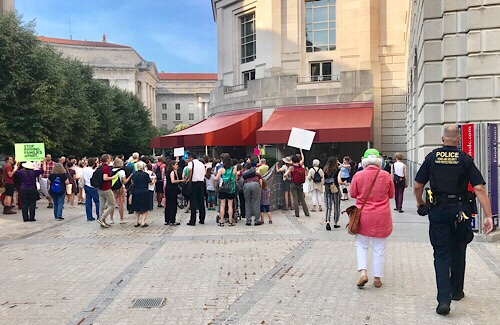
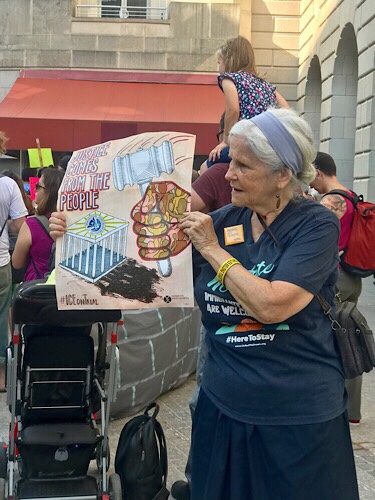
This morning before work, I joined a group of people at the International Trade Center who were speaking out against separating immigrant families at the border. It was already 80F when I left the house at 7:30. It added two miles to my morning walk to join in. I thought about how far these families have walked in desperate hope only to meet such cruelty. What was a little discomfort and arriving at the office a bit red in the face and damp?