Art and Culture | Asana, Pranayama, and Yoga Practice | Community and Family | Food for the Mind (Yoga Philosophy, etc) | Meditation
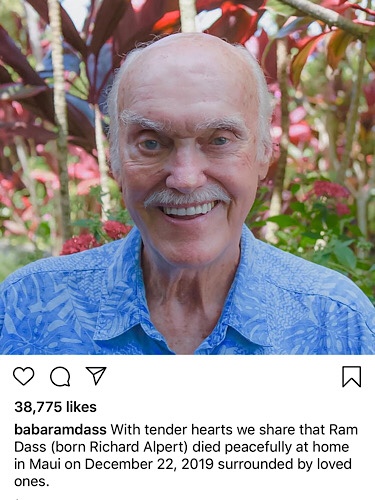
RIP Ram Dass
Paul Muller-Ortega, who teaches philosophy and meditation from similar roots to those that inform Anusara yoga, spoke yesterday of the differences between the path of the renunciate and the path of the householder. He strongly stated that neither path was better. What he suggested, though, was that a householder will better flourish practicing yoga designed for the householder rather than attempting to practice renunciate techniques, while still staying in the householder path.
What does this mean? I think it means that we become unhappy and conflicted if we try attempt the practices of the path of complete non-attachment and transcendence of body and mind while we are still very much staying in society and responsible for family, work, and citizenship. The tantric, householder path, including that of the Shaivite tradition of Kashmir and Abhinavagupta, offers practices that enable one to live liberated in society, instead of suggesting that the only way to true liberation is to reject and transcend work, family, and community. In yoga terms, the householder path is one that realizes moksha (liberation), through ardha (physical and material well-being), kama (love/relationship), and dharma (right work/path) rather than by transcending them.
Taking the householder path does not mean just indulging. It still requires sensitivity, dedication, discrimination, and alignment. I think it may be even harder than renunciation. I know it is easier for me to just stay alone and practice, for example, than to bring yoga off my mat to how I work, consume, relate to others, and participate in society. The householder path, though, is the one for me.
Yesterday the mysterious beeping was beeping again in Studio 1B. I have all sorts of approaches to teaching with the beeping. One of them is to switch the attention of the ears to music. We flowed to Now by Bhagavan Das (because it was already in the CD player and I like it well enough) and listened to selections from Love Reigns by Diana Rogers during final relaxation. Monty asked me after class to give a list of some good music for home practice. Here are some of my favorite “yoga” cds in no particular order:
Krishna Das — Live on Earth; Faith of the Heart
Wah! — Hidden in the Name; Jai, Jai, Jai
Jai Uttal — Kirtan (this double CD also has a useful spoken background piece on what is kirtan)
Deva Premal — Love is Space; The Embrace
Ragani — Best of Both Worlds
Dave Stringer — Mala; Japa; Divas and Devis
Shantala — Sri; The Love Window
Many of these are available at the Willow Street Yoga Center shops. Most should be available on-line directly from the artists. Dave Stringer also has other music available for download. The rest can be obtained from Amazon. Also great listening is Invocation, which was put together by Ty Burhow. It is a collection of different artists offering versions of the Anusara invocation. Willow Street work studies are raving about MC Yogi’s Elephant Power, which is rap music telling the stories of various deities — funny and delightful.
Mostly, I prefer to teach and practice without music, but I was a dancer and find music helps to lead me into heart and body simultaneously. I find bringing music into a practice session especially helpful when I am having trouble getting settled on my mat. I do not just play “yoga” music, but play whatever gets me into the spirit of play or relaxation and contemplation as I am moved. My bias is towards chamber music (especially Bach) and Indian classical music for a late evening quiet practice and for an upbeat daytime practice anything that would go with being outside on a grassy field on a bright sunny day with frisbee players around. Alice Coltrane is also wonderful if you haven’t discovered yet her discography.
Play what enhances rather than what distracts. Also, check out the artists when they come to town: Wah!, Dave Stringer, and Shantala (Heather and Benji Wertheimer) all come to town. Enjoy!
Whatever we are doing or not doing, we are creating our lives.
What do you want to be creating?