Illuminated Blossoms
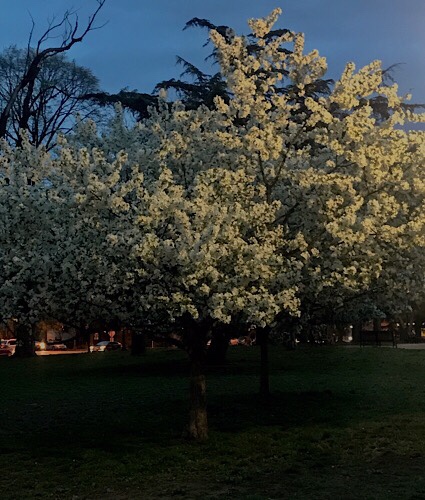
I realize that this blog entry was in my drafts page; I never hit the publish button. As I ponder the few intervening weeks of snow (in some ways it feels as if time just stopped, except for the work that piled up and the lengthening of the light of day), I treat this as a reminder to myself to come back to “first principle” to respond with the most light — even in this unusually harsh winter:
On my way to Friends Meeting yesterday, I stopped at the Dupont Circle Fresh Farm Market yesterday to buy whatever was fresh. When I got in line with a daikon radish, a bunch of turnips, and a couple of leeks, I noticed the way the woman in front of me in line was holding her selection: sunchokes. Her hands were held as if she had just received prasad — the offering sometimes made after a puja so that the fruits of worship may actually be tasted and injested, incorporated with our senses and our whole bodies into our being. “Your hands and those sunchokes are so beautiful,” I said, “may I take a picture and use it for my blog?” “Sure,” she replied, “and shifted her hands a little so that it would be easier for me to frame the picture.” We talked while we waited in line about potential ways to cook sunchokes and how happy we were that the farmers (these particular farmers’ must be incredibly good at working with cold frames) were out all year.
Seeing this offering of the earth itself, the farmers who tended the earth and grew the vegetables, the workers who made and repaired the vehicles that enabled the food to be brought into the city, the city and neighborhood for allowing the market to block off a street, the shoppers for supporting it, brought me back to my contemplations this week of what “first principle” means to me. I mentioned in an earlier post that my focus for winter classes would be Anusara sequencing principles. No matter what else we are doing or focusing on, it always starts with “first principle.” The “first principle” is what we call in Anusara “opening to grace.” For me, a large part of “opening to grace” is a recognition that all the nourishment we receive is a gift. When we practice such a recognition, then we practice receptivity, openness, gratitude, courtesy, respect, delicacy, and reciprocal desire to serve and make offering. How could one mindfully receive nourishment such as this fresh, beautiful food on a bitterly cold winter day, and not want to celebrate it by giving thanks, nurturing the earth, supporting the farmers and the market, learning how to prepare it as tasty and healthful as possible, and share it and other things with those around us?

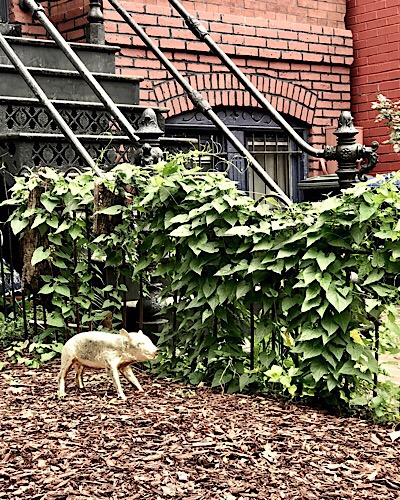
I think it highly unlikely that the neighbor who chose to decorate a front yard with a silver-painted pig and wood chips intended in any way to reference Vishnu in his incarnation as a boar. But as I’m caught up in learning about the animal chariots and incarnations of the 330 million these days, that is what came to mind for me.
There’s a story that Vishnu incarnated as a boar to kill a demon who could not be killed by man or god (similar to the story about Durga slaying Mahisha, the buffalo demon).
When in anthropomorphic form, Varaha is often seen with Bhudevi (Earth goddess) and sometimes also Lakshmi. There she is again–Lakshmi–calling to me to remind me to act from my abundance (from there comes my capacity to slay demons).

Peace and light, E — Posted with WordPress for BlackBerry.
The practice of yoga nidra is a wonderful way to deepen the connection between the full range of consciousness and your physical body. It is enjoyable and helpful to practice it on an occasional basis — we did it for the last class of the session in the Willow Street gentle/therapeutics class and you all are welcome to come to the New Year’s Yoga Nidra workshop on Sunday, January 4th — but it can be even more productive as a regular weekly practice.
Here are some good resources if you have found yoga nidra helpful and want to find out more about it and establish a home practice:
To read more about yoga nidra, I recommend the following books, both of which I believe are available at Willow Street Yoga Center.
These CD’s lead you through yoga nidra practices of various lengths and emphasis: