Similar Posts

  • | |

    Knowing Your Garden (and svadyaya)

    This will be my 20th season in my garden.  I know that my back garden — where I grow my herbs, flowers, and vegetables —  is easily 4-5 weeks earlier than the gardens of my friends’ in Potomac and Silver Spring and the outer suburbs.  It is even almost that much earlier than my front garden.  I have a brilliantly sunny, south-facing, protected back garden with a brick patio that is against an unpainted brick house and a densely shaded, north-facing front garden.  Not only is the back garden sheltered from the wind by the house on one side and the fence on three sides, but the bricks retain enough heat to change the temperature by a a couple of degrees.  I have a special micro-climate.  My climbing rosebush (pictured in the header) is already in leaf.

    What does this mean?  While my friends in the suburbs or those with east/west facing houses are starting seedlings for kale and spinach indoors, I can put seeds into outdoor containers in the next week or two without compunction.  The seedlings I would need to start (if I don’t instead choose to purchase them from the organic farmers at the market) are peppers and tomatoes for planting in mid-April.  If I start with strong 8″-12″ plants in mid to late-April (depending on the 15-day forecast), I can have and have had for at least 10 of the past 20 years, cherry tomatoes in May and peppers in early June.  My greens, obviously, bolt earlier.  I’ve figured out that certain varieties of chard do better in these conditions, and that spinach and lettuce do better sheltered by the fence where they get afternoon shade, so that I can have them farther into the season.

    This kind of knowing by combining general book and teaching knowledge with personal observation of my little space, is much like the yoga practice of svadyaya (self-knowledge), which is the fourth niyama of Patanjali’s yoga sutras.  Svadyaya is literally study of the self through the scriptures.  Implicit in that is the guidance of a teacher or guru.  Ultimately, though, self-knowledge or awareness must be experiential.  We make the effort to study and we listen to our teacher, but then we practice.  We soften and open to who we (or our garden) truly are — another way of practicing and experiencing the Anusara principle of opening to grace — and then in the context of the teachings, accept who we are.  As gardeners, that means accepting what zone we are in, how much shade, water, space, and sun we have.  As yogins, it means accepting our strengths and our limitations.  We can shift our zone by treating certain plants as indoor/outdoor or as annuals rather than perennials; we can enhance our water flow by storing it in rain barrels, but that is merely expanding the edge rather than making a complete change.  We can expand the edge of our practice, but still need to accept the bodies with which we were born.

  • | | | | |

    Found Quotations (“For Remembrance”)

    In recent months, I have listened to the stories of a number of close friends and co-workers as they navigate the difficult process of saying their good-byes to the tangible, physical embodiment of a loved one and participating in the loved one’s own good-bye.

    I find myself filled with memories of those I still love though the loved one is no longer embodied in the physical form in which I met them.  For me and for those with whom I share my memories, they live on as such and. in greater and lesser amounts, in how I think, respond, and act to this day and beyond.

    For Remembrance

    At the Shakespeare Garden in Central Park, NYC

  • Vegan Peanut Butter Wheatgerm Cookies

    These cookies are loosely inspired by the peanut butter cookies from the Joy of Cooking because those were my first peanut butter cookies.

    1.  Soften a half cup of vegetable shortening (preferably organic), then cream with 1/4-1/2 cup of sucanat (sweeten to taste).  Beat in 1/2 cup agave nectar or maple syrup.  Add in equivalent of one egg of either “egg replacer” or flax seed emulsified with water.  Cream in peanut butter (make sure the peanut butter is organic; creamy works best in this recipe as they are crumbly cookies), a dash of salt, and a 1/2 tsp of baking soda.

    2. Mix together 1/2 cup whole wheat flour and 1/2 cup whole wheat pastry flour.  Then mix the combined flours into the wet ingredients until well combined.

    3.  Blend in 1/2 cup of toasted wheat germ (flax seed meal or a combination also would work).

    4. Chill the dough for at least 1/2 hour for best results.  Lightly grease a cookie sheet while the dough is chilling.  Shape the dough into walnut sized balls (or make them smaller, but shorten the cooking time).  Make an indentation with your thumb to flatten slightly.  The dough will rise and the thumbprint will disappear during the baking process, leaving a smooth, round pillow of a cookie.

    5.  Depending on your cookware and whether you have convection (needs lower temperature) or conventional oven, bake at 335F-375F.  Starting from a cool oven (many baked goods are fine without the oven preheating; to save energy, try to start baking with something that doesn’t mind starting in a cool oven and then baking several items at the same time to take advantage of the already heated oven), bake for 15-20 minutes, depending on whether the oven was hot already, until golden.

    6.  THIS IS IMPORTANT:  these cookies crumble very easily when first taken out of the oven.  Leave them to cool for at least 15 minutes on the cookie sheet before transferring directly to a plate.

    Variations:  any nut or seed butter.  Hemp would be particularly good, as would almond.

  • | |

    One Person’s Weeds

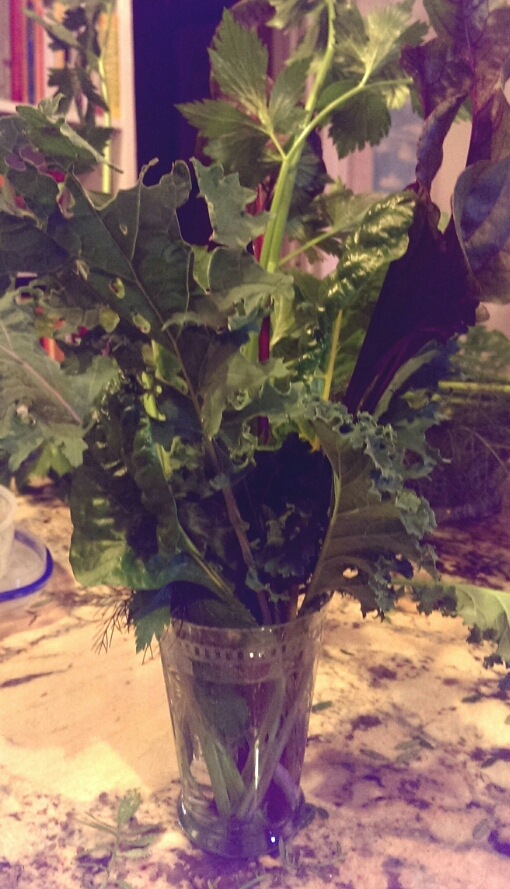
    Last year, some romaine lettuce must have bolted.  I have baby romaine lettuce coming up everywhere.  Having reverted to the wild, it is quite bitter.  It is also taking up a fair amount of space, so to be able to plant more appealing things (new herbs and greens) I will be pulling it up.  It has become, in essence, a weed.  Later in the year, I’ll also have a surfeit of volunteer epazote and purslane, which many would pull as weeds.  Those, I actively encourage, eating young the ones that come up over and over again through the bricks and confining in containers a few others to grow larger and to reseed.

    Even though it is too bitter to be palatable raw, the now “weed” romaine tastes fine cooked as a tender green.  So it does not get discarded.  I just won’t make myself eat it in its bitter form as the salad green that it is “supposed” to be.  Instead, since it is nourishing and tasty as a cooked green, it is a welcome early addition to the garden.

    Just I have challenges and tribulations from whatever is my overall plan for the garden, I have my share of aches, pains, challenges, and disappointments, in life and in my yoga practice.  The question is how to discriminate (viveka) among those that are poisonous, those that are bitter, and those that can be made nourishing and sweet, through the cooking of understanding, practice, and effort.

Leave a Reply

Your email address will not be published. Required fields are marked *

This site uses Akismet to reduce spam. Learn how your comment data is processed.