State of the Garden

Last night, after yoga class, I went with a couple of students to the new Italian restaurant at Eastern Market, Acqua al 2. I’d been shown the inside before it opened, but this was the first chance to go and eat. A long-time neighbor, yoga student, and friend is the mom of one of the co-owners and has known the other owner since childhood. The co-owners were both were raised in the District and have returned after college, along with many of their friends to live, and work, and be with family. I went to eat with the eagerness of knowing my friend and her family better and supporting them, more than for the purpose of needing to be one of the first to check out a new dining opportunity on the Hill, although that was certainly another pleasure.
As we planned the dinner (we have been awaiting the opening for some months and talking about going since then), I thought about how different it is to go to a business where I feel a connection to the proprietor or the workers. I felt more open to what would be there, more joyousness at its very existence, and a yearning to find it wonderful and be supportive. When the business is run by a stranger, or even more removed, some corporation whose duty is mostly to shareholders, the natural forgiveness for quirks that we have for those we like, welcome, and love is missing, and we ourselves miss out the essence of true relationship. Getting to share this new place with my friends was a superb reminder how important is community and how we can support it and cultivate it.
What a delight that, even as a NY-bred food snob, I can cheerfully recommend the restaurant. It is larger than most restaurants on the Hill, so it does not feel like a neighborhood-style Hill restaurant. but I think the neighborhood was ready for something larger. The atmosphere is lovely: communal seating in front near the bar for those who have forgotten to make reservation (yes, you already need them, unless you are coming after 9 [kitchen serves until 11]), spacious, pleasantly lit, comfortable tables, and a great mural on the outside, which transforms a concrete wall a foot along the side of the restaurant into a view of Florence.
We started with the “zuppa del giorno,” which yesterday in keeping with the unseasonably cool weather, was a warm bread and tomato soup that was a rich and flavorful concoction. Given the lateness of the hour, we didn’t have the entrees (though I’ve heard good reports). We shared at our table for three, the pasta sampler (for two), which was five different vegetarian pastas of the chef’s choosing, and the salad sampler (which you can get as all vegetarian if you ask). We each had different favorites of the pastas, but all were good and very classic in preparation and presentation. The salads were light and fresh, with an emphasis on bitter greens, which I like, and were an excellent foil to the rich pastas. The pastas came out one by one, giving an opportunity to have two or three bites to savor, with then a little wait in between for the next one. This was not a meal to be hurried; things come at a European pace. I was too full for dessert, but my friends insisted. The cheese cake is the kind that is more like mousse than the heavy American cheese cake and my companions raved. I had a fruit tart that was well-prepared — most of which I took home. I will enjoy eating it today after speaking on a telephone seminar with people I know are asking challenging questions.
The restaurant is still getting its rhythm. It was packed with lines out the door even at 8pm on a Tuesday night just two weeks after its opening, which is no doubt inviting the staff to live up to intense challenges. The food is sure to be good, and if you go with the generosity you would have for family and friends starting out on a new venture, you will have a delicious experience.
Note: Plenty of vegetarian options with the pastas and salads, but it would be harder to find vegan on the menu (given that it is a Florentine restaurant). My only wish based on last night’s meal, is that the restaurant would use more environmentally friendly containers for taking things home. Right now, it is using foil trays with a plastic cover, so if you anticipate bringing part of a dish home, try to remember to bring your own carry container.
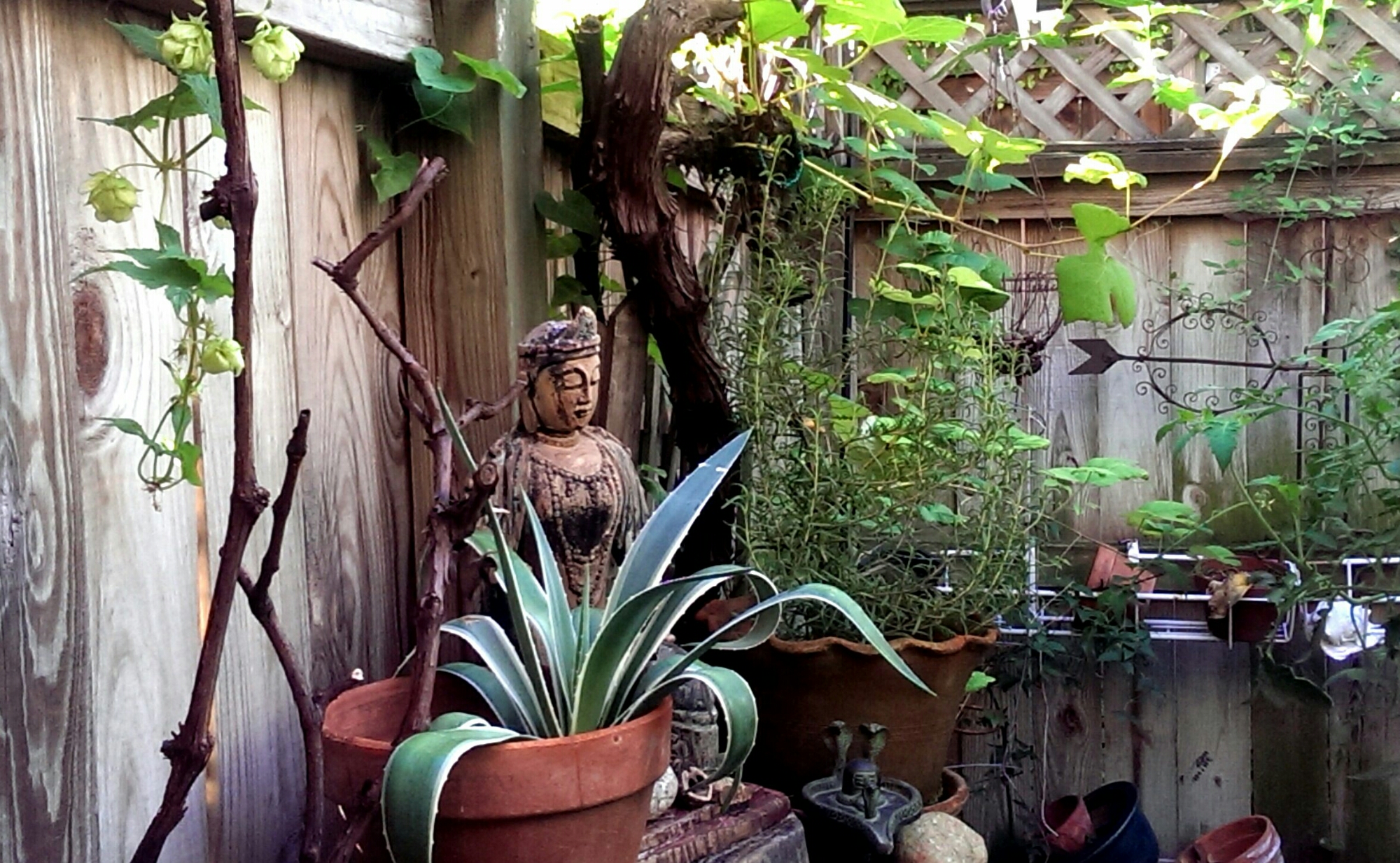
This morning when I stepped out into the back garden, I heard the sound of clippers on the other side of the fence. It was my back garden neighbor of over 15 years. “Is that you?” I asked. “Yes,” was the reply and we both walked up onto our decks so we could see across the fences. “It must be summer,” my neighbor said, in acknowledgment of it being the first morning of the season we coincided in the garden. “I am so ready,” he said, and we caught up with the winter news and discussed what was going on in our gardens. I told him about Becky, marveling at her wonderful long life of 21 years. “It was time, then,” he commented. “I still miss her, though,” I replied.
Yesterday, several people said to me that they were not ready for summer. Whether people were ready (or not) for the 90 degree weather seemed to depend a lot a preference cold or warm weather.
It hardly matters whether we are ready for a shift in the seasons, the loss of a precious being, or the arrival of gray hairs and degenerative arthritis (I am finding myself not ready for any of these, really).
Life comes to us, ready or not. We can use our yoga practice, especially asana, to help us expand and shift and be prepared for whatever comes, by inviting all of our practice and our growth (which includes both expansion and contraction) a rich exploration. We can experiment with where is our edge, listening to both ourselves and our teachers to discover not only what we are ready for, but also how we react when confronted with that for which we think we are not ready. By seeking the subtle knowledge of when our mind is ahead of our body and when our mind is holding back our body, we can enhance our ability to respond to what comes in the most open, sensitive, discriminating, flexible, and thus, life-enhancing way, on and off the mat.
In the meantime, I give in to the premature summer heat. This morning, I picked spinach and herbs to go with mushrooms from the fresh farm market for breakfast and made a posy of pansies for the altar. Why leave them in the garden if they will just wilt in the heat? It was a great afternoon for a siesta and a treat to be out in the city in the morning unencumbered by sweater or jacket. For my evening practice, I will emphasize deep, cooling forward bends and pranayama. Will I be ready for the cool days to come back at the end of the week? I do not think I will have a choice.
Spring flowers are not much more ephemeral than are we from the perspective of infinity (or even geological time). I think one of the central aims of yoga philosophy is to make some sense of the need for recognition of our own place and worthiness, while still acknowledging our undeniable individual smallness in the vast web of being. In that light, it seeks to offer us awareness of some idea of ourselves that is infinite and not just our distinct finitude.

Peace and light, E — Posted with WordPress for BlackBerry.
Voting is still open, see The White House Farmer. (Pretty sure this is a non-partisan position).