| | |

Happy New Year (and vegan Hoppin’ John variant)

Having grown up in the New York metropolitan area without much in the way of traditions of any kind, I was not familiar with Hoppin’ John.  I am fairly certain that the first time I heard of it was from a college friend whose family has been in South Carolina since before the Revolution.  As it is not part of my tradition, I do not feel bound to any particular recipe (I am sure it is sacrilege in some circles to leave out the ham/bacon) or to eating it at any particular time of day (e.g., immediately after the clock strikes 12 midnight).  It would not be Hoppin’ John, though, if I did not know its tradition and know where I was deviating from tradition.  (Though this would entail a much longer blog than is within my time frame today, this balance of freedom from tradition and needing to know and honor tradition is very much an issue for the Western yoga practitioner.)

1.  Soak a cup of dried black-eyed peas for at least several hours or overnight.

2.  Dice one small onion or 1/2 large onion (about a cup), a few celery stalks, including the leaves, and mince a couple of cloves of garlic.

3.  Heat a few tablespoons of a flavorless oil (peanut, corn, or safflower) in a pressure cooker (my preferred method for saving energy and time) or a stock/stew pot.

4.  Saute seasoning vegetables along with a few hot peppers until onion is translucent.  I used the last habanero from my harvest and so left it whole.  You can use fresh or dried chilis in an amount to your taste/tolerance for spiciness.

5.  Stir in a cup of brown rice until rice is coated with oil.

6.  Pour in 1/4-1/2 cup of white wine and stir until absorbed (as if making risotto).  [You could use stock instead.  If you are using white rice, skip this step, which serves to partially cook the brown rice, so that it will take the same amount of time as the black-eyed peas.]

7.  Crumble in some dried thyme (preferably from your own garden) and a bay leaf or two.

8.  Drain and rinse the soaked black-eyed peas and stir into the cooking pot until all ingredients are combined.

9.  Add one 28 ounce can of diced tomatoes and 2 1/2 – 3 cups of vegetable stock or water.  How much liquid depends on (a) whether you want a soupy consistency or one more like pilaf or risotto; (b) how liquid are the tomatoes; (c) whether you are using a pressure cooker (less liquid needed) or cooking in a pot.

10.  If using a pressure cooker, cover and bring to full pressure, then lower heat and cook at full pressure for 28 minutes.  Allow natural pressure release (about 15-20 minutes additional).  If cooking in a regular pot, bring to a boil, stir, then lower heat and cook for an hour or more until rice and peas are tender, stirring occasionally.

11.  While rice and peas are cooking, mince a few cloves of garlic.

12.  Rinse and chop several handfuls of greens (collard or curly kale are best; don’t use spinach or chard, they are too tender).  Heat oil and garlic together.  When garlic start sizzle, add damp greens and saute until greens are wilted and dry.

13.  When rice and peas have finished cooking, stir in sauteed greens and bring back up to full heat.  Adjust seasonings, adding more salt and your favorite hot sauce to taste (or allow guests to add their own hot sauce at the table).

I don’t know whether having eaten this will bring me luck and prosperity, but I’ve started the year with lots of vitamins, minerals, fiber, flavor, and cooking, which for me means health, love, technique, tradition, flexibility, and joy!  Try this, make your own, read all about Hoppin’ John, or call a friend from the South who must eat Hoppin’ John on the New Year and learn about the tradition and what it means.

Similar Posts

  • |

    Krishnamurti’s Daily Thought

    Three or four weeks ago, I came out of my morning meditation thinking about the teachings of Krishnamurti.  (I read a lot of Krishnamurti when I was in high school, so his teachings have influenced me with varying degrees of subtlety).  Two or three days later, I was “spammed” with Krishnamurti’s Daily Thought.  Someone, apparently somewhere in Europe, somehow got access to an email list to which I subscribe.  As I had just been thinking about Krishnamurti, though, instead of hitting “unsubscribe,” I read the thought for the day.  I’ve been reading it since, and I am exploring how much my readings in high school have been part of my foundational thinking.

    When I was volunteering at the Lantern yesterday, one of the other volunteers called and reminded me that there were books put aside for me.  It is not my habit to put books aside, and I had no recollection of so doing, so I was curious to discover the books were there.  One of the two books was a slightly water damaged paperback of Krishnamurti On Right Livelihood.  The universal energies are obviously suggesting I examine this early influence.  I am contemplating what the following question means for me in today’s current context of multiple wars, a deep recession, and burgeoning environmental degradation:

    Is it not necessary for each one to know for himself what is the right means of livelihood?  If we are avaricious, envious, seeking power, then our means of livelihood will correspond to our inward demands and so produce a world of competition, ruthlessness, oppression, ultimately ending in war. Krishnamurti, Ojai, July 1944

  • | | | | |

    Avilokitesvara

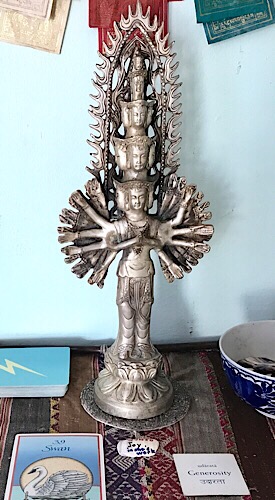
    Avilokitesvara– god(dess) of compassion had one head and two arms. Zhe didn’t have enough ears to listen to all the stories of suffering, so one of the buddhas busted one head into eleven. Avilokitesvara’s two arms broke from the weight of helping, but instead of two arms broken and worn out, two arms broke into a thousand arms.

  • |

    “This confused war”

    My dear friend from college, Dan Harper, just posted the following on his website.  I feel fortunate to have a friend who inspires me to me more learned and more concerned.

    Martin Luther King would have been 80 today. On February 25, 1967, not long before he was killed, he spoke about the Vietnam War and its effects on our country. The following excerpt from that speech could easily be delivered today, with just a few minor changes:

    “This confused war has played havoc with our domestic destinies.

    “Despite feeble protestations to the contrary, the promises of the Great Society [anti-poverty program] have been shot down on the battlefield of Viet Nam. The pursuit of this widened war has narrowed domestic welfare programs, making the poor, white and Negro, bear the heaviest burdens both at the front and at home.

    “While the anti-poverty program is cautiously initiated, zealously supervised and evaluated for immediate results, billions are liberally expended for this ill-considered war. The recently revealed mis-estimate of the war budget amounts to ten billions of dollars for a single year. This error alone is more than five times the amount committed to anti-poverty programs. The security we profess to seek in foreign adventures we will lose in our decaying cities. The bombs in Viet Nam explode at home: they destroy the hopes and possibilities for a decent America.

    “If we reversed investments and gave the armed forces the antipoverty budget, the generals could be forgiven if they walked off the battlefield in disgust.

    “Poverty, urban problems and social progress generally are ignored when the guns of war become a national obsession. When it is not our security that is at stake, but questionable and vague commitments to reactionary regimes, values disintegrate into foolish and adolescent slogans.”

    Full text of the speech on Stanford’s Web site. Crossposted on PaxPac.

Leave a Reply

Your email address will not be published. Required fields are marked *

This site uses Akismet to reduce spam. Learn how your comment data is processed.