Similar Posts

  • |

    Putting the Garden to Bed Sun Salute

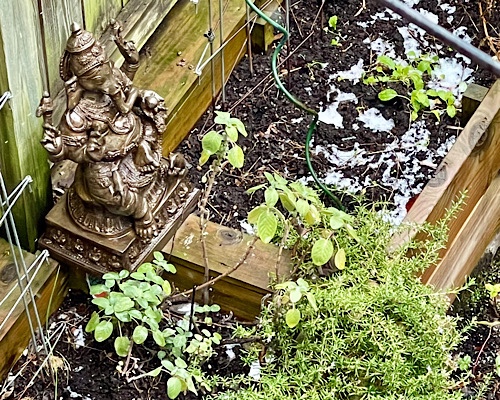
    Yesterday (latest in the season ever — see interesting articles in the New York Times last month about Thoreau as a climatologist) I spent the morning bringing all my tropical plants inside.  Part of the reason it was later is that I have learned that the orchids and night-blooming cyrius like nights in the low 40s and can tolerate the occasional single night in the high 30s, but most of it is that it is a warmer season than any in the decade I’ve had a significant number of tropical plants.  I also bring inside the lemongrass and lemon verbena (annuals here; perennials where they are native).  I also like to bring in rosemary in a container.  Also, what were once small plants in growers pots are now a huge jasmine and a bay tree.  When I bring all of this inside in the winter, I transform the house into a retreat.  When I bring it all outside in the early spring, my tiny yard is full and lush before the annuals start flourishing.

    Once the tropicals were all inside, I cleaned up, tended the beds and containers, and strew some more winter kale and baby spinach seeds (no frost in the forecast for the next 15 days — so I could have new kale and spinach through December; also, some of the seeds will wait and be the early ones that come up during that warm week we always have in February).

    Putting the garden to bed has a sweetness to it.  I prepare for next year, but also engage in tending what will flourish best when the days are coldest and shortest.  It is a going inside, knowing that there is a need to go inside and let some things be dormant in order to flourish fully when the sun is bright and hot and calls me outside.

    This type of gardening is stressful for the lower back, hips, and shoulders.  Throughout the hours I am gardening,  I like to engage my alignment by intermittently doing some poses, strongly integrating my shoulders, hips, and core:  working strong “shins in/thighs out” I practice uttanasana (standing forward fold), utkatasana (chair pose), and adho mukha svanasana (downward facing dog), and maybe even handstand.  It is critical to make sure not just to bend from the knees, but also to make sure you have a good lumbar curve and your tailbone is tucked, when picking up containers or other heavy objects.

    At the end of several hours of gardening (bringing the tropicals inside also entails vaccuuming), I need to realign, stretch, and reintegrate, but I’m tired.  I also want to practice in a way that honors and celebrates the sweet inward nature of the work I have just done.  This is what works well for me:

    1.  Seated foot massage.

    2. Balasana (child’s posture) with arms stretched out, palms, forearms, and armpits lifted.  Inhaling lift underside of arms to strenthen, exhaling soften between shoulder blades to integrate.

    2. Chakra vakrasana (cat/cow breathing).

    3. (putting the garden to bed sun salute):  Table pose (if you make sure you have good lumbar curve, table is one of the best postures for making sure hips, back, and shoulders are aligned well); Downward facing dog (play in the pose to integrate and stretch the legs and arms and strengthen your core); Palakasana (plank);Table pose; Balasana;Table.

    Repeat the series several times.  Add in lunges (coming into the lunges from table).  Add in twists from table, threading one arm through and coming down onto that shoulder).  Add in pigeon pose (with a forward bend).

    4. End with legs up the wall, a supported or seated forward bend or two, and savasana.

    Enjoy how this practice nourishes and realigns, but generally draws the attention inside, getting you ready to enjoy the inside while waiting for the next growing season.

    E

    ps While I was practicing, I had a big vat of tomato sauce cooking from the last (perhaps second to last) harvest of cooking tomatoes.

  • | |

    “Now Write in Your Journals…” (and What It Means to Be a Good Student) (DWTD)

    The first day of the advanced intensive this week, John Friend invited us to write in our journals about what we wanted to get out of the three days from both an energetic perspective and from the perspective of a particular asana that has challenged us. This was not long into the first session of the first day, but it was after he spent some time speaking about what he believes it takes to be a good student–of yoga and of life. Though he did not specifically relate the qualities to the Anusara principles or the mahabhutas (elements), based on what I have heard him teach before about studentship, which is a significant aspect of a committed yoga practice, the qualities of studentship he outlined are parallel to the principles of alignment.

    The first quality of studentship, he explained, is having a simultaneous sense of wonder and of humbleness (openness to the teaching and the teacher). This is about being spacious (akasha) and an application of the first and highest principle–opening to grace.

    The second is steadiness, which includes showing up, paying attention, being consistent, being diligent. This is being like the earth, being muscular and strong (muscular energy) in how one studies.

    The student also needs to be accommodating, to be able to be fluid (like water), to go with the flow of the teacher, the studies, and the class as a whole. This is similar to how the expanding action of inner spiral helps us make more space to grow in a pose.

    Third, the student should always do his or her best, to be on fire to learn and grow. Doing one’s best in this way is like the action of tucking the tail bone to engage fully outer (or contracting) spiral to draw into the inner power to shine.

    Finally, just as air reaches out in all directions and the Anusara yogi, in asana practice, uses organic energy to extend outward, a good student makes offering of all he or she is learning, to make studying an act of loving service (seva).

    When John asked us to take out our journals this week, I took mine out and wrote on what he asked. As I did so, I found myself remembering the first time he asked me to write in my journal, which was at an Inner Harmony retreat in 2003, when I was in the middle of my Anusara teacher training. I have been keeping a journal steadily since I was 11, and though I was on fire for studying yoga, being told what to write in my journal felt a little like an invasion of sacred and intimate personal space. I think others probably expected this; they had “yoga” notebooks with them and did not need to write in a personal journal when the received this instruction, but all I had was my regular journal.

    I am still in Miami; tomorrow I will be visiting a friend and then joining with others for the Mahashivaratri celebration, or I would pull out my journal entry from the week at Inner Harmony to see what I wrote. I know that I wrote as much about why it was hard for me to be told what to write in my journal as I wrote on whatever was the topic on which I had been directed to write. I know also that was the week I really decided how important it was to study with John. Finding the balance between knowing what was my own space and truly understanding where I would best learn by following completely the teacher, was a critical part of my yoga studies. Being a good student is not always easy, but it is an evolving part of the sadhana (practice) of relationship, which is the true yoga. This is why how to be a good student initiated the week’s teachings for a group of advanced students, most of whom were teachers themselves.

    This afternoon, at the end of the last session, John asked us to get out our journals (I am still using my regular journal as I am not much for taking notes and separate notebooks for yoga just get left behind mostly empty) and look at what we had written on the first day. Did we get out of the training what we had written that we wanted, he asked. For me, the answer was mostly yes, and in some profound and unexpected ways. Would I have gotten so much in that regard if I had not done what my teacher directed and thereby focused my intention for the training? I think probably not. And part of what I wanted, though I did not write it down that way, was to be yet still a better student of my teacher, the teachings, and the spirit.

  • | | |

    On the Way to Dinner in the Neighborhood 

    To make space at William Penn House for a full group of college students visiting DC to take advocacy training and to do service projects, Tuesday Night Yoga practice was cancelled. The regulars decided to go out for dinner instead–a most pleasant way to spend my birthday eve.

    I was asked what I wanted from this year. Hard to know what I want, I said, with all the chaos and tragedy and upheaval. I think I want to find more ways to share my resources–talents, time, and finances–and maintain equanimity and joy, while deepening friendships and connections to community. If this year brings that, I will indeed be among the very fortunate.

Leave a Reply

Your email address will not be published. Required fields are marked *

This site uses Akismet to reduce spam. Learn how your comment data is processed.