| |

FYI–Info on Bystander Intervention–Do’s and Don’ts

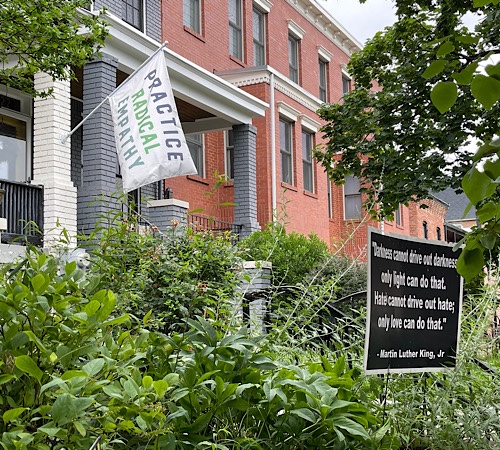
The other day on one of my now only occasional walks out, I saw a man on the ground at the entrance to the CVS and several cops.  Rather than trying to stay completely away, the first thing I did was get out my own phone and then only walked on when I had confirmed that someone else was already standing witness and filming.  Earlier in my life, to film would not have been my first reaction.  I’ve also had unfortunate opportunity to be called to help out in the face of witnessing harassment more than once since 2015.  We all should know what to do.  Here’s a good resource:

https://www.afsc.org/bystanderintervention?emci=d4f309b3-0e1a-eb11-96f5-00155d03bda0&emdi=03d69ace-741b-eb11-96f5-00155d03bda0&ceid=319218&utm_source=weekendreading103120&utm_medium=email&utm_campaign=weekendreading
Similar Posts

  • |

    Minding the Gap (and vinyasa krama)

    One meaning of the phrase vinyasa krama is “the yoga of sequencing.”  This is the art of knowing how to practice in an order that will be most optimal for where you are in space, time, and health in any given practice.  Part of a true practice of vinyasa krama, like beautifully played music or an exquisitely presented music, is the silences and the pauses.

    I’m sure you have all seen the “mind the gap” warning, the admonishment to notice the space between the train and the platform, the place where one thing ends and another begins.  In that case, it is presented as a warning of danger, but it also can be seen just as an exhortation to be mindful.

    When we are truly mindful of the space between things — both spatially and temporally — then we are better able to honor what has just come and to be open and conscious for what is to come.

    In our yoga practice, noticing the space between coming in and coming out of the pose helps keep us aligned in the transition and enables us to better reap and experience the benefits of the pose.  The reason we are advised always to practice savasana at the end of any practice is so that we will have a good pause between a practice and going back to our other activities.

    Off the mat, taking time to pause in between thoughts and activities, helps us appreciate little moments of joy during a busy day.  It also helps us sequence our day more optimally and can prevent mistakes and misalignments by giving us time to be more aware of what will work best next.

  • Using Your Head to Connect (and skull loop)

    I think one of the most wonderful things about the Anusara principle of skull loop is that it uses the head to bring mind into connection with the body.  Far too often, staying in our heads or using our mind can disconnect us from the body.  Skillful practice of “skull loop” reminds us that the head is part of the physical body. Skull loop, like all the loops, is a refinement that typically would not be the focus of alignment after not only the major principles (open to grace, muscular energy, inner spiral, outer spiral, organic energy) are set in the pose.  It is also the refinement that generally would be done last in most poses because of its distance from the foundation of the pose.

    I rarely work skull loop as a focus without also concentrating on shoulder loop and the relationship between the two.  Both start in the upper palate.  While shoulder loop acts to integrate us and draw us in by hugging the shoulder blades onto the back of the heart as a refinement of muscular energy, skull loop helps us to reach out and serves as a refinement of organic energy — inviting us to extend more fully out of the crown of the head.

    Even though skull loop helps remind us how much organic energy — a reaching out with offering that goes all the way from the focal point (more on that another day) out through the periphery, including the head — can empower us, skull loop also has a sweet and subtle reminder to come back to the first principle.  Skull loop starts in the upper palate and goes up the back of the skull to the crown of the head.  That initial action is what helps with organic energy, and when done powerfully, it can really give a lot more strength and lift to a pose.  The second part of the loop softens the forehead and lower eyelids, bringing our inner gaze (drishti) back to the heart.  Skull loop thus shows us both that the head is physically an powerful and important part of the movement of the body and that no action of the head is complete unless it brings us back to the heart and the ultimate purpose of our actions and offerings.

Leave a Reply

Your email address will not be published. Required fields are marked *

This site uses Akismet to reduce spam. Learn how your comment data is processed.