Untitled


In response to requests, here are some photos of the garden in its current state.
The vine on the left is grapes–there are many dozens of bunches forming. The vine on the right is a kiwi. I planted it four years ago, and finally there are some fruits–at most a couple dozen, but it’s a start. There aren’t enough strawberries to bring inside, but there are always a couple to eat when I am out working.
Current herbs: cilantro, basil (thai and genovese), Mexican and Greek oregano, parsley, sorrel, tarragon, lemon balm, spearmint, kentucky colonel mint, garlic chives, savory, sage, thyme, rosemary, lavender, stevia, and dill. Greens include mesclun, arugula, kale, chard, and are ready to eat now.
Snowpeas are on there way (and I ate snow pea greens with garlic scapes and herbs for dinner tonight). Beans are blossoming; cherry tomatoes and cucumbers have formed, as have a couple of zucchini and a variety of peppers. Blueberries are ripening and figs are just starting to bud on the new growth. Carrots and turnips are mostly just a promise, but I expect at least a few. Leeks and spring onions are poking through, but don’t seem to be getting along with this year’s weather patterns.
What’s growing in your garden? (Even when I lived in an efficiency apartment in school, I had herbs growing in pots. And sprouting is its own kind of gardening and only requires a kitchen counter.) A garden can be made wherever you are, if you want one enough.
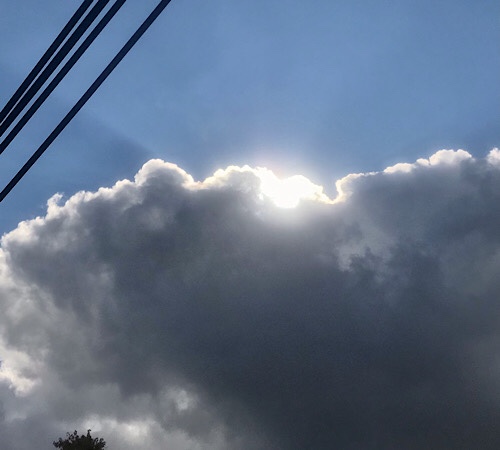
I got up to stretch my legs and ease my eyes (excellent to do this a few times an hour if you have a desk job). The sky is magically beautiful and captivating out the window no matter what goes on inside (a mostly stressful, thankless day today) or what is on the ground (the view from this window is the homeless shelter, highway, and tax court).
Find a moment to change your gaze, whether it be closing your eyes to the inner world of meditation or directing them to some small or large beauty or wonder. It will help make what is hard less so–at least that is my experience.
Peace and light, E — Posted with WordPress for BlackBerry.
Last night I went to see the revival of the Bernstein musical version of Voltaire’s Candide, now playing at the Shakespeare Theater’s Harmon Hall (discount tickets available), which was absolutely a delight — fantastic staging and direction, luxurious costuming, enthusiastic performances. Throughout his journey, which is beset with cruelty, hardship, natural disaster, and other mishaps wherever he goes, Candide sings of his tutor’s optimistic advice that “all’s for the best in this best of all possible worlds.” The application of this philosophy leads to some silly results, including the Monty Python-worthy lyric “it’s a great day for an auto da fe.”
I have a friend who, after telling me of various life challenges and griefs, inevitably signs off with the phrase “it’s all good,” though I am not sure she believes it. I thought of her repetition of the phrase “it’s all good,” while I was watching the musical. Later in Candide’s travels, he encounters a second philosopher scholar who (I’m paraphrasing loosely) contradicts the “it’s all for the best” philosophy of Candide’s tutor by telling Candide to just look around and he will know that things are not in fact always for the best. A fluffier version of the debate in the novel, as to whether things are all for the best when there is so much cruelty and devastation, is interwoven into the rest of the play.
I’ve never had a desire to wear the t-shirt proclaiming that “it’s all good.” I look around me, and I simply do not believe it. I do believe wholeheartedly, though, Voltaire’s premise that we have the responsibility to “cultivate our garden.” As my teachers John Friend and Paul Muller-Ortega espouse, we should “respond from the highest,” regardless of what we experience and encounter. By having our response make the best of all possible worlds from things that are not evidently for the best, we bring more light into the world, whatever is our world view. I can only hope that with steady practice of yoga and meditation, I can keep ever truer to these teachings when I am seriously challenged.
For the first few years I was teaching, one season a year, I would have as my overall session theme the Anusara invocation (for the words written out, click on “invocation” in the menu bar above). In so doing, I invited myself and others to contemplate at the heart level the meaning of each word, of why we were making the invocation, of how the invocation might inform not only our practice, but how we bring our practice off the mat and into our daily lives. Each time I chant the invocation–and it has been hundreds of times now over the years I have been studying, practicing, and teaching Anusara yoga–I seek to invoke into my practice the deepest qualities of the heart that it represents.
Over the winter break, when I was preparing for this session, the invocation called to me. I decided it was time to make it as a specific offering again. Last week and this week, including in the restorative workshop offered at Willow Street Yoga last Saturday, I have been exploring namah shivayah from the first line. Namah–which has the same verbal origins at the English word “name”–means to bow, to honor, to name. It forms the basis of the greeting namaste–with the light in me, I bow to the light in you. Sivayah here is our siva nature. It is variously the light within, auspiciousness, spirit, divine nature, elemental goodness.
When I was practicing in preparation for teaching the week’s classes and the restorative workshop and contemplating (practicing bhavana on) namah shivayah, I thought about a question I often get when I teach restoratives: “should I be maintaining the alignment principles or should I be relaxing completely?” When I get the question phrased this way, I look the student straight in the eye and respond, “yes.” I get a quizzical look; how could the answer be “yes” to an “either or” question? The answer is “yes” because in each pose, we are seeking to embody the fullest expression of namah shivayah. Taking the time to make sure to be in alignment when setting up for a pose, moving into a pose, reaching the pinnacle of a pose, and then moving out of or dissolving a pose, is out of loving respect for your body and the energy that courses through your body. We seek to be fully in alignment in all stages of each pose, not only to minimize the likelihood of being in pain or getting or aggravating an injury and to increase the likelihood of healing any existing injuries and expanding our capacity to feel free in our bodies, but also out of a profound respect and honor for the self, the teachings, and the practice.
Sometimes people think that focusing on getting the alignment just right is fussy or rigid and the antithesis of relaxation. In the case of restoratives especially, everyone coming to the practice wants to be at peace and feel free of effort. In the hunger to get to a place of relaxation, some hurry into the pose without honoring the alignment. Oftentimes, it is the hurry to relax and the loss of attention to the details of alignment (of both the mind-body and the props) that leads to pain or discomfort in a pose that is meant to be held for a long time, as are restoratives. When a student tells me that they are in pain in a particular posture, I invite the student to back off, set up the pose again, and far more often than not, all discomfort disappears, and the student is able to move into a blissful place. The student then experiences for herself how much the alignment enables the surrender to the exquisite opening to siva and the blissful attributes of siva (satcitananda).
One of the reasons I find restoratives to be such a powerful practice is because they require such focused attention on alignment to enable full relaxation. As such, they are a great way to understand the need for the perfect and simultaneous balance of effort (tapas) and surrender (ishvara pranadhana). So the answer is “yes;” the answer is “nama shivayah.” In everything we do, in every aspect of our practice on and off the mat, we want to be consciously in alignment. We want to use all the knowledge that has been imparted by our teachers and experienced in our own practice as a way of honoring and naming and helping to enable an unceasing, simultaneous, and full surrender to our own siva nature.