| | | | |

Signs Around Town

Signs with intelligent, thought-provoking, and action-inspiring quotes are proliferating in my neighborhood.  I took this photo last night when I was walking home after getting a Friday evening massage in the neighborhood.

This morning, after practicing, I took care of cat, house, and garden, reading the news, signing petitions (not as helpful as visiting/writing to a Senator/Congressperson–but I don’t have those as a DC resident) and doing targeted giving (today to support a free press) in addition to my expanding monthly giving. This afternoon, I am attending “Active Bystander” training.  Then off to share dinner and then watch friends I know from Contact Improv perform works in progress at Dance Exchange.  I will get time outside by traveling as much as possible on foot.

How are you spending your Saturday?  Did it help you feel more engaged, connected, and grateful or less?  If less, what small shift could you decide to make that would be easy enough that you would actually do it?

Similar Posts

  • |

    Hanuman — Adamantine

    When I prepare to teach a workshop, I usually do a fair amount of background reading in addition to preparing the asana practice and contemplating the theme.  Right now, I am getting ready to teach a workshop on the hidden powers of hanumanasana (See Workshops page for more info).  A few weeks ago, I came across a tattered 1987 edition of an Indian publication of the Ramayana by Chakravarti Rajagopalachari. I was planning to read other works about Hanuman, but thought that I must be meant to read this one.

    It is an interesting little book.  Chakravarti, also known as “Rajaji” was the first Indian governor-general of India and a close compatriot of Gandhi.  The work is interesting from a historical perspective.  It was first published in 1951 in Tamil and then translated from Tamil into English.  The purpose of the work was to make the Ramayana accessible to those who were not educated in Sanskrit and philosophy.  Although purportedly for children, it obviously had appeal for a wider audience (the 1987 edition I found was the 25th).  Rather than a translation, it is a retelling of the story, filled with homilies and somewhat paternalistic commentaries. Although because it is faithful to the story it still has the relentless sexism of the original, Rajaji does tell his readers in his commentary that the commonly held belief (supported by the language of the Ramayana, which is regarded as a religious text) that a woman has sinned or is shamed if “a villain behaves like a brute” to her is just wrong.

    What was most interesting to me about this particular telling of the Ramayana, aside from its historical and social context, was how it resonated with my Anusara studies.  When Hanuman first battles the demons, Rajaji says the demons “showered missiles on him which mostly glanced harmlessly off his adamantine frame.”  Rajaji uses the word “adamantine” to describe Hanuman elsewhere in the work. Here, Hanuman is adamantine because his devotion and steadiness make an energetically impermeable boundary.  Hanuman is able to love deeply and to engage in battle fully, but is protected from the inside out by his practice and his devotion.  John Friend speaks often of using one’s practice to become “adamantine.”  He suggests that the practice of opening to grace, and then pulsing a perfect balance between drawing in and reaching out energetically (muscular and organic energy), gives us an adamantine core that enables us to be open to a full range of experience without being harmed by negative things.  I have experience myself from six steady years of Anusara practice, how the principles can indeed help me be open, while keeping negative energy from invading my space.

    A used copy of this edition would likely have been around when John Friend was traveling in India when he first went to the Siddha yoga ashram.  Did reading this particular edition lead him to use the word “adamantine” in the context of his teaching of the energetics of asana?  I do not have an answer to that question, nor should I conjecture.  What I do know, is that regardless of how I feel about some of the exterior social influences and teachings of the great Indian texts (think how I might feel about the Spanish Inquisition as it relates to the Bible), there is much to learn about meditation, yoga practice, and personal integrity interwoven in the stories.

    Other readings:

    The Concise Ramayana of Valmiki by Swami Venkatesananda (much more scholarly — the translation you would read if you were taking a university course, but didn’t know Sanskrit)

    The Ramayana retold by William Buck — easy to read; like reading a novel-length fairy tale rendition for adolescents (changes the ending to make what happens to Sita more palatable)

    The Ramayana — A Modern Retelling of the Great Indian Epic by Ramesh Menon.  Great novel.  Cannot recommend highly enough, but probably won’t resonate as much unless you are familiar with the Ramayana and other Indian epics and philosophy.

    The Monkey Grammarian by Octavio Paz, trans. from the Spanish by Helen Lane.  From the back cover:  “Hanuman, the red-faced monkey chief and ninth grammarian of Hindu mythology, is the protagonist of this dazzling prose poem — a mind journey into the temple city of Galta and the occasion … to explore the nature of naming and knowing, time and reality, and fixity and decay.”

  • | |

    Kvelling and Kvetching

    It started before yesterday’s Tuesday night class.  There was a piece of fuzz next to one of the students mats–a schmutz.  We then decided that the yoga outfit, especially the old raggedy one, was a schmata. Tonight, I was in an uncharacteristically silly mood.  With birds falling out of the sky, fish washing up on the shore, and the Republicans taking back “control” of the house, I could weep or I could find the laughter in small things.  Tonight, with a practice theme of the Anusara’s “first principle” — opening to grace — I spontaneously and giddily came to the latter.

    I mentioned the idea of yiddish for yogis, and the class took off.  We were all women tonight, so it was “yoga for yentas.”  The word one utters when going into the first forward bend of the practice, is of course, oy, which can be lengthened to oy vey is mir. When we are truly opening to grace, we are kvelling; when we are noticing our aches and pains and forgetting to move towards the good, we are then kvetching.

    Just FYI, I learned after doing a cautious internet search before posting this blog entry, that it turns out that the phrase “Yiddish Yoga” has been trademarked.  I am pretty certain we can still have fun talking about using yiddish vocabulary words in yoga class without violating any laws, though it has been over 20 years since I took class in copyright and trademark law.  So feel free to think of your favorite yiddish word and how it should be used in yoga class.  You never know how it will enhance your practice, for whom it will bring a smile or a laugh, and what other thoughts might arise.  I’m pretty sure that there isn’t a yiddish equivalent for satcitananda, any more than there is an English equivalent for weltanschauung or schadenfreude, or a French word for sandwich, but at least one student wants to give it a try.

  • | |

    Limits and Creativity

    For over a week, the WordPress app on my phone has not worked. First it would not let me upload photos. After trying uninstall/reinstall, it would no longer recognize my username/password combination. I know I have that right because I can sign in through the browser.  It’s a bit awkward to use the browser on the phone as opposed to the phone format friendly app, but sometimes we need to explore alternative methods and be grateful for skills and creativity, and managing to function in a computer world reminds me of this regularly.  For example, every time I sign in at work computer, I first have to engage in a counterintuitive activity before I can get to the password screen.  But I think about it in terms of yoga: control, i.e., disciplined and educated practice; alternatives, i.e., if something doesn’t work, try something else; and delete, i.e., let go of what does not serve. Only then can I get started.

    1471352717117


  • Guest Bedroom Restorative Yoga

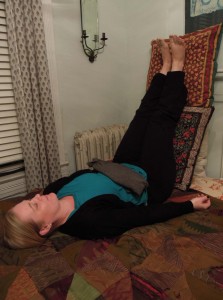
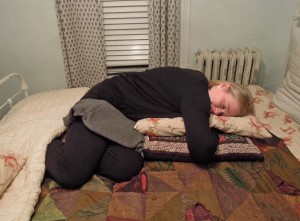
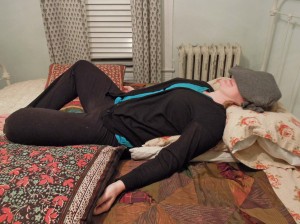
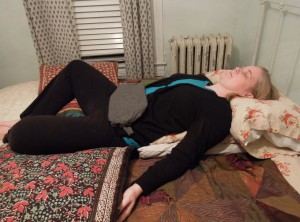
    Let’s face it.  When we are on travel and staying at someone else’s house or in a hotel and doing all the running around that comes with visiting or working or sightseeing out of town, we can get out of balance.  This disruption of routine can upset our sleep and our digestion.  You don’t need the exact collection of pillow shown in these photos.  The point is that you can use whatever pillows and blankets (or even towels or your own coat or sweater to make the shapes of yoga bolsters and blankets) to do a nourishing and balancing restorative practice.  I like to travel with a hot water bottle in the colder months; there is little more comforting than yoga restoratives with a hot water bottle.

    1.   Legs up the headboard (sometimes there isn’t enough room on the floor to do any yoga even to do vipariti karani (legs up the wall pose)).   Here, pillows are stacked against the head of the bed because it otherwise would be uncomfortable (and risky for the art over the bed).  I suggest this pose first to surrender to being turned upside down, to undo the effects of gravity and too much walking around and carrying things, to relieve the legs and feet and to allow more energy to recenter itself in the heart.  Stay for 10 minutes, or even longer.

    guest bedroom restoratives 1a


    2.  Supported twist.  Start with your left thigh against the pillow stack, so that the energy follows the natural direction of the large colon, thereby helping relieve the impact of travel disruption to the digestion.  The gentle twist also wrings the adrenals, allowing them to release the toxicity of travel and disrupted diet.  After 7-10 minutes, switch to the other side with the right thigh perfectly parallel to the pillows before bowing forward.


    guest bedroom restoratives 1bguest bedroom restoratives 1c


    3.  Balasana.  Place a pillow or two between your heels and your seat.  With your toes touching and knees wide apart, bring a couple of pillows, or folded blankets between your knees back to mid-thigh and then bow forward over the support, adjusting your makeshift props as needed to feel at ease in the pose.  The pose invites a fullness in the back body, letting the adrenals rejuvenate after the cleansing action of the twists.  This is good.  Stay for 10-12 minutes or so, remembering to turn your head to the other side half way through.

    guest bedroom restoratives 1d


    4.  Supported supta badha konasana (bound angle pose).  After you’ve relieved the feet and legs, nurtured the digestion and the adrenals, now is the moment to surrender to bliss (ananda) and open the heart to being right where you are–wherever that might be.  Key for this pose is to make sure that the support under your back is right up against your sacrum.  Shown by the fabulous yogini model are three possible ways to use the hot water bottle.  I wouldn’t have thought to put it on my face, but she delighted in that idea, and I can see how it would be good for sinuses stressed by travel.

    guest bedroom restoratives 1e guest bedroom restoratives 1f guest bedroom restoratives 1g


    As with any physical practice, you should approach even gentle poses such as these with appropriate awareness, honoring your own body’s limits.  If you want to learn how to practice yoga  asana safely and optimally, it is best to take classes to supplement a personal practice.

  • | |

    May They Be Healthy

    My first reaction when seeing young people go past my house without a mask, is to ask, where’s your mask? My second reaction may not be kind. I am trying to make a habit of thinking, may they be happy–starting in the middle of the litany.

    That may be more about enlightened self-interest, than exercising true compassion, but it’s a start.

Leave a Reply

Your email address will not be published. Required fields are marked *

This site uses Akismet to reduce spam. Learn how your comment data is processed.