| | | |

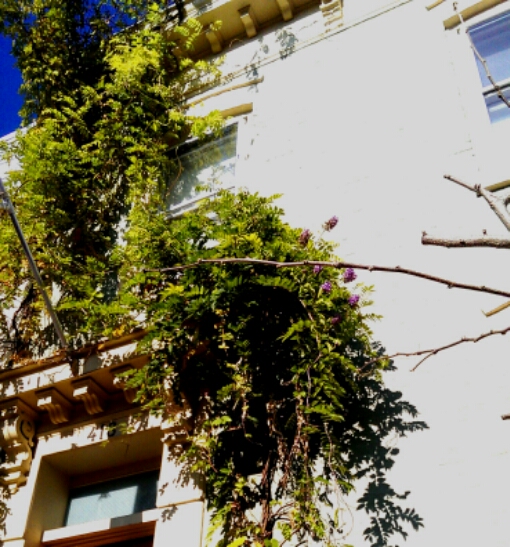
On the Way to Willow Street Yoga for a Workshop With Moses Brown
image

Yes.  That would be blooming wisteria. In December.

It was good to practice with old friends and acquaintances.  Moses, suggested, towards the end of the practice, that the best way to become skilled yourself, is to practice regularly with those who are themselves skilled.

Similar Posts

  • | |

    To do list? (Yoga citta vrtti nirodaha)

    Twitter?  What would be

    The point without an I-phone?

    Buy one? Save the nation?

    Last night I wrote this “twaiku” (why is it not a “twittiku?”) after having read yet another series of articles on why or why not to Twitter and still more articles on why it is important for a nation of consumers to keep consuming even if that is what got them into trouble in the first place.  One of the articles was lamenting the loss of true communication that comes with being limited to 140 characters, and it set forth some examples of how peculiar, when taken out of context, some twittering can sound, especially to the uninitiated.  In my attempt to keep an open mind about devaluing language while still communicating in language, I was led to think about haikus v. sonnets and other longer poetic forms.   A haiku easily fits into 140 characters.  This led me to wonder whether anyone had created a haiku trend on Twitter?  A quick Google search revealed that I am way behind the times in terms of the twaiku?

    One of the articles suggested that Twittering is about being in the moment.  Contrarians say it fosters attention deficit disorder and a host of other language-loss ills.  This led me to think of the Yoga Sutra of Patanjali “yoga citta vrtti nirodaha” (yoga is stilling/aligning with the thoughwaves of the mind).  When evaluating what to consume, when to consume, and how to consume (whether it is language and communication methods or electronic goods or anything else), if we are serious about taking yoga off the mat, it is good to think about whether our consumption eases the trials of being embodied or makes daily living more agitating, and whether our consumption brings us more into alignment with nature/spirit (brahmacharya) or turns us away.

  • How Injuries Can Help Us Open to Grace

    Earlier this week one of my long-time students emailed me before class to say that even though she had strained a muscle in her mid-back, she still intended to come to practice because she hoped it would make her feel better.  “It even hurts when I laugh,” she added.  I emailed her back saying that I would offer alignment instructions to help with her back, but I could not promise that we would not laugh (which, of course, she reported made her laugh).  In fact, it was a class filled with much laughter, but applying the principles of alignment served to alleviate the pain the student had been experiencing.

    Towards the end of the class, as we were getting ready to move into a seated forward bend, I asked my student what alignment principles she should apply to take care of her back in the pose.  Demonstrating as she spoke, she said that she should spread her toes to activate “shins in;” take her inner thighs in, back, and apart to inner spiral her legs in order to widen her pelvic floor and enable curve in the lumbar spine, releasing some of the strain on her back; and then work outer spiral to engage and protect her back.   “Perfect,” I said, “but what should you do before those actions?”

    Another student jumped in, “open to grace.”  Quite right, but how, I asked, would you apply “opening to grace” as a physical principle in this instance?  That seemed a little like a trick question, so I explained how I use the action of “opening to grace” when I am working with an injury (obviously this applies all the time, but it especially applies both when working with an injury and when moving towards a more advanced pose than you have previously practiced.)

    Opening to grace here means being patiently and exquisitely sensitive, moving slowly and mindfully enough to be able to tell from the beginning and throughout the entire cycle of entering into, reaching pinnacle (whatever that may be under the circumstances), and getting out of the pose whether the movements are serving to heal and expand before causing more pain and injury.  Does any movement into the pose at all aggravate the injury?  Does applying the principles gently make it better?  Does applying them with fierce intensity help more?  If we start with the strongest, we will have already gone past the place where we discover that resting or just a gentle attempt would have been healing or expanding, but any more would be aggravating.  When we start with the gentle and sensitive and then move in deeper and stronger without losing the perfect sensitivity that is when true change can occur.

    It never feels good to be injured, but because of the immediate motivation to get out of pain, injuries can be great teachers of just how much practicing with true sensitivity and awareness can enable us to expand heart and mind instead of just moving towards wilder poses for the sake of some idea that we are better yogis if we can do more poses.


Leave a Reply

Your email address will not be published. Required fields are marked *

This site uses Akismet to reduce spam. Learn how your comment data is processed.