Some Things Depend on the Body With Which You Were Born
I participated today in the determination as to whether the noon gentle/therapeutics class at Willow Street should be cancelled due to the weather. It is hard to know when and what to decide unless the roads are absolutely unpassable or it is clear that that storm is not impacting most roads and sidewalks. Some students will have wanted to come to class regardless of the weather, even if it would have been both difficult to get the ice off of their cars if driving and very slippery going from house to car and parking spot to class. If class was held, other students would have wondered why class was not cancelled and felt it unfair that they now had to do a make-up since they were too sensible to go out in the ice. It is a balance of trying to offer the yoga as committed and making decisions about the reasonableness of trying to hold class given safety and logistical concerns. For a class with lots of physically intrepid students within walking distance, the determination is different than for one with people who are facing injuries and other challenges of embodiment, which can make it a challenge to get to class on even a beautiful day.
I’d love to get your feedback on where you think is the weather line between holding class as usual and cancelling. For me, part of the call was that within an hour of class, my porch, front stairs, and sidewalk were still solidly slick with ice. It would have been a challenge even to get to the corner, much less walk ten blocks and take the metro. Things did not really start to melt until mid afternoon.
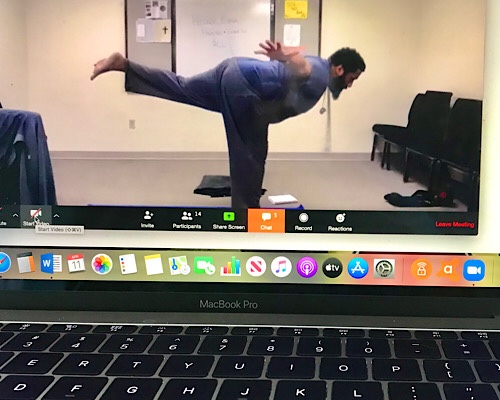
Yesterday I participated in a practice led my brilliant activist friend Reggie (@oreggieglobal).
Class by Zoom doesn’t have quite the same bhavana as in person, but part of living yoga is adapting to the circumstances at hand.
Reggie demonstrates grounding to soar.
A regular reader of this blog, who was a member of the Willow Street Yoga community until she moved out of the country, wrote and said that though she enjoyed the classes in her new home, she missed the adjustments and alignment instructions at Willow Street. She asked in this context the following: “I’ve been wondering lately, when teachers leave anusara, can they still use the same terminology in their classes? If not, why not? Does JF have a copyright on some of the words?” I cannot speak to any copyright and trademark issues–I took a copyright class in law school, but that was 25 years ago.
All that I can speak to is how I will continue teaching, both at William Penn House, where the only class of the week is the one I teach, and at Willow Street Yoga Center, where I will continue to teach my gentle/therapeutic class, and the other workshops and classes I may teach. Although I have not tendered a formal resignation, I have removed the title “certified Anusara instructor” from the header of the blog. At this time, I do not even know, given John’s decision to step down for at least some period of time, what is the organization from which I would resign or whether a renewal license would be sent. For the moment, there is no need for me to make any specific changes in how I teach.
If my formal affiliation with Anusara as a corporate entity were to change, the thousands of hours I have spent contemplating, exploring, and studying the principles of alignment and how to teach them will still be the major part of my asana practice and teaching. Anusara is a deep, strong, significant presence and has been the most significant physical and energetic component of my practice and teaching and to some extent my yogic framework for being in the world for a decade. Given the healing and delight I have experienced from practicing in accordance with the principles, I do not expect anything to be otherwise. As I have been taught only to teach what I have practiced and experienced myself, and not just what I have heard from a teacher or read in a book, although obviously I cannot have experienced in my own body healing for all the various challenges of embodiment that my students have experienced, how could I not be teaching from my own interpretation of the principles of alignment, regardless of a possible need to shift vocabulary?
What will happen with the organization from a business perspective remains to be seen. The name of the system carries a trademark. Whatever happens and wherever I am led in my practice and commitments in the future, as have always done, I will honor John Friend and Anusara as the source of much of my learning and it will be a recognizable influence on my teaching. I will say in class or when I am writing that the alignment principles I have just articulated would be called [insert Anusara alignment principle] in Anusara. This will be true regardless of how the Anusara community is reconfigured and what my relationship is to any future organizational structure.
In answer to the question of what will my local yoga class be like now from my own perspective: Yes, I will be offering the same alignment instructions and adjustments–and hoping to get better over time with continued study and practice. But also, I will be even more precise about attribution, and I will be less likely to be using the “short hand,” which I already use relatively minimally. I have always found that a description of the actual physical and energetic aspect of one of Anusara’s “Universal Principles of Alignment” that applied to what was going on in the practice far more helpful than just using the name of the principle as a pointer to the action being emphasized.
It is a great question, and I am sure that the answer will be slightly different for each teacher, though I trust that all are committed to offering the best yoga class possible, just as they were before. For me, it will take a little feeling my way around the changed landscape to see how it influences my teaching. All I can say is that I am still committed to offering yoga practices that bring healing, joy, and connection, and I hope that I can do an ever better and fuller job of living up to my commitment. This is true wherever I teach and whatever name is given to the hatha yoga I teach.
With the spell of hot, sunny weather, the tree pollen has arrived. Everything is covered in a haze of green. It is beautiful in its own way. Even if one is not particularly allergic, though, the sheer density of the pollen, coupled with the degraded air quality from car emissions and other city pollution without any cleansing rains, can make it hard to breathe easily. You may have noticed that you are feeling especially sluggish. I do not have significant seasonal allergies, but when there is this much pollen, we are all breathing in a lot of particulate matter, and I notice I am fatigued for no apparent reason. That by itself is a challenge.
What can you do to feel better? Listen to your body. You may feel a need, after our long, snowy winter, to get out and run and play, but take it a little slowly. Drink lots of water, juice, and herbal tea to flush out your system. Use a neti pot to clear the pollen out of your sinuses so that it doesn’t stay there bothering them.
Do cleansing practices. Kapalabhati can be especially effective. Make sure to use ujayi breathing while doing your poses. I find that the action of channeling the breath with ujayi makes it much easier to breathe through the nose. Incorporate some extra twists into your practice for their cleansing action. Instead of giving up your practice because of allergy symptoms and fatigue and choosing to just lie around, make the effort to set up some restorative poses. I find supported twists for the cleansing effect and supported backbends, which expand the area of the heart and lungs, making it easier to breathe, feel especially good.
It may be hard, but instead of looking at the green film and your dirty tissues, notice the beauty burgeoning around you. The flowering and leafing trees, the greening grass, the proliferation of flowering bulbs and bushes are extraordinary. Where we put our attention is what we feel and experience the most.
ps Using cloth handkerchiefs and napkins instead of paper and just throwing them in with your other laundry, will make breathing easier in the long run if enough of us do it. Fewer trees killed. Less pollution. Better air.