| | | |

This Night Empty of Moon

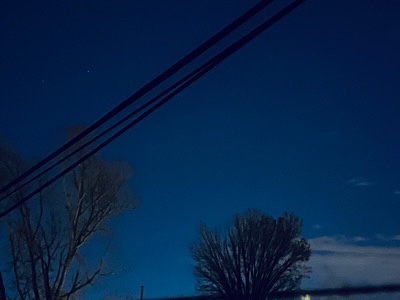
The sky emptiest of moonlight, the darkness of the absent moon of mahashivratri lets the stars reveal themselves and illuminate the fullness of possibility. That it is also the first day of meteorological Spring and was the State of the Union feels like quite a confluence.

Similar Posts

  • | |

    Negation, Affirmation (and a new yard sign)

    I went to a delightful brunch yesterday hosted by friend and neighbor K, who lives on the other side of the Hill.  A number of the guests turned out to live within a couple of blocks of me on the Northeast side.  In describing my house to those who lived farther from the Capitol than I (knowing my block was part of their usual walking path), I said, “mine is the one with the ‘War is not the answer‘” yard sign.  “Oh yes, I know which one it is,” was the uniform response.

    K said she did not have the yard sign because she did not want a negative message in her front yard.  It served its purpose for a time, she claimed, but she wanted a more positive message.  I replied that if the sign said “peace is the answer” it would not have the same p0litical meaning.  People would just think, “yes, peace is nice, but whatever,” and keep walking.  We all agreed that was likely, but I left still thinking about the conversation.

    One of the reasons K gave for wishing to turn the sign on its head, was she did not want something renunciatory, and she referenced the principle of “negation” in Buddhism.  I knew what she meant.  Advaita vedanta has a phrase, “neti, neti” or “not this, not this” which means extinguishment of the individual self and a life of the senses and mind to unite with the ultimate Spirit.  The Buddhist “nirvana”  literally means “void.”  I did not engage the conversation in such a way as to bring it to tantra lest I go too far in the direction of yoga geekiness, but the conversation certainly led me to think in that direction.  Tantra seeks to do exactly what K was seeking:  to turn the phrase, “not this, not this” into an embrace that will reveal truth and light by means of affirmation rather than negation.

    Interestingly, though, I think a possible inspiration for K’s yard sign dilemma could come from from Buddhism:  metta meditation (note:  I have been offered this meditation in various settings and have practiced it many times, but it is not my regular meditation practice, so I hope I am not misinterpreting or mischaracterizing it here).  The theory behind metta meditation is to distance one from anger to cultivate calm.  In this creation of calm comes a general demeanor of loving kindness and compassion.  I personally become calmer by embracing and aligning with all my emotions, including grief and anger, but still find the languaging of the metta practice beautifully inspiring.

    In that spirit, I suggest as a possible rewording of the yard sign that still serves the political message, the call to serve:   “may all beings be free from war.”

    Or maybe FCNL should make a sign with the query:  “what do I do in my life to remove the causes of war?” Is that still a negative, if we are calling for positive actions to remove causes?

  • Savasana

    Savasana–pose of the corpse, the pose of final relaxation, the pose without which no practice is fully complete– is both a very simple pose and one that is rather advanced.

    Sometimes when I teach beginners I ask them what was the first Sanskrit word they learned. Usually they guess the word is “yoga.” The first Sanskrit pose name they get, though, and it doesn’t take more than a couple of classes is savasana. For most beginning the practice of yoga, the permission to stretch out on the back after an hour or more of new ways of engaging body, mind, and spirit is welcome indeed. This is particularly true for those who are overly busy and chronically sleep-deprived as are so many people I know.

    What teachers often miss about savasana is that it can be very hard for some students. Injuries (chronic or episodic), tightness, or habitual misalignment (or expectations of how lying down should feel) make it challenging to be in the pose. The default can be to put supports under the knees or head without taking the time to recognize that it may be necessary to focus on and adjust the alignment before relaxing to see if ease can be found without props.

    Other practitioners find it agitating to be asked to lie still for 5-10 minutes, because they are so used to being active all the time. Even if they can make their bodies still, their minds race around, and the idea of final relaxation seems anathema.

    At the beginning,
    savasana can be just stopping movement and enjoying letting go and relaxing.

    But the pose is something much deeper than relaxing after a good workout. The pose of the corpse is not about being unmoving like a dead body, but about ceasing consciously acting and surrendering to the elemental vibration of universal being so that the inner fullness becomes indistinguishable from that which infuses all of the matter of the universe. As one gets more advanced, the alignment in the pose evidently becomes one of inner fullness and luminousity supporting the draping of the physical body. We practice going to earth and light, dissolving the constant awareness of our individuality.

    Peace and light, E — Posted with WordPress for BlackBerry.

Leave a Reply

Your email address will not be published. Required fields are marked *

This site uses Akismet to reduce spam. Learn how your comment data is processed.