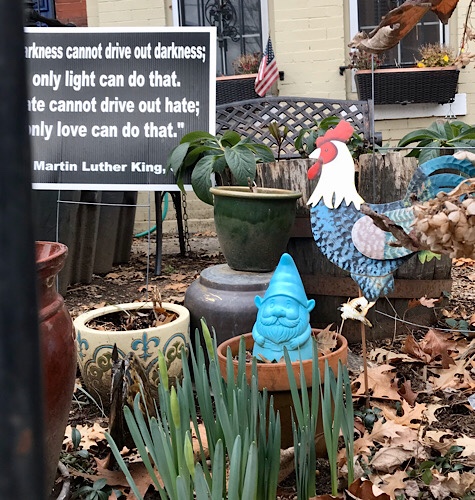
Sadhana
We cannot say we did not know. United States Supreme Court, January 29, 2020. Have you called your Senators (for those that have them)? Please.
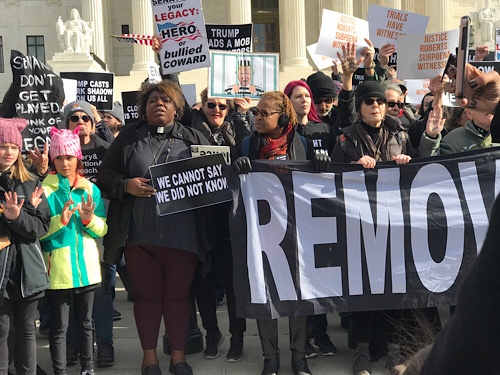
We cannot say we did not know. United States Supreme Court, January 29, 2020. Have you called your Senators (for those that have them)? Please.
Tonight, in addition to the regular students, a group of high school girls who were staying at William Penn House for the week, joined us. Their school, which is a Catholic girls school in Kentucky, requires the students to select a work of service in their senior year that involves the quality of mercy.
On the initiative of two of the girls, the group came to DC to lobby their senators on global climate change for their mercy service. They mostly hadn’t taken any yoga, but were enthusiastic to have it be part of their experience, and we explored a little how yoga practice might support them in such service.
I’m pretty sure the Sanskrit word for wonder is abhuta. I found myself contemplating my conviction that part of the practice of yoga (and my photography, which is a practice for me) is to instill everything with a sense of wonder.
I still find plane travel–as wearily familiar as it is–completely miraculous and awe-inspiring.
To go, in just a few short hours, from perfectly temperate to cold and gray with an impending storm (and, of course the reverse) is an outrageous feat indeed. I’m happy to have the cat in my lap.
My long-time friend and yoga/meditation buddy Suzanne Lynch extended a warm invitation to lead a practice on her nascent on-line yoga and wellness platform for the next difficult several weeks, and feeling a strong need for such myself and a calling to make offering, I extend the invitation to you:
On-Line Practices October 17-November 28, 2020–Saturday Mornings from 8:30 to 9:45am with Suzanne Lynch Wellness
Please join me, Suzanne, and her wonderful group of practitioners to focus time to maintain our collective grounding so we can better be of service to others, while taking care of ourselves. Practices will be omni-level, with the intention of being inclusive for all bodies (and a warm welcome to feed back to help make it more so) and will include intentional movement and asana, breath and body awareness explorations, meditation, perhaps a dance move here and there, and the connection that comes from live classes–even if by video.
To participate in the practices, you will need to become a member on Suzanne’s website, which requires a monthly fee. In addition with practice with me (at $27 a month, that works out to about $7 a practice, even if you were only to do practices led by me, but I expect you would do more; Suzanne offers 12 live asana practices a month, plus live meditation twice a week, and access to videos for all practices. I like Suzanne’s classes, and those of you who have practiced with me will recognize shared points of practice and teaching methodology.
To sign up, go to Suzanne Lynch Wellness and register for the Reset for Resiliency course. Your code for the special rate of $27 per month (you can cancel any time) is: Elizabeth27. Any challenges signing up, please contact customer service through the SGL website. Any profits that are attributable to my leading these practices will be donated to causes that serve justice and equality and wellness for all.
Hope to connect with many of you.
I wanted to share this article on “ecotherapy,” a term I had not heard before. I found the article interesting because for years now, I have gradually practiced all the elements listed in the article as treatment for depression, not because I had been told by a therapist to do so, but because, despite my feeling the repercussions of going against the grain, I felt happier and healthier settling in one place, traveling more slowly, connecting with my pets, and tending a small patch of nature.
These shifts in lifestyle simply feel to me more in alignment with my own nature and that of the earth. I found, incidentally, it gave me much more time overall to do things. People ask me how I do so much (usually referring to the day job, the yoga teaching, the gardening and cooking, the volunteer work). Thinking of the way they live, and what they do, they ask when do I rest? I say that my life is in fact rather slow and restful. I rest when I meditate. I rest when I am taking the time to make a home-cooked meal — every day when I am in town, often two or three times a day. I rest when I am tending the garden. I do not think of cooking and gardening as chores, but as ways to nurture myself.
I rest when I am commuting because it is on foot or sitting on the bus or metro (note: instead of getting anxious or angry when metro is slow, think of it as an opportunity to draw into yourself and meditate, contemplate, or read).
Not having moved or changed jobs in years, even though there have been serious challenges with both where I live and my job, I had the time, money, and energy that would have been used up in a major upheaval, to engage in the study and practice to become a certified Anusara yoga instructor, and before that, to study drawing and photography and to exhibit my art. Staying in place, I continue to have time to study and to read (not watching TV helps alot, too, for finding time). The choices are different with children in the house, but it is still possible to make choices that require less racing around for the family.
This, to me, is a larger aspect of vinyasa krama, the art of sequencing. When we sequence how we move in space and time in a holistic, sensitive way that honors the rhythms and cycles of our bodies and the earth’s, then we feel less trapped or overwhelmed. When I was trying to keep up with society, I was often sad and anxious. Now I am much less so. I have often attributed it to these choices. Now, I see, society has given us a word for it — ecotherapy. With a word coined for it and put in the press, will people feel more comfortable practicing it?