| | |

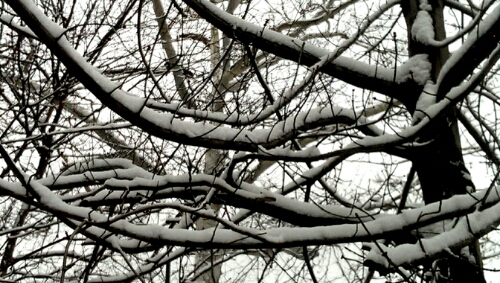
Snow on Trees

image

It was really quite beautiful when I took a break from my work computer to go outside and shovel.

My nearly 90-year old neighbor, Mrs. G., was also out shoveling, though no one else on our side of the street had made any effort either this snow or the last to clear their sidewalk.

When I was mostly finished, I  went to say hello and to tell her, though we have never really socialized, how much I love and appreciate having her as a neighbor. She thanked me for saying so and said she has always tried to be a good neighbor.

I asked if I could give her a hug. She hugged me and then asked rhetorically when that had last happened. Her doctor. Before Christmas. Gave her a hug. “It’s always good to hear,” she said, “that you are appreciated.”

I offer my appreciation to you for reading and for how much so many of you enrich my life.

Similar Posts

  • | |

    Wintry Mix

    As I write, big fat flakes of snow are falling against a pale gray sky that is struggling to turn to daylight.  It is too early to know how much of the storm will be snow or freezing rain or just plain rain, though all are both possible and probable.  If there is mostly snow or mostly rain, some of those I know will be sure to say the weather forecast is never right.  My experience is that the weather forecasters are usually quite accurate about pointing out the probabilities and then sometimes the probabilities at the far end of the spectrum are the ones that happen, which makes the forecast apparently off the mark.

    I am always entranced with the anticipation of a storm.  It only takes the slightest shift in temperature in the atmosphere or a move of a degree or two of the pressure system for there to be a dramatic change in the outcome — a day of rain or a half an inch of ice or several inches of snow.  I think all relationships — to places, jobs, people, illnesses, our meditation practices are like that.  Just the subtlest shifts in atmosphere and attitude and the whole thing can seem completely different.  What I continue to work on is to open to the best path that results from the combination of factors.  If because of a less than optimal shift, there is an ice storm with power outages and downed wires and trees, then I try to learn why it happened, see the beauty, and try to shift in a better way.  It is hard, and I do not always succeed, but I continue to make the effort.

    I remember my first big icestorm.  I was in high school and at a big party a few miles from my parents house.  We were teenagers and mostly oblivious.  We just thought it was raining and continued partying.  At some point, we realized that everything was coated with ice, and then we needed to start calling on help to get home.  It was disappointing to have the party end prematurely, but very exciting to have the wild and unusual weather.  And the next morning, when the temperature dropped and the sun came out, the whole world glittered.

  • |

    Discomfort v. Pain

    My friend Reya posted a good blog entry today on pain.  What John Friend says of pain is that it is nature’s way of showing that we are out of alignment.  I am in full agreement with Reya that intentionally causing ourselves pain is not what brings the most gain.

    We sometimes have to go into discomfort, though, to get out of pain, when we are practicing therapeutically.  What I tell my students, when they are seeking to use the physical practice of yoga to heal injuries, is that they want to practice mindfully enough to notice and back away from stabbing, pinching, tearing, or cramping sensations (you might think of other words to add to the list, but you get the idea).  On the other hand, intentionally embracing some level of therapeutic discomfort can be necessary to heal and grow.  An obvious non-yoga example is getting an operation to remove a tumor or fix something that is broken.  The operation is going to be a challenge, but it is better than not healing.

    If we are not used to holding poses for a long time or balancing on one foot or on our hands, our muscles may think they would rather slouch on the couch–though slouching on the couch may be what precipitated injury or ill-health in the first place.  The discomfort of working muscles more than we usually do, but to the right degree and in alignment, is radically different than the pain of forcing our body to do something beyond its current capacity that exacerbates existing injuries or causes new ones and does not sufficiently heed proper alignment.

    I invite you to practice slowly and with sufficient attention to know deeply whether you are just bringing on discomfort from right effort and changing old patterns that no longer serve or whether you are making yourself suffer for no real purpose.  No pose or distance or timing is worth injury, but healing and getting stronger and more flexible (as well as more courageous and expansive for what life brings to us) is most definitely worth some intentional discomfort.

  • | | |

    Ecstatic Serenity

    When I was eight or nine, a teacher asked everyone in my class to say what they wanted to be when they grew up.  The other children named the various jobs or professions that appealed to them at the time.  I responded that I wanted to be independently wealthy.  At that age, I was expressing something I already knew from family issues.  Though I did not have the words for it or a clear understanding, what I was saying was not just false precocity.  I knew at a basic level what is taught in yoga:  I would need enough material support (ardha) to follow my heart in love (kama) and work (dharma); then my life could be free (moksha).

    When I was 22 and visiting my friend Dan, he asked me what I really wanted to do with my life.  We had just graduated from college.  Dan was working for a sculptor who was a professor in the art department; I had just moved back to New York, had just gotten over a failed attempt to serve as an office manager for an off-off Broadway theater, was in a place of deep emotional and financial struggle, and was trying to determine what work and corresponding further education I wanted.  “I want to be content,” I said.  “That’s too passive,” he replied.  “No, that’s not what I mean,” I tried to explain.  “For me being content being satisfied and engaged with my work and life, but still working hard and having goals.  It’s not just hanging out.”  I had all sorts of things that I found interesting and possibilities for a life path, but I didn’t have one specific career or life plan that I was certain would be more fulfilling than any of the others.  They just would have satisfied me in different ways.  Because of the dilemma of too many choices, I wanted to be able happy with whatever choice I made, even if it seemed like a compromise.  I was conscious that once I picked, because of the inherent limitations of time and space, that I would either have to be content with my choice or be unhappy.  I have since learned to think of contentment (samtosha), which is one of the niyamas of the path of yoga expounded by Patanjali, as a practice rather than a goal (and it is a very important and continuing practice for me).  Contentment is not an end, as I had thought when I was 22; it is just one part of the path to a goal of living liberated (jivanmukti), experiencing self as spirit in all that one does.

    On a recent telephone seminar, Paul Muller-Ortega, my meditation and philosophy teacher, in the midst of a broad dialogue regarding various studies and practices, spoke a little of ecstatic serenity.  Memories of the discussions I had had long ago about what I wanted welled up in the forefront of my thoughts.  In thinking about what is my intention now, especially with regard to my practice (sadhana), I witnessed my previously stated intentions as just stages on the path to this discovery.  As soon as I heard Paul say the phrase, I thought, “that’s what I want; I want to be ecstatically serene.”   I seek to be always in some part of my conscious being still and peaceful, while simultaneously being passionately engaged in what life brings to me and I bring to life.

One Comment

  1. Elizabeth, I read your post before doing anything else. The cat is craving attention and so is my hair, but I think it’s best to start the day with a smile, so your blog first.
    Margann

Leave a Reply

Your email address will not be published. Required fields are marked *

This site uses Akismet to reduce spam. Learn how your comment data is processed.