| |

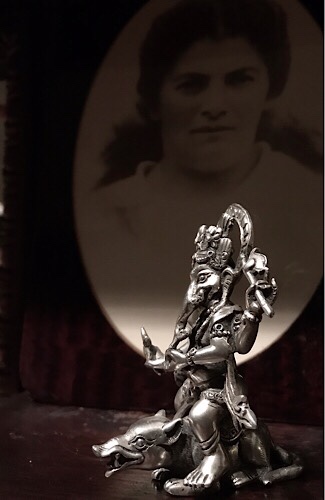
Nilakantha (and personal strength and practice)

It takes incredible strength to take on the sorrows and poisons of others.  How many times have you witnessed someone who is awe-inspiringly dedicated to bringing out change to society, but does so at the expense of his or her own health or intimate relationships?  Have you felt yourself getting worn down by trying to make things better?

The archetype of Nilakantha (who drank up the poison churned up by the devis to save humanity) includes what most of the tales of Shiva tell us:  that Shiva was able to drink the poison and become stronger from the experience because he was already strong from deep, long term practices.

When we ourselves wish to serve, we must serve ourselves also, and perhaps first.  To have the strength and boundaries to ourselves live richly and fully while serving those who are suffering or wreaking destruction without such service destroying ourselves means we must have a practice that enables us to come from a place of light even when going into darkness.  (Doesn’t get much more challenging than that).

To some extent, for modern yogis, this includes a physical practice.  For all yogis, it means a steady practice of meditation and a way of life that aligns with nature.
Similar Posts

  • |

    Praying Mantis (and pausing to make offering)

    This morning as I approached my office, I noticed in the middle of a wide patch of sidewalk that is flanked by the street on one side and a brick building on the other, with no tree boxes or other plantings for several yards in any direction, a praying mantis stranded in the middle.  I wondered how it had gotten there and worried that it would not survive if it was just stuck in a sea of concrete.

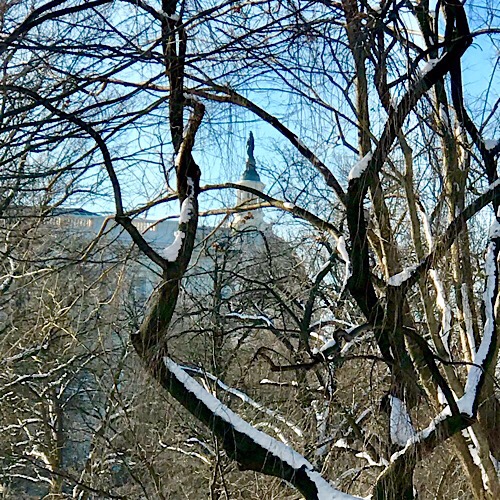
    I crouched and put out my finger.  The praying mantis crawled on to my hand.  I did not have time to go all the way back to the park next to the Capitol or to the nearest “island” with trees, but I took it to the nearest tree box, certain that there would be enough mosquitoes for it to eat well.  When I placed my hand next to the bush in the tree box and helped the praying mantis move onto the greenery, it first came back onto my hand again.  So I talked to it (as if it understood English) and encouraged it to get onto a branch (yes, I was getting some strange looks from passers by at this point).  I watched as the praying mantis eventually turned around and started moving into the denser foliage.

    With this act, did I make anything in the world better except give myself the joy of interacting with a wonderful being?  Does it matter?

  • Savasana

    When I first started teaching, one of the things I found most inspiring was seeing my students in savasana.  It is such a rare and precious things to see a group of people deeply relaxed, especially for someone who came to yoga essentially restless and who inhabits a workplace that is, so to speak, rather caffeinated.  For me, the practice of savasana has been transforming.  After 10 years of steady practice, my sleep has deepened and become more consistently restful, which has enhanced my ability to come from a yogic place off the mat.

    Savasana is in some sense for me always the so-called “pinnacle pose” of practice.  The pinnacle pose is not necessarily the most physically challenging pose in terms of combined strength and flexibility, although it is an essential component of the sequencing of any good practice to have the poses gradually open all the parts of the body needed to do the most physically challenging pose.

    When thinking about any practice and determining whether a cooling or heating, expanding or inward-going, playful or serious practice would be most appropriate, I ask whether the practice will lead to a place where is will be possible to be completely free and relaxed for 10-15 minutes?  Will the practice enable the body feel open and released, strengthened and supported, integrated and aligned, so that lying on a hard floor will seem like being on the finest bedding?  Will the focus of the practice help simultaneously free the mind of thought and burden and yet keep it focused and alert so that body and mind can surrender to the full, blissful of conscious being in the moment?  Will the practice serve to align the koshas (or sheaths) so that the outer body is soft and relaxed, the energy body full and bright, and the mind and intuitive bodies one with the anandamaya kosha (the bliss body)?

    Some teachers have said that savasana is one of the most advanced of yoga poses.  I would agree.

  • | |

    Ganesha’s Vahana

    I don’t have much family, and I know little about the family I have. I am the one living with this photograph (the only one I’ve seen) of my maternal great grandmother because we are the only two with frizzy hair. The story I heard about her was that she gave birth to my grandmother en route from Eastern Europe and carried her across the ocean to the lower East Side.

    This Ganesha makes me think about that level of determination –what we can do when we figure out how to turn a rat into a ride.

Leave a Reply

Your email address will not be published. Required fields are marked *

This site uses Akismet to reduce spam. Learn how your comment data is processed.