| |

What Grows in a Very Small Space (and living freely within limitations)

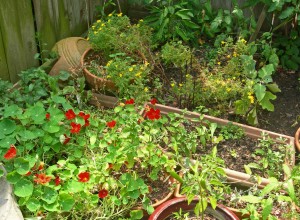
Sometimes when I am blogging about my garden — the joys I experience and its wonderful produce — I feel like I might be presumptuous.  I am no Christoper Lloyd or Alice Waters.  I just have a tiny space behind my urban, rowhouse that I have turned into a personal celebration.

A visitor from out of town graciously commented that in some ways the limits of my garden make it even more wonderful.  In this sense, I know, perhaps best,  from my garden the yoga teaching that ultimately to find freedom in this life we need to celebrate all we are within our limitations to find an inner space of unbounded, liberation.

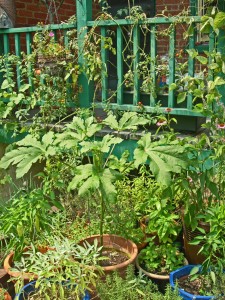
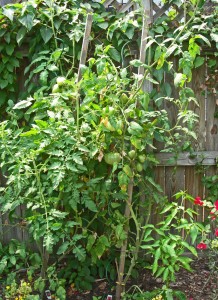
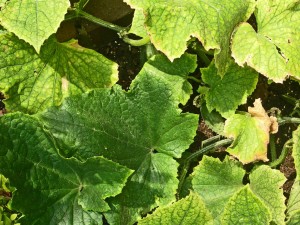
(Shown here, cucumbers, mint, nasturtiums, peppers, greens, sage, savory, basil, okra, onions, more peppers, red and yellow cherry tomatoes (well picked), brandywine and roma tomatoes, eggplant (slow to start this year), echinacea, lavender, orchid.)

cucumbernasturtium-pepper-mint-eggplantpot-garden

brandywine-romaechinacea-lavenderorchid

Similar Posts

  • | | |

    Going on An “Advance”

    I am sitting at the airport getting ready to fly to Phoenix. At Sky Harbor International, I will join friends, and we will drive together to Sedona for a weekend of study, meditation and other practice, and companionship.

    On the most recent study call, our teacher Paul Muller-Ortega said that we are not going on a retreat. We are not joining together to get away from things, to escape from our lives. Rather, we are taking an opportunity to deepen and expand our practice to live life more fully. Would it not be more accurate, then, Paul suggested, to think of it as going on an “advance” than on “retreat?”

  • | | | | |

    About Money and Leisure and the Spiritual Quest (and the 99 percent)

    Spiritual pursuit is, in a great sense, a luxury. Without enough time and money for leisure, when and how would we explore spirit? But where else would we find solace if not in spirit when we are suffering from deprivation?

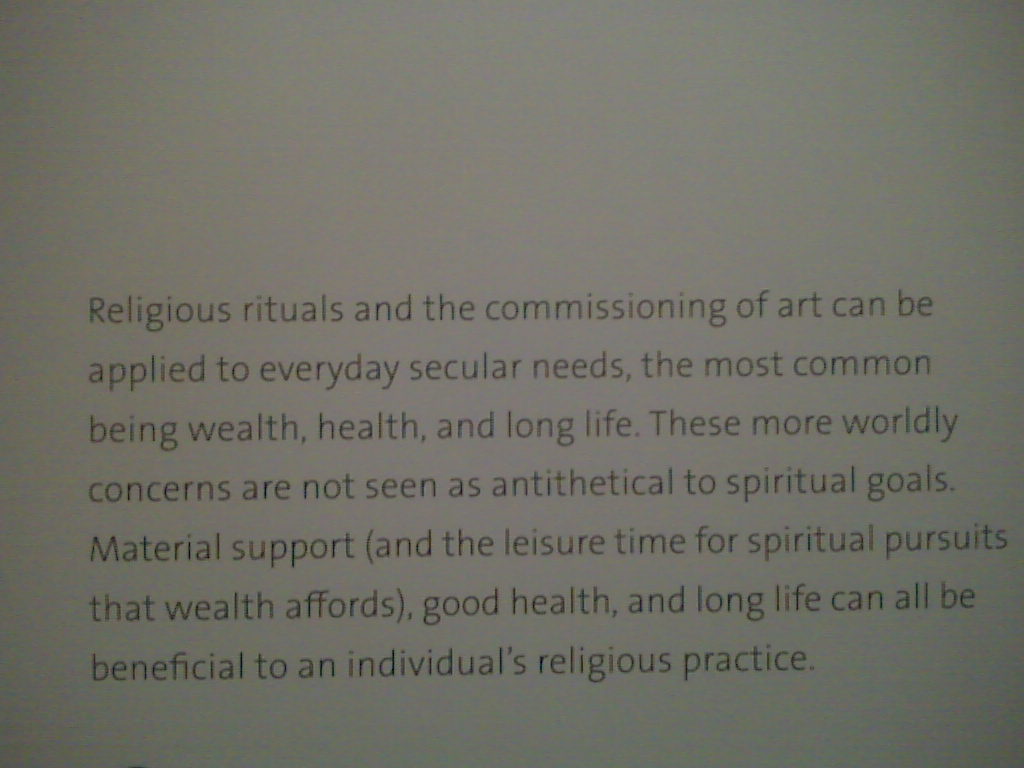
    This question becomes even more pointed when we consider it in terms of the curatorial note (Rubin Museum) below. Those who can afford to commission art to further their own spiritual ideals (including prayers for wealth and family) may not be the one percent, but most surely are the ten percent, or any money would all be for food and shelter at the survival level. I would certainly rather see money spent on making art than war, but what about food, education, and shelter for more in society in a way that nourishes the environment? Such a complicated web of questions about individual and collective desire and responsibility in our relationship to each other and the earth past and present when we think of having wealth sufficiently focused to allow individuals to use it to seek religious boons for themselves in the material world.

    I say this as one who loves and makes art and engages in spiritual exploration with vacation time and budget, who regularly wonders if that is really for the good of others and not just another way of enjoying what life has to offer the fortunate.

    What do you think?

    Photo is of exhibit notes at the Rubin Museum in NYC.

    Peace and light, E — Posted with WordPress for BlackBerry.

  • |

    Prithvi (the earth element) and Muscular Energy

    The first of the mahabhutas is prithvi or earth.  When I think of the earth element, I think of stability, grounding, earthiness, nurture.  My experience is that I can more deeply connect to this element in ourselves by emphasizing what John Friend has termed “muscular energy” in my yoga practice.

    As with all practices from an Anusara perspective, I try to start with the principle of “opening to grace.”  In this context, opening to grace can mean being sensitive to our earthiness and how it manifests energetically in us.  I have found that it can lead to my foundation and connection to the earth and invite a soft weightiness.

    Muscular energy has three essential physical/energetic actions:  (1) hugging all of the muscles to the bone; (2) drawing to the midline (our central energetic channel); and (3) drawing energy from the periphery to the focal point of the pose.  See J. Friend, Anusara Teacher Training Manual (Anusara Press, The Woodlands, TX).  These three actions combined help stabilize us; they nurture by inviting us to give ourselves an unceasing self-embrace initiated from our opening to the good in the energies around us (like the loving hug of an “earth mother”); and they bring our focus from the physical extremities to our core, thus reminding us to bring our physical body to the support of the energetic body and spirit.

    When I am feeling ungrounded, unsettled, or needing a little love, I remind myself to emphasize muscular energy and open to and invite in the light-filled energy all around me.

  • | | | |

    Yes, I Knew Him (and the Maha Mrityunjaya Mantra)

    When my students arrived at William Penn House last night for class, I said, “yes, I knew him; they are both my co-workers.”  I didn’t need to say anything else.  All of them read the Washington Post and know that I work for the Department of Labor in the area of pension benefits.  I said that I was shaken by the news, and I would offer the best practice I could.  At my invitation, we worked on grounding, being heavy in the best meaning of heavy so that we would feel the stability to rise and to stay graceful and open as we practiced some challenging standing poses and backbends, leading to a modified version of natarajasana (dancing in the cosmic fire).

    One co-worker is dead (either suicide or murder in his jail cell) after having severely injured another.  Yes, we all worked in the same office for three years when I first started at the Department in 1991 and episodically have worked on common projects for almost 22 years, most recently just three weeks ago. Had it been a fatal accident or a heart attack, a few dozen of us would have been at the funeral and spoken of what we liked about him.  It wouldn’t have been the horrified questioning ourselves and each other of what possibly could have gone so terribly, shockingly wrong.  The grieving and sense of loss are no less present and real, though, for the recoiling from his last acts and the salacious and rapacious local media coverage.

    Quaker practice has me holding those affected in the light–he and his family and she and hers, and our co-workers.  On hearing yesterday that he had died in jail, I was moved to chant the maha mrityunjaya mantra.  I was taught that chanting this mantra every day for 30 days can help a spirit cross-over.  What is spirit and to where it might be crossing was not really explained because how could it be?  But I do think chanting with such an intention can be a useful tool to help focus one’s own emotional process and healing in connection with a death.

    For some background on the mantra, you might want to start with this overview with useful links published by the Himalayan Institute (be advised that though citing to the YI because of the breadth of coverage, to get to the basic details, I needed to ignore the cheesy graphics and the use of the term “Lord” before Shiva in the linked article on what the author says are appropriate uses of the mantra).

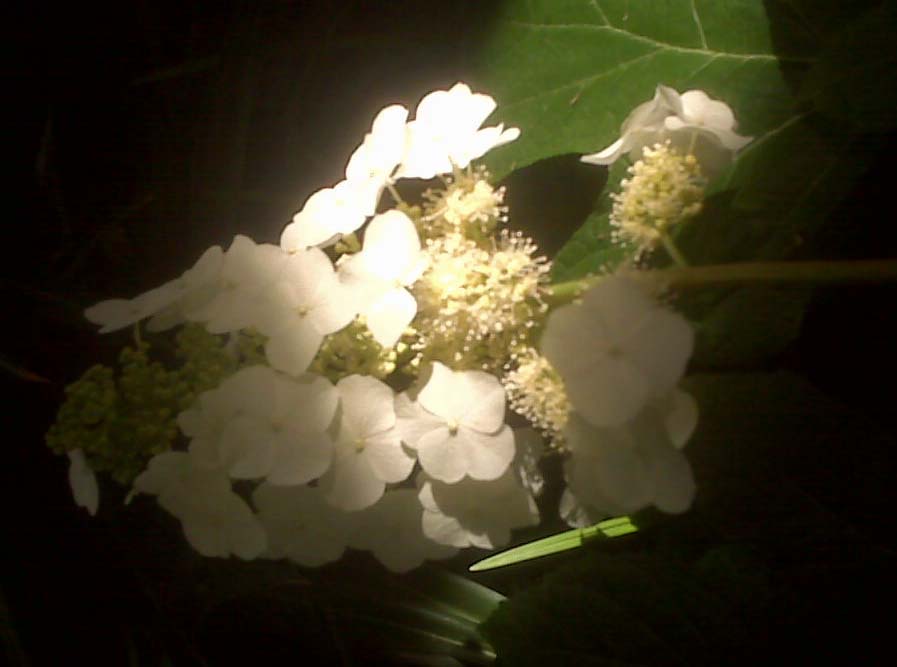
    oakleaf hydrangeaMy co-worker gave me this oakleaf hydrangea about 10-12 years ago; his brother had pulled an extra seedling that was an offshoot  from a larger plant in his yard.  It did not start thriving until two seasons ago when I moved it to a different corner of my front garden.
Leave a Reply

Your email address will not be published. Required fields are marked *

This site uses Akismet to reduce spam. Learn how your comment data is processed.