| | |

An Excellent Sufficiency, Homegrown Tomatoes (and the Isha Upanishad)

The Isha Upanishad starts, “That is fullness (purna).  This is fullness.  Fullness comes from fullness.  Take fullness from fullness, and the remainder is fullness.”

My maternal grandfather died when I was just a toddler, so I never got to know him.  My mother used to tell us that when he had eaten enough at a bounteous meal, he would say “that was an excellent sufficiency and any more would be a superabundency.”

On Sunday I went over to Lovejoy Gardens to my little plot (approximately 3′ X 7′ raised bed on concrete, half shaded by a fence) and harvested tomatoes.  There were about 15 ripe tomatoes.  The first thought was that it was too many tomatoes.  Then I thought of all the neighbors I had who didn’t have their own tomato plants.  I knocked on one neighbor’s door.  He gave me tea while I played with the cat.  I gave him tomatoes.  I went for a massage in the afternoon.  I brought tomatoes.  I was sent home with freshly made spanakopita.  I invited another neighbor over for dinner.  We at pesto with basil from the garden and cucumber and tomato salad (cucumber, tomato, and shallots all from the garden drizzled with a little of the best balsamic vinegar and seasoned with just ground sea salt and pepper).  We had a lovely visit, and I sent him home with tomatoes.  In the next day or two, I will make a batch of tomato sauce and put it in the freezer and have someone over for dinner another night.

There is only “too much of a good thing” or a “superabundency” if we hoard it or try to ingest it all ourselves out of fear, greed, or desire for power or control.  When we have enough ourselves and then share the abundance, we simply create more abundance.  Once again, I am given again from my garden another sweet insight into the yoga teachings.  I am also reminded by this small example that I could share even more broadly from my blessed lot of fullness in global society.


Similar Posts

  • | | |

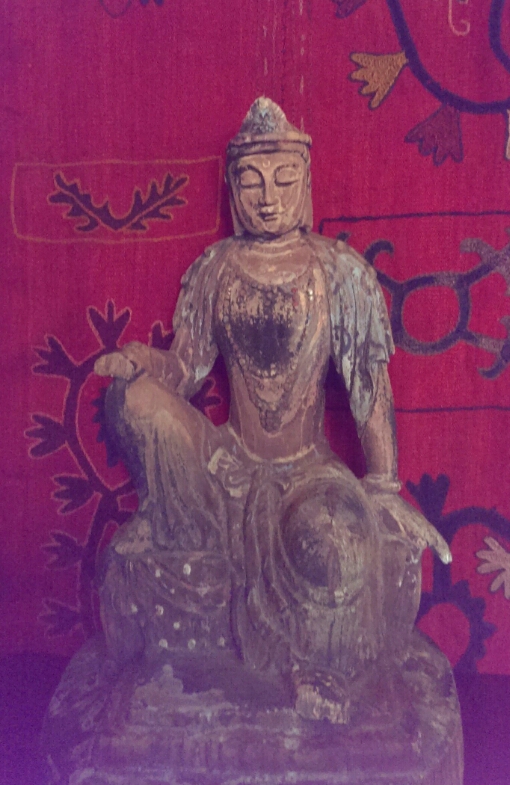
    Kuan Yin (At Eastern Market)

    Last Sunday, when I was at Eastern Market to get apples and pears, I saw a small, painted wood statue of Kuan Yin.  I have been attracted to this one of the 330 million gods and goddesses for some time.  Her primary attribute is compassion. She is said to be a female Chinese metamorphosis of the Buddhist bodhisattva Avalotikeshvara, who, according to some, is an emanation of the Hindu deity Shiva.

    She had a price tag of $70 around her neck.  It was too much, especially since her hand and foot looked like they had just broken off in transit.

    Still, I was attracted to her.  The vendor, who is from Pakistan, came over to talk to me, asking me if I was interested.

    “Too high,” I said.

    “What would you pay?”

    Knowing it is holiday season, and the vendors really need to do well to survive the winter, I suggested $45, thinking it was really too much, but I very much liked the impeccably serene expression on her face.

    “You have bought things from me before,” he said.  I’d bought a couple of older rugs from him last Spring, at which time he had chatted with me for a while and showed me a picture of his chosen guru.  “You are a divine being; I will give her to you for free.”

    “I bet you say that to all your customers,” I replied.

    “Everyone is divine, yes,” he said, ” but you are different. You know it.”

    Somewhat overwhelmed by this, I thanked him for the honor and took out my wallet.  I had $42 and change.  “I will pay $40.”

    I paid him and walked her home unwrapped in my arms, thinking it will be hard to live up to his expectations.  Who better, though, to remind me to relate to others, always recognizing their inherent divinity (whatever that might mean to me or anyone else), than the goddess of compassion?

    Where the wood was raw from having been broken, I rubbed the edges with ash from Chidambaram temple (that I happened to have in the studio), so that the breaks would not visually distract, and one would only notice the sweet face.

    image

  • | | | |

    Haiku About An Assignment

    I’m attending via the Internet a year-long series of lectures through the Upaya Zen Center about Socially Engaged Buddhism. On the honor system (the program consists only of watching zoom or YouTube lectures and a Facebook forum with no interaction with any leading the program other than group emails), as part of the year, we are supposed to have a “social engagement” project informed by Buddhist principles of right living.

    Social engagement as an intrinsic element of spiritual practice/observation seems completely consistent with the principle of Quaker practice I was raised with —that of putting one’s faith and recognition that there is good in every being—into how one lives and works. It also resonates with my understanding of the yoga practice of seva (“selfless” service), which I have tried to make a consistent part of my personal yoga sadhana.

    After much intentional and spaciously open contemplation of this exhortation to have a project, and in response to my listening to the lectures and the questions and observations of others listening to the the program, I came to the conclusion that, actually, I could not take on another thing without it being toxic to myself.

    In fact, after 30 committed years, I’ve given notice of my intent to retire from the Federal civil service at the end of the year. I am also doing less volunteer work than I had been prior to the pandemic. For the rest of the year, I am continuing my concerted efforts to share my experience and knowledge to make sure my co-workers are prepared to take on the responsibilities for the complex project that has been largely my responsibility to lead and coordinate for over a decade. That, along with what it is taking for a mindful emergence from pre-vaccine pandemic living, is taking all the energy I can give and still be healthy.

    I continue to budget to make reparations, to speak out, and make other consistent offerings, but am at last releasing the need for measurable accomplishments, rather than feeling compelled to find or produce more.

    As saying that I am doing what I have already been doing has not seemed sufficiently responsive, and after these months of trying to articulate what I mean in a way that would not sound dismissive of the task, I wrote this haiku:

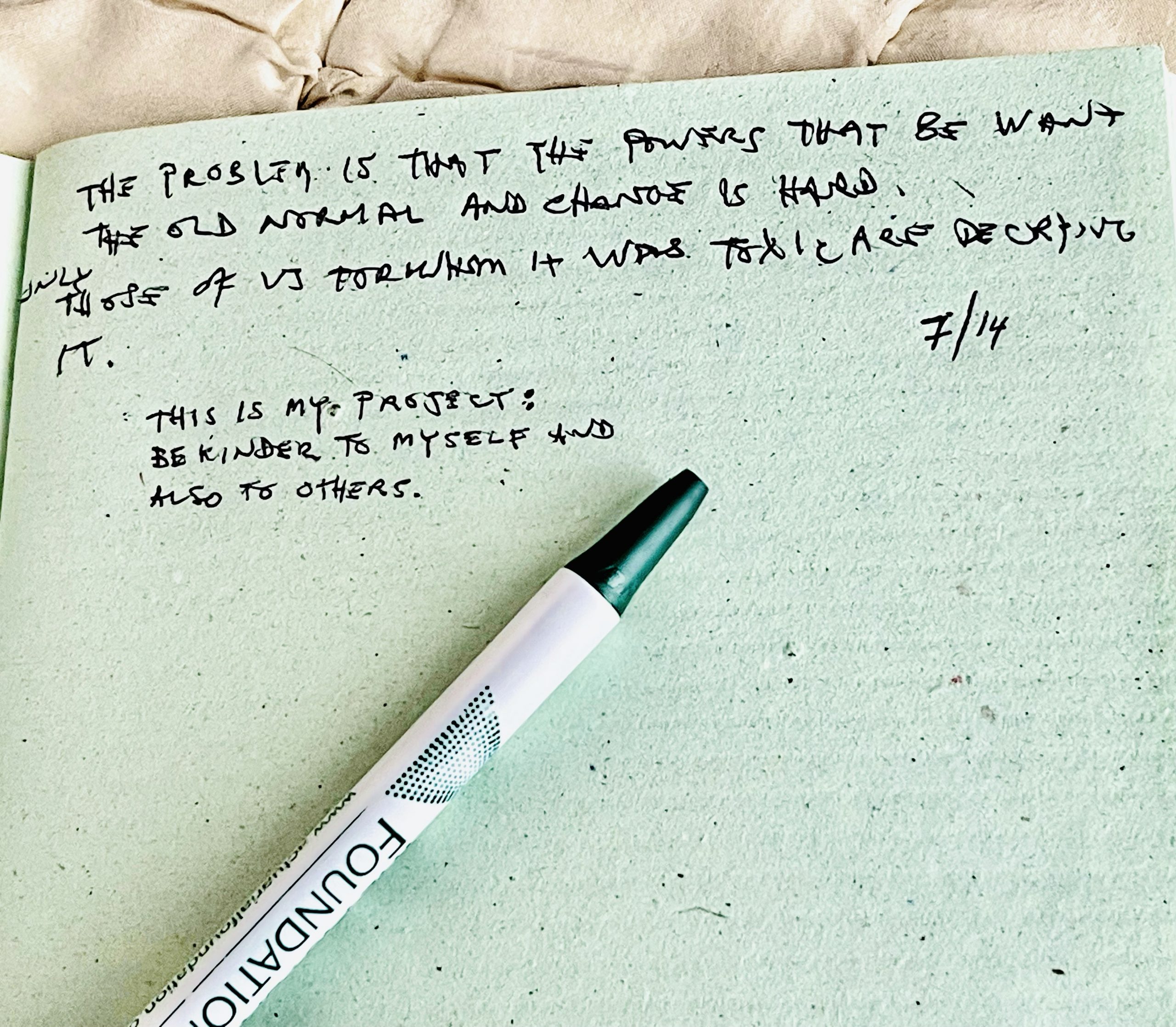
    This is my project:

    Be kinder to myself and

    Also to others.

    PS It is, I am sure, just a coincidence that it is Bastille Day.

    PPS Get out the vote!

Leave a Reply

Your email address will not be published. Required fields are marked *

This site uses Akismet to reduce spam. Learn how your comment data is processed.