| |

Aphids (and limitations)

Even though we had real, hard frosts this winter, there are already aphids on my roses.  I went out this morning and picked the aphids off of the new buds — yes, my roses are budding.  It was too cold to stay out long, but I did a little weeding and planted a couple of pots of pansies.

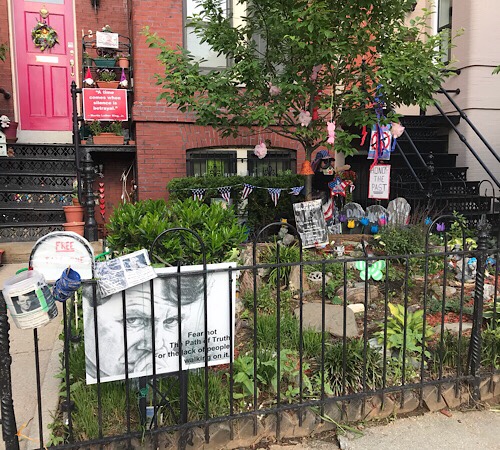
I was thinking about how I garden in my tiny space — using my fingers to take the aphids off of each rose bud, pulling up individual weeds between new plants in containers, choosing to let some volunteers come up between bricks because it expands my planting area.  How different it would be if I even had a small yard by suburban standards.  It would not be possible to attend to all the detail that I see, unless I were to spend every waking hour in the garden.  If I had an acre, it would take three full-time gardeners to attend without tools and sprays the small things I touch by hand.

It seems we make our world as big or as small as we want it.  My tiny garden is as much a universe for me as a gardener as would be an acre garden — though of course I cannot grow sprawling things like melons and potatoes and fruit trees.

But the fullness of how much I see and experience, how much calls out for love and attention, how much I am enriched by tending and observing what is there,  is not diminished by what I do not have.  Rather, I am called to expand to the greatest what I have within my limits.  This is true, too, in our yoga and meditation practice, and our lives.  We can choose to live expansively no matter what our limits or we can choose to feel bound and diminished by our limits.  The garden, this morning, helped me remind myself of that choice.  It helped me turn towards possibilities for growth instead of towards constriction.
Similar Posts

  • | |

    Blustery Winds, Prana, and Yoga Practices

    The other day was very windy–steady winds of 20-25 miles per hour and gusts of up to 30-40 miles per hour. I needed to go to work, so I had no choice about which direction to walk. That direction was, unfortunately, straight into the wind. It made the already cold day feel much colder, and I felt like I needed brute strength just to move forward. Knowing that I did not have the option of turning the other way to feel warmer and have the wind push me along, I instead consciously softened and leaned into the wind so that I was fighting it less and able to ride it a little.

    I was moved by facing the wind to think about the various yoga practices and how they help us understand and be with the force that connects and moves around and between things, without and within us–prana.

    When we meditate, the intention is to be in either absolute fullness (purna) or absolute emptiness (sunyata). (I don’t think it matters which one). In the absolute stillness of meditation, prana does not flow, and we experience being in a state where we are not tugged at or blown by the forces of change and relationship between object and beings. Being able to tap into that state is essential, I think, to be able to weather the times when the energies around us are too much of a whirl for whatever reason.

    When we practice pranayama (breathing practices), we learn about the many ways prana flows. Although pranayama is often translated as breath control, I think it is more about learning to control our physical and mental relationship to the breath than it is about controlling the breath–the breath serving as the best proxy for us to experience the flow of the life force, prana itself. Learning how to be more intimate with the subtle energies helps make us more humble, more aware, and more skillful in relationship to the world around us.

    When we practice asana (postures), we practice dancing with and riding the prana so that we do not have to do everything by rigid physical and mental effort. With steady, educated and discerning practice of asana, we can move with more power and grace and less effort and risk of injury, just as a skilled sailor knows how to align her or his sails both to be able to move when there is just a bit of wind and also to ride out a gale, harnessing the wind instead of being torn up by it.

    To those of you facing the blizzard, may you find time to be still and warm and at peace and use skill in alignment to stay safe when clearing out from the snow and moving from place to place.

    Peace and light, E — Posted with WordPress for BlackBerry.

  • | | |

    On the Way to William Penn House for Tuesday Night Yoga Practice (with a Detour to Stand with the People’s Filibuster)

    The filibuster and related activities, including an interfaith vigil on Wednesday the 28th, continues until Thursday. Details on various Facebook Pages–ACLU, NARAL, Planned Parenthood, Move On, and others. 

    Mostly I will be working during the scheduled times, but I will head over outside of my work day again. Senator Chris Murphy was on his way to dinner with friends from Connecticut who had spent the day doing citizen lobbying–telling their story about why keeping and improving on the ACA was important to them. Senator Murphy said that he’d heard people were outside and felt he needled to at least stop by and connect. He said this is just the beginning, don’t let them tinker and declare a victory if they only deprive 5 or 10 million people from getting insurance; he said keep it up; he’d like to see millions of people coming to D.C. and making their voices heard.  I was starting to get caught up in listening and then realized it was time to be at William Penn House.

  • | | | |

    “Remember Thich Nhat Hanh”

    My boss with whom I’ve worked for over 20 years and who has an unfortunate tendency to get agitated (gentle understatement here) at the workplace has just discovered Thich Nhat Hanh.  My boss was intrigued by Thich Nhat Hanh’s suggestion that when you find yourself getting angry, “don’t.”  Knowing that he is still going to have to take action in response to the things that tick him off (and, as I would add, that not getting angry is distinct from disengaging, failing to act, or being apathetic), my boss still invited us to say to him when we see him getting worked up, “remember Thich Nhat Hanh.”   I liked that.  I like that he recognizes a need to change and grow and is starting to take steps after years of appearing not to be aware of the impact of his tendencies on himself and his co-workers.

    One of the best ways I know to shift our reactiveness is to develop a steady meditation practice.  If you don’t already have one, I invite you to begin to develop a daily meditation practice, which could include conscious breathing or visualizations.  If your practice is only sporadic, notice how much better it is when your meditation is part of your daily routine.

Leave a Reply

Your email address will not be published. Required fields are marked *

This site uses Akismet to reduce spam. Learn how your comment data is processed.