|

“First principle” (and akrama and krama)

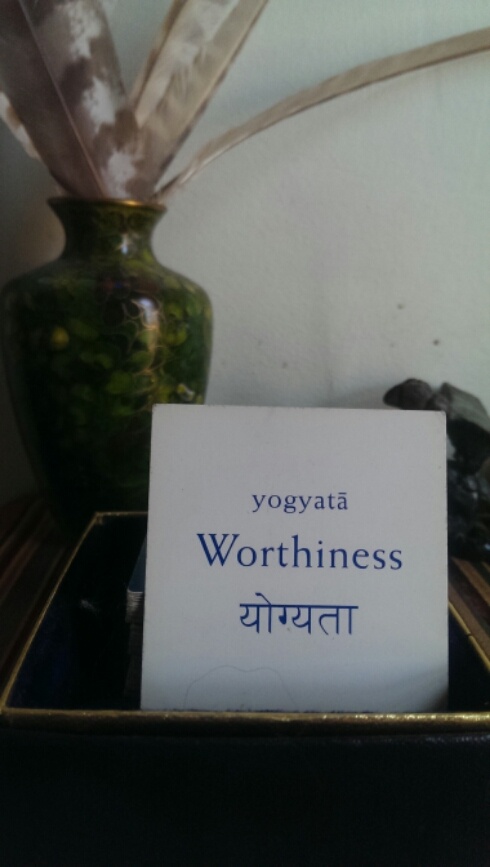
When I think about the Anusara alignment principles in the context of the tattvas (see earlier posts), I think about “opening to grace” appearing in two places on the tier.  As “first principle” it is the first among a larger sequence about how we come to the mat, rather than just the first of the physical principles.  “First principle” not only starts the practice and the dialogue, but is already there. It is, in this sense, so fundamental that it is not part of the sequence, but is sequenceless (akrama).  If you are fully conscious of “grace” and can embody it in all aspects of your physical, energetic, and mental day to day existence without further instruction, study, or practice, then there is no need for other practice or instruction (this I think is a very rare being, and certainly I’m not such a being).

The next set of tattvas — suddha vidya, ishvara, saddha shiva, and shiva-shakti (see link above), correspond to the Anusara alignment principles of “attitude, alignment, and action,” which although they are themselves described in sequence, are fundamentally sequenceless as they happen all at the same time and are more elemental than the practice of the physical/energetic alignment principles in sequenced practice.

In this way of understanding the play between the sequenceless and sequenced, we have a universal “first principle” that embodies the purpose of all we do on and off the mat.  It is followed by how we want to practice, described in a way that becomes less of just a concept (which as a universal concept is akrama) and more of a practical understanding (which applies when we are in space and time and therefore in the krama of embodied existence).  As we dance in this play between the sequenceless and the sequenced, we come to practice (or to do any activity) with the “attitude” of wanting to live the “first principle,” to know and experience what is fully present and not bound by time and space.  We then (because we must) study and practice specific “alignment” to try and express this attitude with our “actions.”

The physical/energetic alignment principles then come in as a the way of better refining, studying, and practicing the desire to recognize with mind and body the “first principle.”  The sequence of “open to grace, muscular energy, inner spiral, outer spiral, organic energy” comes then at the level of physical and mental practice to return us back to “first principle.”  “Open to grace” is first in this sequence, too, but as “first principle,” for me, it is something more than the first of the alignment principles.  “First principle” is not just the start of how we practice when we practice Anusara yoga, but the whole reason for practice.  It is the universal, overarching, blissful element of being that draws us to the practice because of our yearning to know it.

Similar Posts

  • | |

    What Made Me Notice?

    Yesterday was the first day of the season working in the youth garden at the National Arboretum. Something made me look up. A bald eagle perhaps 40-50 feet overhead before soaring higher. “Look; follow my finger,” I called to my fellow gardeners, pointing to where the great bird was flying. They all looked up, and we shared a moment of awe.

    “What made me notice?” one of my companions asked. I could not say exactly. I could have seen it’s shadow or perhaps even, without hearing it well enough to identify the sound, heard the wind in the eagle’s feathers. Or perhaps just instinct.

  • |

    When to Bring in the Tropical Plants (and stress v. distress)

    From late September through the first week when there either are two or more nights forecast to below 38F or one night below 35F, I assiduously watch the 15-day weather forecast to determine when to bring in my tropical plants (orchids, bromiliads, a night-blooming jasmine plant (now 8 years old), a bay tree in a 24 inch pot (now 12 years old)).  I also bring in the lemon grass and lemon balm I have in containers so that they can be the perennials they would be in a warm climate; here, left outside, they are annuals.

    When I first had a few orchids — over 10 years ago now — as soon as there was a hint of cold weather (below 45F) I rushed the plants inside, believing that if they were tropical, they needed to be inside.  In one of the early years, the first night below 40F was in late September.  The plants really suffered from a full seven months inside.  I have since learned (by studying and personal observation) two things about my tropical plants.  The first is that they are a lot happier outside than inside (when inside is not a properly humid, sunny greenhouse).  The second is that they like cold weather as long as it is not near or below freezing.  They especially like cold rains like we had the other weekend.  The stress of a few weeks of nights in the 40sF, in fact, seem to help the orchids bloom.  Now, by waiting until the last possible minute, and bringing them out as soon as it seems like the danger of last frost (for my backyard, which is very early) has passed, the orchids are outside at least seven months of the year.

    Thinking about how the orchids flourish with the stress of some chill, but not too much, reminds me of what my teacher John Friend talks about in yoga practice of the difference between stress and distress.  Some stress actually strengthens us.  This is why one of the best ways to avoid or at least slow the process of osteoporous (according to the general medical literature to I’ve read) advocates weight-bearing exercise.  Putting weight, i.e., stress, on our bones and muscles strengthens them.  Too much, too fast, however, will injure our muscles and bones.

    So, especially for those of us with injuries (prior or current) or physical challenges such as arthritis, it is optimal to exercise, to seek our edge, to put ourselves under stress, mindfully and intentionally.  We need to be aware, though, of the subtlety of the edge between stress and distress so that we are strengthened not injured, just as exposing the orchids to some fall weather invites them to bloom, but actual freezing or near-freezing temperatures will harm or kill them.

  • | |

    Little Things

    I am not missing getting a mani-pedi. Never did manicures. Stopped polishing my toenails right before I went to India in 2017 because it was one of the things that I was holding onto that I could let go of that was bad for the environment. I’d been painting my toenails for long enough that it took several months before they looked clear.

    I’m glad I don’t miss painted toenails. I would have, however, preferred to see my hairdresser of 36 years, rather than have snipped at the back of my hair myself this afternoon.

    Did you practice any yoga today? Did you find yourself raging or grieving over the cruelty, injustice, ignorance, and selfishness in this country? Did you appreciate something in your life? Did you speak out and/or give money or time? For me, that’s pretty much been a daily “yes” to all those questions for years.

  • | | | |

    Tapas, Sadhana,  Demons, and Us

    In the yoga stories, all of those who work, who commit to the arduous practices get boons, including the demons. If it looks like the demons are winning the day because of their efforts, the only way to change the game is to commit and surrender more deeply to our own work and practice.

Leave a Reply

Your email address will not be published. Required fields are marked *

This site uses Akismet to reduce spam. Learn how your comment data is processed.