Art and Culture | Asana, Pranayama, and Yoga Practice | Community and Family | Food for the Mind (Yoga Philosophy, etc) | Meditation
Signs Around Town

Peace and light, E — Posted with WordPress for BlackBerry.
Peace and light, E — Posted with WordPress for BlackBerry.
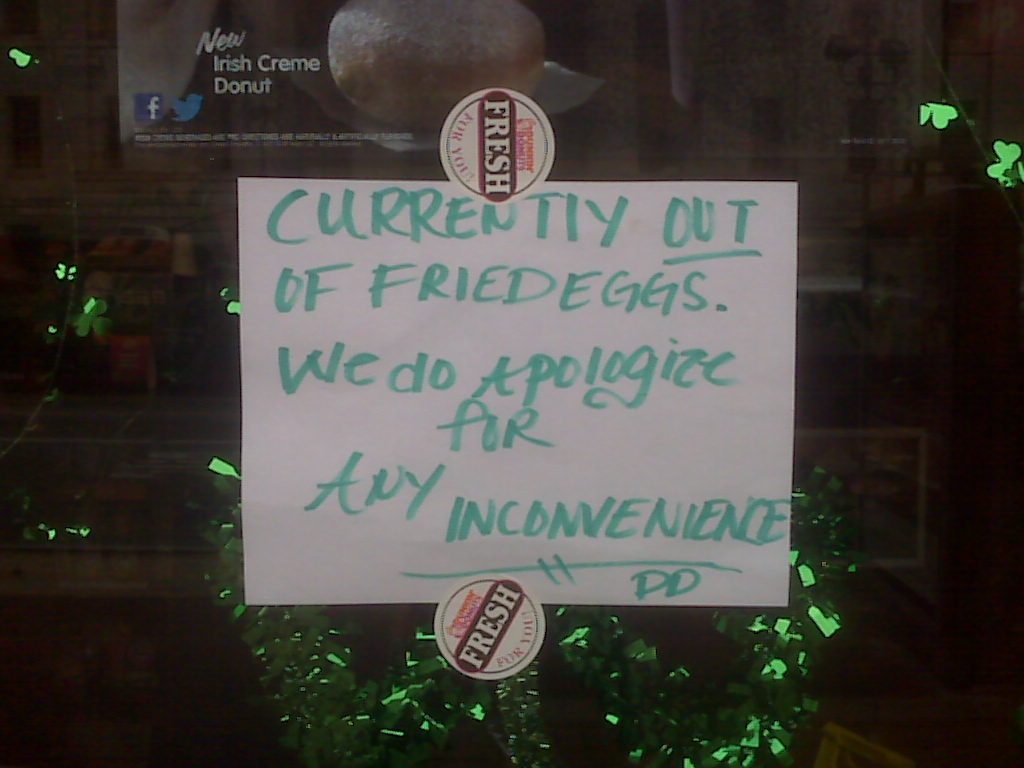
Peace and light, E — Posted with WordPress for BlackBerry.

Peace and light, E — Posted with WordPress for BlackBerry.
Here’s the text of an email we received earlier in the week from building management:
As a result of sequestration, effective Friday, March 8th the Frances Perkins Building (FPB) Facilities Management Office will be modifying the hours of operation for the FPB heating and cooling systems to achieve required savings detailed in OASAM’s sequestration plan. Normally, the FPB heating and cooling systems are operational for 14 hours, from 5:00 a.m. to 7:00 p.m. daily. In order to achieve the reductions required by the sequestration, the FPB hours of operation for the heating and cooling will be adjusted to the General Services Administration standard 10-hour operating day, from 7:00 a.m. to 5:00 p.m., Monday through Friday.
We encourage you to prepare for the building being cooler/hotter in the morning and evening hours by:
–making sure that window blinds are opened or closed appropriately to maximize the sun’s effect,
–leaving private office doors open to maximize air circulation, and
–dressing appropriately, layered clothing that can be added or removed during the day.
We appreciate your cooperation as we implement these sequestration-driven cost reductions.
We apologize for any inconvenience.
Here’s what I wrote back (restraining myself from noting that when President Obama called upon federal workers to make suggestions for how to save money two years ago, I suggested that we change the dress code and the building temperature to reflect the season, not some outdated notion of what is “professional” dress and was resoundingly ignored):
This is fantastic news. I have long advocated making the inside temperature more consistent with the outside weather for our health and for the environment. I hope that you will keep a policy of spending less money and precious fossil fuels on heating and cooling even if the budget picture improves.
I’m thinking that building management doesn’t usually get positive feedback. 😉
It is hard to think of trash as lovely, though I am acquainted with a few who make extraordinary meals from dumpster diving (though they would be doing that from a better class of dumpster).
Is finding lovely a dumpster in the parking lot of mostly closed stores anything like the yogis who seek the divine in the cremation grounds? Am I up to the challenge? Are you?

Peace and light, E — Posted with WordPress for BlackBerry.
My younger sister, too, loves the luminous work of William Laib, whose work is currently on exhibit at NY MOMA. The radiant golden square of hand-gathered hazelnut pollen brings to mind saffron-robed monks; think of the loving patience needed to gather this much pollen.
For me, it also is reminiscent of Lakshmi–goddess of prosperity, who is said to glow golden and whose energy we invoked the day before at a workshop with scholar and intuitive Constantina Rhodes.

Peace and light, E — Posted with WordPress for BlackBerry.
I was just led by a friend’s Facebook posting to the website for an upcoming movie about the Siddha yoga ashram (Siddha yoga was part of the teaching and practice lineage of John Friend and Paul Muller-Ortega, and both have told stories about how useful the fierce ashram discipline was for them, but who adopted too much of the ashram style in their yoga organizations for me ever to have tried to be in the inner circle). In watching the trailer and reading the background materials for the movie, it struck me that the most important point for me is that the followers who were most injured were those who doubted least and who were the most hungry for an authority and love figure.
As a born and bred doubter (how could I not be one who consistently doubts as part of my spiritual practice, given that I am a culturally jewish, New York intellectual who was raised on the Quaker system of queries and advices, who studied western philosophy and law, and who works inside the Beltway?), I believe that you will always be able to get the good out of teachings without losing your own control, sense of self, and discriminating (viveka) ability to evaluate your commitment to a teacher or organization and the teachings offered, if your faith is in your own intuition and education and not in any one human or organization or specific teaching.
Faith (in Sanskrit shrada), in order to serve us well, needs doubt; it needs questioning; it needs testing at every point of the way or it is superficial faith. Don’t let anyone–particularly someone with whom you study or engage in religious or spiritual practice ever tell you otherwise. Sometimes doubting with faith means getting involved or staying fully committed to an organization or teacher despite misgivings or despite troubling behavior (assuming you are not sticking with being abused yourself or standing idly by when witnessing the abuse of others). After all, no humans, organizations, or relationships are without their shadow sides. Sometimes doubting, even with faith, means a radical and complete separation–quietly or loudly. Sometimes what is best for you is something in between. Learning to be in community is part of the practice, after all, keeping in mind that you are the company you keep.
All I can say is this: Please doubt. Please doubt with sincerity. Please doubt with love. Please doubt with respect. Please educate yourself, and with appropriate doubt, have faith that there is good in connecting and in the teachings, no matter how challenging is getting and sharing the teachings and the practices with and through the filter of others.
For me “untitled” as the “title” of a work of art means that the image speaks for itself and that to name it would be to bind the viewer from access to a “pure” and open response of his/her own.
In the yoga philosophy much is made of the fact that any attempt to describe mystical (for want of a better word) experience already veils or distorts the experience and that which has been experienced.
Sometimes, then, I show what I cannot say in words, recognizing that the camera, too, alters and separates the viewed and the viewer.
Jnanam bandaha, by the way, is the second sutra in the Siva Sutras and means roughly, knowledge is bondage. Later in the text, we are also told that knowledge alone liberates. It is a delicious paradox for contemplation.

Peace and light, E — Posted with WordPress for BlackBerry.
Was Janice Joplin right after all? Personally, I don’t think that freedom is just another word for nothing left to lose and nor does tantric yoga philosophy.

Peace and light, E — Posted with WordPress for BlackBerry.


