| | |

Golden Radiance

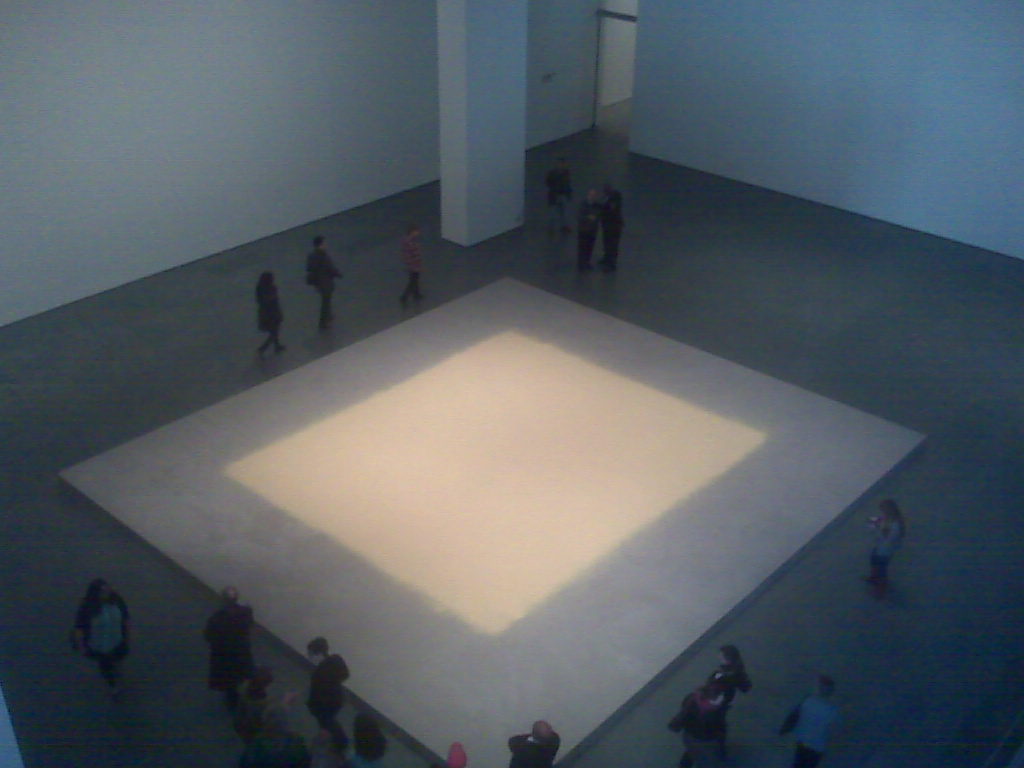
My younger sister, too, loves the luminous work of William Laib, whose work is currently on exhibit at NY MOMA. The radiant golden square of hand-gathered hazelnut pollen brings to mind saffron-robed monks; think of the loving patience needed to gather this much pollen.

For me, it also is reminiscent of Lakshmi–goddess of prosperity, who is said to glow golden and whose energy we invoked the day before at a workshop with scholar and intuitive Constantina Rhodes.

Peace and light, E — Posted with WordPress for BlackBerry.
Similar Posts

  • |

    Guru Purnima (without a “guru”)

    A yoga teacher acquaintance once said rather dogmatically to me that it was not possible to be a true yoga teacher unless one had a guru.  He meant having a guru in the traditional sense — being devoted to a particular person as the embodiment of the divine and of the true teachings.  I did not engage on the issue, thinking (perhaps unfairly) that he would not listen to another point of view.

    I do not have a guru in the technical sense.  It would be unlikely.  I was raised attending unprogrammed meetings of the Society of Friends (Quakers), where services are premised on the idea that there should be no preacher or minister because the light of the spirit shines equally in all and that each person is equally able to connect through his or her own faith and practice to the spirit.  My first major exposure to the teachings of yoga was through the writings of J. Krishnamurti, which a teacher in an alternative program in high school I attended gave us to read, along with the classic yoga texts.  Krishnamurti believed that all change comes from within and eschewed devotion to a guru.

    Although I do not have a particular guru to whom I give my devotion (bhakti), I strive to honor and recognize that our true teacher is the light and spirit that is within all beings.  The first line of the Anusara invocation — om namah shivaya gurave — resounds with truth for me.

    On this guru purnima, the full moon of July, I honor the teachings that have so shifted my life, my teachers, especially John Friend and Suzie Hurley, and all of my students and friends, who shine with light always, and who inspire me to try each day to live more aligned with the ideals of yoga.

  • | |

    Ways to Eat Day Old Bread (Is that “fresh” food?)

    Ayurveda says one should only eat “fresh” food.  What does that mean?  How does that translate into having delicious food making the best use of every bit of it without waste and without having all of our time being devoted to creating it (from start to finish).  Is making a fresh dish from a food item from yesterday’s meal “stale” food?  I don’t think so, but then, I am not an ayurvedic practitioner.  I am fairly certain it is less “stale” than “fast” or packaged food.  And I am too much the New York grandchild of peasant immigrants to forego making the most optimal and complete use of all the food that enters my kitchen.  Also, the simple efficiency of leftovers are too important a component of having the most personally and lovingly prepared food I can with my life style.

    Here are some of my favorite ways to eat bread the day after it was a fresh accompaniment to a salad, sandwich, or larger, festive meal.  (Obviously, this is not for all of those who cannot or do not like to eat bread, which I think of as indeed the staff of life.)   Here are some of my favorites, not in any particular order:

    Crostini/Bruschetta (topped with tapenade, salsa, chopped tomatoes and cucumbers, etc.)

    Bread salad (with the best of the summer tomatoes and fresh basil)

    Croutons (for salad or soup, my favorite is rubbed with a little garlic)

    Red pepper spread with pomegranate molasses and walnuts (bread is the thickener)

    Skordalia (also can be made with potatoes or a mix of bread and potatoes)

    Stuffing for squash

    Bread crumbs for a whole variety of things

    Savory bread pudding

  • | | | | |

    “What Is It?”

    As I squatted on the brick sidewalk to take this photo during my lunch time walk, a nice-looking older man stopped and asked “what is it?” He was quite tall and standing at an angle that would not have showed the shape as well as from where I was positioned.

    “Stand on this side; what do you see?” I asked. He looked from my perspective. “A leaf,” he said with a quizzical expression, wondering why a dessicated bit of English ivy would have captured my attention sufficiently for me to take a photograph.

    “Look again,” I suggested. “Can you see anything else?”

    “Ah,” he said with delighted recognition: “it’s a heart.”

    “Yes. I see them and other interesting shapes in all sorts of things–litter, blackened chewing gum, the pavement itself.”

    “Everything has more than one form,” he rejoined. “You are blessed.”

    And thus we went our separate ways, having brightened our day with this small connection. If he lives in the neighborhood, no doubt we will recognize each other enough from this encounter, at least to smile and say hello.

    Peace and light, E — Posted with WordPress for BlackBerry.
Leave a Reply

Your email address will not be published. Required fields are marked *

This site uses Akismet to reduce spam. Learn how your comment data is processed.