Community and Family

thoughts on how we fit into the web of community, family and society

  • | |

    Happy, Overly Optimistic, or Just Plain Crazy?

    It’s not something I see everyday: a whistling old man sticking his thumb out for a ride. Pretty sure the first ride he will be offered (or would actually take) is the bus, but I imagine he will be happy with that.

    I have no idea what was going on in his mind. Witnessing him made me hope that the older I get, the happier not only will I be, but will be my recollection of the past, however crazy I might appear to be.

    Peace and light, E — Posted with WordPress for BlackBerry.

  • | | | | |

    A Flash of Abhuta

    I contemplate (practice bhavana on) the yoga principle abhuta (wonder) on a fairly consistent basis. When we can find wonder in sheer miraculous diversity of manifestation, we can enter a space of joy whence we can more likely respond in the highest.

    This afternoon, perhaps because I have so recently gone on a practice intensive, I experienced a spontaneous uprising of delighted wonder on receiving an email that would otherwise cause me some consternation and annoyance. Instead, my first reaction was, “My goodness! Another one just like the others, but still new and different! Amazing how that happens. And now I will have to respond.”

    I felt that way again as I joined the rush hour crowds on my way from work to go lead the restorative class at Takoma Park. (If you’re in town, drop-ins welcome. Thursdays at 8pm at Willow Street Takoma Park through the end of May).

    Peace and light, E — Posted with WordPress for BlackBerry.

  • | |

    Good Information on Companion Planting

    In the plant world, we recognize that some plants get along more beneficially than others and some are better kept apart.  Hmmm.

    Here is some good information that I just saw on one of the list serves I read on “companion planting.”  I have been strategically planting marigolds, onions, and garlic for decades as natural pest control, but I hadn’t known that planting basil and tomatoes together improves flavor.

  • | |

    An Obituary and a Quote Being Widely Shared

    It is extraordinary to think how one man can have had such significance in so many lives.  This quote provides valuable insight and perspective:

    “I mourn the loss of thousands of precious lives, but I will not rejoice in the death of one, not even an enemy. Returning hate for hate multiplies hate, adding deeper darkness to a night already devoid of stars. Darkness cannot drive out darkness: only light can do that. Hate cannot drive out hate, only love can do that.” Martin Luther King Jr.

    According to one source, the quote is a hoax (though no proof is offered).  It is a beautiful quote, whoever penned/said it.

  • | |

    Found Exhortation (Less Clearly Seen Than Would Be Most Optimal)

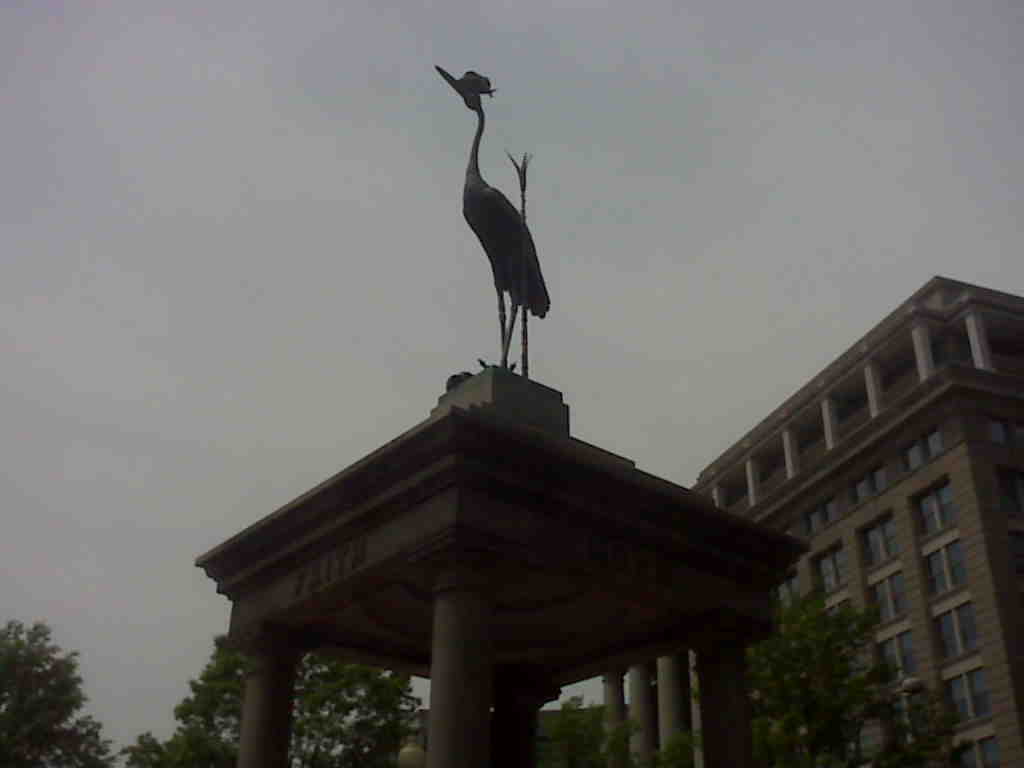
    I cannot tell from looking at the image on my Blackberry whether the words “faith” and “hope” that appear on this statue can be discerned in the photo, but they are there when standing and seeing the statue in person.

    This morning, when I was reading through the news, I came across a curious headline that averred that the killing of Osama Bin Laden had brought us a “rare moment of unity.” This saddened me, as did the reportage of spontaneous celebrations.

    I am calling on my reserves of practice so that my sense of faith and hope for humanity, for peace, and for social priorities is not as faint as the way the words appear in the photograph.

    Peace and light, E — Posted with WordPress for BlackBerry.

  • | |

    In Which I Learn a New Acronym While Away on Meditation Intensive

    On our last day of the intensive, many of us ended up talking about different upcoming events and opportunities for study, practice, and exploration. We all had many things that we would love to do. I do not think that I was alone in feeling twinges of longing when friends shared what gatherings or courses they were planning to attend or considering attending. We knew that we could not possibly fit it all into our lives.

    My lovely and witty friend Emma said, “it’s just f.o.m.o.” That’s an acronym I had not heard even though I live in a town that flourishes on acronyms. “It’s ‘fear of missing out,'” Emma spelled out.

    We never want to miss an opportunity to discover the secret, to learn the perfect piece of wisdom, to experience the most exquisite of delights. The reality is, though, that if we get caught up in the fear of missing out, that we undermine the possibility of experiencing the greatest possible happiness with what fits into our lives.

    Peace and light, E — Posted with WordPress for BlackBerry.
  • | | | |

    Balance of Stability and Freedom

    Last night, we were talking about the parameters of cultivating a steady and fruitful meditation practice, and Paul Muller-Ortega suggested that it was about the balance of stability and flexibility. He had learned the principle from a different source, but I have contemplated and explored the principle in depth from teachings I have received from John Friend.

    A critical aspect of the Anusara alignment principles is to find the perfect balance of stability and freedom. We need stability to stay fully and safely in each pose. We need freedom to achieve the fullest and most delightful expression of the pose.

    We find the stability both by making certain that we have established our foundation (which is an aspect of the first principle of opening to grace). By then using the three aspects of muscular energy–hugging the muscles to the bone, drawing into the midline, and drawing energy from the periphery to the focal point, we make possible an expansion of our edge, whatever that might be. Having a solid, aligned foundation and affirming our very core with these actions, gives us security and balance. We also want to reach out, to be playful, to expand to our fullest, which we do using the expansive, outreaching organic energy — from focal point to the periphery, from the midline to our outer edges, from the very marrow of our bones through bone, muscle, skin, and beyond.

    If we over-emphasize (including natural inclination) stability, then we can get stuck. If we just let ourselves be free, then we end up all over the place. When these elements are perfectly balanced, we can safely find our deepest freedom of expression.

    When I teach this principle as the focus of a class, I always invite my students to think of how important the balance of stability and freedom is for every aspect of our lives.

    The discussion last night put this principle in the context of the regularity and steadiness of our practice, with the recognition that to stick with our practice, we will sometimes need to vary the time or amount of our practice, or what elements are included in the practice.

    To get the fullest benefits of a practice (this applies to any practice and not just to meditation), we need to show up consistently and to practice in accordance with how we have been taught. To stay steady, though, we need to give ourselves the permission or freedom not to show up, or within appropriate parameters, to modify the practice when life gets in the way of what we think would be the ideal practice. If we think we have to do things at the exact time and place every day in a perfectly precise way, we become rigid. On the other hand, if we are loosey-goosey about it, then we do not have much of a practice and will not realize the benefits that we could get.

    Where in your practice or life would more stability and steadiness give a field for greater freedom and happiness? Where could you give yourself a little more flexibility so that you feel that steadiness brings the possibility of joy, rather than tying you down?

    Peace and light, E — Posted with WordPress for BlackBerry.

  • | |

    Artha, Kama, Dharma, Moksha (and Politics)

    Last night, Paul Muller-Ortega, as part of the introductory talk for the meditation intensive, spoke at some length about the principles of ardha, kama, dharma, moksha.

    As I have written about before, in the classical yoga view, it is the renunciation of the first three–material well-being, love and relationship, and right work or path, that leads us to the fourth–liberation. From a tantric yoga perspective, it is living and having the first three from the perspective of illuminated wisdom and discerning (viveka) insight (pratibha) that makes us free (jivanmukti) in this life.

    One of the most exquisite things about a steady practice and study, is that each time we revisit a core concept, we hear and understand new aspects to bring into our lives.

    When speaking of approaching these elemental aspects of human being, Paul noted that ardha includes not only material well-being, even wealth, but also the power that wealth brings and how we use it. Although he only mentioned that briefly amidst several other concepts, it really resonated with the current state of my being in relationship to the world and our country.

    I have been contemplating deeply about wealth and power in this time of budget debate, and how they can and should be used to bring nurture, peace, and health to the maximum degree possible. (You might guess that I don’t think increasing spending for war and decreasing spending for education and health is going to bring us freedom).

    Thinking about the power of money as part of our contemplation of our material well-being is something of critical importance at this time. If we shun or disdain in our minds wealth and power while still yearning for our own comforts, than we have lost an opportunity to bring the yoga principles into our lives as optimally as possible. (Of course, grasping and coveting money and power is completely destructive of the possibility of happiness, but most of us think about that, and it is why some say they are bad — money being the root of all evil, etc.).

    If we are really in the world and want to be happy and to share and spread happiness, while living in accordance with the principles of the yamas and niyamas, especially the yamas: ahimsa, satya, aparigraha, brahmacharya, asteya (non-harming, truthfulness, non-greediness, aligning with spirit, and non-stealing), that is when we will start opening up the possibility of true living liberation.

    Imagine, instead of thinking about material well-being as a “guilty pleasure” thinking of ways in which you can use your own well-being (and work through your practice to discover greater health and strength) to be a voice and power for good in your own individual way.

    Peace and light, E — Posted with WordPress for BlackBerry.