| | |

A Good Place to Sit

I came out briefly to sit and contemplate and write in my journal before a staff meeting at lunch time (no lunch provided).

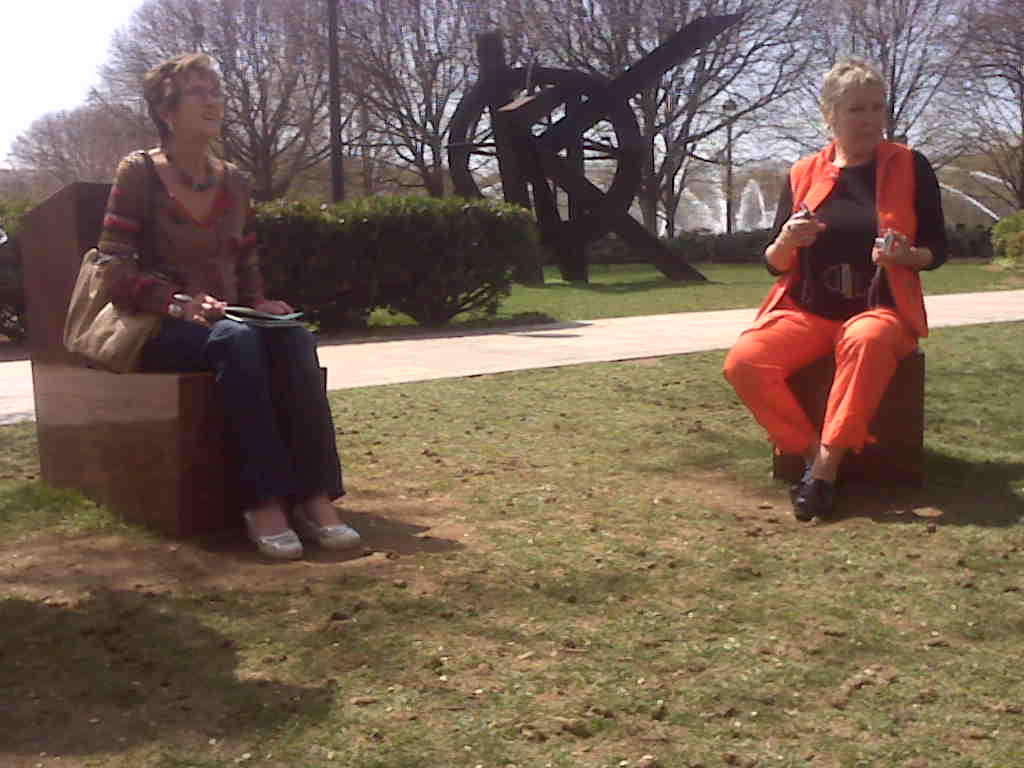
The Scott Burton chairs in the National Sculpture Garden are one of the more delightful places to sit outside near my office.

First, I was joined by several birds. Then some tourists came along. The one with all the jewels sat down at the direction of her friend in orange for a photo. “We’re not allowed to sit here,” the sitter said with a little glee in her voice.

I directed her to the sign near the seats giving permission. This led the photographer both to sit down with her friend, but also to lose any real interest in taking the photograph.

What was it about the loss of transgressiveness that made the photo less desirable? The chairs are the same whether permitted or not. In fact, with sitting permitted, there is more time to explore fully their function as chair as well as their form as art.

This set me wondering about how much our desires are driven by social ideas, rather than needs and comforts.

A father and his son approach the chairs fro the other direction. After reading the sign giving permission to sit, they promptly sat down. The bare statement “granite chairs,” was all that was said before they got back up and went on they’re way.
Peace and light, E — Posted with WordPress for BlackBerry.

Similar Posts

  • | |

    Kate Swift, Inherent Sexism in Language, and the Bhagavad Gita

    When I read Kate Swift’s obituary yesterday, it lead me to think more deeply about a recent conversation I had about the Bhagavad Gita.  The Bhagavad Gita, not surprisingly, is required reading for most yoga teachers.  It is an integral part of the history and philosophy of yoga thought and practice.  It is, though, about a battle in the middle of war, in a time and place where a woman’s highest and best (and arguably only role in life) is to be obedient first to parents and then to husband.  Purity, obedience, and beauty (as decided by society) are the great virtues of women.  As a dialogue between a male warrior (Arjuna) and a male incarnation of the deity (Krishna), all of the spiritual and social teachings are presented in terms of men and males, right down to the pronouns.  The translation that was being discussed was that by Juan Mascaro.  As a mid-twentieth century translation by a Spaniard at Cambridge University who has lectured on “Literary and Spiritual Values in the Authorized Version of the Bible,” the translation no doubt perpetuates (without any specific or willful intention to do so) the inherent sexism that is also found in the English language and in the Bible and its notion of God.

    The question raised was how a book that perpetuates sexist stereotypes could be required reading to be a yoga teacher.  (See my previous blog entry on how we, as yoga teachers, can rely on a book that is primarily about war.)  How would it read, it was suggested, if all the pronouns in the Gita were changed from he to she?  The person raising the question said that making this change made the spiritual guidance more accessible to her.  For me, shifting the pronouns from male to female does not address the challenge because I do not believe in spirit that can be given gender.  I read the Gita and other yoga texts in two ways:  (1) as historical and literary/philosophical documents that are products of the author’s time and place in history; and (2) as a source of universal human truths.  The Gita, as a dialogue between a warrior and a male avatar of “God,” does not have much place in the ideals I hold dear.  Neither the caste system nor the roles for women espoused in the text support my own beliefs about equality, justice, fairness, or love.  The extraordinary teachings of yoga, though, transcend the history out of which they arose.  To do justice to the yoga texts — and not just the yoga texts, but the great teachings and texts that are an integral part of our social fabric — we must both recognize their historical context and be open to learning what has transcended history and cultural boundaries to make them living words.

    In attempting to make the shift to a modern interpretation that allows for “feminism,” I know many who try to address some of the challenge for modern readers by saying that we all have characteristics of the masculine and the feminine, and so we can read the guidance in the texts as being valid for both sexes.  The problem I have with that is Kate Swift’s point.  If we label various personality traits and characteristics as being elementally male or female, we are still perpetuating sexism through linguistic bias.  It is not enough for me to make the warrior female and allow her “male” characteristics.  What I think is that all human characteristics are gender neutral.  If the teachings are not to be biased when we as teachers transmit our reflections on the texts to our students (after recognizing how history has done it), then we need to say that all people can be assertive or passive, strong or sweet, rigorous or soft, etc, but not just say that some are masculine and some are feminine and that in having all of these traits to some degree, we are showing that we are both god and goddess, masculine and feminine.

    Or we could just not do any labeling at all, instead concentrating on the truly universal yoga teachings of right action, selfless service, and deep abiding love–none of which have anything to do with gender.

  • | |

    Shadows and Light

    In discussion of erudition and spirituality, much use is made of the metaphor of light. Light takes us out of darkness, reveals the truth of illuminated wisdom, is the truth, is pure consciousness, etc.

    When I noticed the shape in the sidewalk pavement culminated by a shadow, I found myself thinking that we cannot fully experience light without shadow. Not because we cannot understand something (e.g. good) without experiencing its opposite (evil), but because absolute light blinds us to the point of destroying the ability to see even the light. We need shade or dark sunglasses to see what is differentiated when the sun is at its most glaring.

    Just as the stone in the photo would not be revealed as a heart but for the shadow crossing it, so too, we cannot know the deepness and authenticity of love or spiritual teachings and practices until we discover that we can stay true to them through challenge and adversity. The shadow does know, just as the light reveals.

    Peace and light, E — Posted with WordPress for BlackBerry.

  • |

    Construction and Reconstruction

    I have lived in my house for almost 20 years.  The house came with a bottom of the line, circa 1977 Hechinger’s bathroom.  The bathtub has been rusting for a over a decade, part of the faucet would come off when turning it off, etc.

    Finding myself without any pets and between tenants, it seemed like a good time to renovate.  Last week, in just a day, what was a bathroom, is now a gutted space.  Amazing how quickly something can be rooted out and undone.  It will be taking a lot longer to reconstruct.

    What I am finding most challenging is not the physical chaos.  I am used to it as an old house often needs work, and this house needed work (though it was not the kind of fixer-upper that was completely missing floors, electricity, and plumbing).

    Rather, what I am wrestling with is my emotional reaction to the idea of having a brand new, beautiful bathroom.  There is a big feeling guilty component to be spending money on something that feels not entirely necessary when so many are in need.  So while the contractor is working on the construction, I am working with a wonderful opportunity to help reconstruct (post deconstructing) my emotional relationship with things.  How do I find balance between honoring those in need, my impact on the planet, maintaining my house, and my enjoyment of beautiful things?  How do I feel at peace with my decisions once they already have been made?  How do I apply discrimination in my aesthetics to assist in this balance?

Leave a Reply

Your email address will not be published. Required fields are marked *

This site uses Akismet to reduce spam. Learn how your comment data is processed.