Author: Elizabeth

  • |

    One Love

    There are several heart-shaped holes in the sidewalks on my usual haunts. A number have gotten progressively more heart-shaped over a period of months. Who are the good fairies who are chipping away at things to remind us of the heart if we are just paying attention?

  • | |

    Stringing Baby Seed Pearls (and “Opening to Grace”)

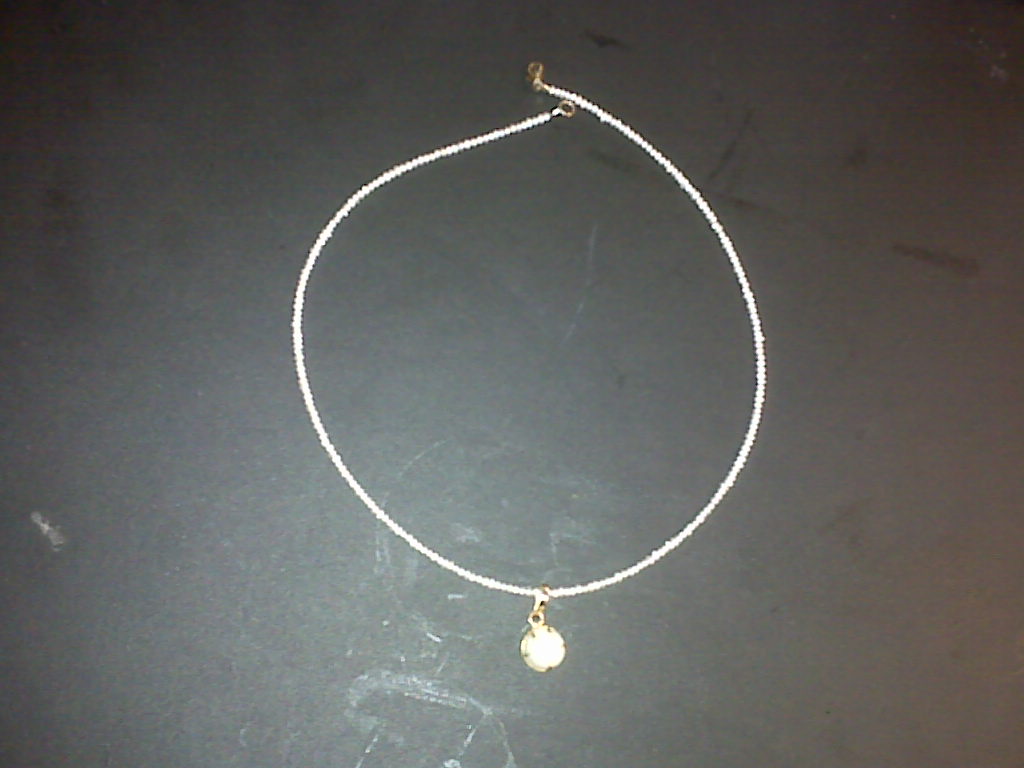
    Last night I sat down at my kitchen table to string baby seed pearls for a mother-of-pearl charm I had gotten from Manoj a few years ago.

    When I took the pearles off of the thread they came on and put them on my jeweler’s mat, several challenges were revealed:  even with the lights on bright and my reading glasses, it was almost impossible to see the bead hole; if I touched the wire other than on the hole, the pearl bounced; if I tried to hold the pearl still, the hold was obscured by my fingernail. Using a needle was not a viable option because the holes were too small for a wire-threaded needle.

    At this point, since I was doing this after a long and frustrating day at the office, the tendency was to get more frustrated. Should I just give away the pearls? Get stronger glasses or a loupe? Try to return them?

    Instead I softened. There was no mandate I get the pearls strung. I was doing this solely for enjoyment.

    In softening, I discovered — to mix philosophical underpinnings — the zen of baby seed pearl stringing. If I grouped a bunch of pearls together, not only was it easier to see holes in certain pearls, but the others around it held the pearl in place for the wire to pierce the pearl. By softening, it occurred to me to use the technique of cutting the wire on a bias (and repeating it every several pearls strung), which gave me a smaller, sharper point, making the threading much easier. Most important, though, I stopped trying so hard. I let the wire and each pearl meet each other instead of my trying to force the meeting. When I did that, the openings were revealed, and I entered a quiet and serene meditative state during which the project completed itself through my agency.

    It is for discovering, experiencing, and always being able to engage this essential and blissful merging of being and acting that I meditate and practice asana. We practice the Anusara principle “opening to grace” so that we can experience grace itself (whatever grace means to you) doing our acting, both on the mat and off.  As such, “opening to grace” is both the primary and ultimate activator of this merged state of being that is yoga--union..
  • | | |

    Green advertising (and viveka)

    One of the important principles of yoga practice is viveka — discrimination.  The longer and more steadily one practices, the greater ease with which one will find path that leads towards recognition and remembrance of our own light and the light in others.  In modern culture, I think one of the critical aspects of practicing viveka is having a healthy doubt and willingness to question claims that consuming certain things will make us happier, or better, or will make the world better.  Paying too much attention will probably just create a tangle of intellectual confusion that will not lead to a greater openness of spirit.  Learning to listen well to your body and mind and what and how you feel and hear on and off the mat will help you start to know better your body and mind and how they interrelate with all around you, is likely to shift your choices and actions.

    It is now fashionable to be “green.”  Discerning what that means, though, is where we need to practice discrimination.  For example, claims of “natural” foods, “organic” foods, and “green” products are now ubiquitous by companies that are part of the existing Wall Street profit-driven industrial and marketing complex because they think they are money-makers and expect most consumers not to question the claims.  We are also seeing more and more articles and stories debunking these claims and calls for regulation so that consumers will understand what is bunk.  If we stop and pause, we can probably figure out some of this without reading about the pros and cons.  Do you know who is selling it to you?  Does it come in packaging with a lot of small print?  Is the packaging recyclable?  Are shareholder profits critical to the entity selling you the food or garden supplies or other consumer good?

    Taking the example of the success of the big companies, small entities are using “green” in their names and advertising without discrimination.  Around town I see fairly regularly, landscaping companies with cozy-sounding “green” names.  When I watch them working, though, they are using Round-up or other chemical weedkillers, throwing into the trash compostable yard waste, and planting non-native shrubs.  They may be making a garden the color green, but they certainly aren’t doing “green” gardening.

    Here’s some great information on having a “climate-friendly” garden from the Union of Concerned Scientists.  The tips are more helpful for a yard large enough to have a lawn, and do not fully apply for my small patio (though I have a tree in front, don’t leave bare soil, and do not use pesticides or chemical fertilizers.  I haven’t yet tried planting winter crops in my containers, but I’ve rearranged the patio so that I have a place for a raised bed (to sit on the brick where the table and chairs once were).  This winter, I’m hoping to add the bed and a cold frame to lengthen the growing season.

  • | | |

    An Environmental Perspective on Yoga

    Every once and a while, I poll my students and ask them whether they find that they need less medication and medical intervention (testing and other procedures) than before they were regularly practicing yoga.  Students uniformly advise that they take painkillers less frequently.  Some students say they need lesser amounts or have been taken off other medications by their doctors.  Others note better sleep, less frequent colds, flu, or other common contagious illnesses.  Others have stated they have avoided recommended surgery by working hard to shift their alignment.  I personally have experienced great improvements in physical and emotional health from my steady practice, which has led to my doctor of 15 years agreeing that I need less medicine (note:  I am not advocating none) and testing. I think my making the commitment to practice to minimize health care consumption as one of the ways I personally take care of the environment.

    No matter what it is we are making, consuming, and disposing, and how we are doing those things, the four R’s of consumption to benefit the environment (refuse [i.e., don’t use], reuse, repurpose, recycle), start with not using things in the first place so that we do not have the environmental degradation of manufacturing and ultimate disposal.   We do not usually think about this in the context of medical treatment because we want to be out of pain and illness and for the most part, think of medical treatment as a fundamental right.

    At an individual level, lots of people would rather just take a pill (or even have surgery) than have to make a consistent change in behavior, physical activity, and diet.  There are also times when western medical treatment is the only effective treatment, and we are very fortunate to have it available.  Some people are not in a position in society to make a shift easily in this regard or to understand what it means.  But for those of us in the know, prevention not just of illness, but of medical consumption, by exercising, meditating, practicing therapeutic yoga, and shifting our diet, is a wonderful way we can personally seek to limit our reliance on fossil fuels and reduce our personal waste output.  In addition to eliminating the need to have the supplies manufactured, it will also keep medications that have passed through your body from reentering the water and food supply (which in turn has its own detrimental health impacts to society and to the environment).

    Has the practice of yoga changed you as a consumer of health care?  Have you ever considered the relationship between being a consumer of health care and your environmental impact?

  • |

    Not Wanting to Know

    I don’t want to see the pictures.  I don’t want to read the news, but putting my head in the sand will not eliminate the existence of the tragedy.  Those of you who have read this blog regularly, know that in my own comfortable middle class way, I am seeking to reduce my energy consumption.  As I write, a contractor is replacing my old rubber roof with TPO roofing (“cool roofing”).  My old black rubber roof has been needing repairs for the past few years.  I am working with another group to get solar panels installed, and I needed to replace the roof first.  I hope this will make things more comfortable and reduce my footprint.  (Yes, I know the only way truly to do it, is to live in a whole different way).

  • A Mini-Experiment (Meditation and Blood Pressure)

    This morning I went for my bi-annual physical. The first thing that the doctor’s assistant did after having me stand on the scale (a blood-pressure elevating activity out of habit), was take my blood pressure. It was on the low end of normal, as usual for me.

    In the middle of the exam, after having intimate discussions about tratment to alleviate suffering vs. treatment for longevity, and similar topics, my doctor took my blood pressure again. No surprise: it was higher than it had been when I irst walked into the exam room.

    When we were just about done, my doctor said, “let’s see if we can lower that blood pressure. Close your eyes and relax.” “Relax” can be a hard command to obey. Instead, I went right to where I go in meditation, softening to my mantra. In less than a minute, my blood pressure was lower than it had been at the start of the exam. “A beauty of meditation,” I said. “Yes,” my doctor replied (who is a very traditional western medical practitioner, “I wish I could get all my patients with high blood pressure to meditate.”

  • | | |

    Neighborhood Fruit

    This spring I decided to for the second time growing a fig in a container.  It has about five figs, all of which I intend to eat before the squirrels can get them (I’ve beaten them and the birds to the three blue berries that have ripened so far; I have high hopes for the figs).  I don’t think my fig in its container is suitable for sharing as “Neighborhood Fruit.”  Do you have a fruit tree that has too much fruit for you?  Let people know.