Last Saturday at the Arboretum
Not out of caution, but out of wonder, first someone pointed out the black snake to me and a friend, and then we pointed out the snake to others walking past. And how exquisite the mountain laurel.
Not out of caution, but out of wonder, first someone pointed out the black snake to me and a friend, and then we pointed out the snake to others walking past. And how exquisite the mountain laurel.
Last week after Thursday night’s restorative class (just two left in the series–drop-ins welcome), one of my students said that now that class was over she was glad she had come. “I wondered whether I was too tired to come,” she said. “Before I came, I was tired, but not relaxed; now I am relaxed, but not tired.”
It is knowing whether our practice will give us the shift between tired, but not relaxed and relaxed, but not tired that tells us whether we are really too tired to go to class (or practice on our own at home).
What does it mean to be too tired to practice? When sick or jetlagged or injured, a strong asana practice can be risky. If your regular class is a challenging one and you are tired, consider taking an easier class or doing your own practice rather than just not doing at all or trying to muscle your way through a class that feels wrong for the day. Try starting with a restorative or self-massage or gentle meditative movements and see whether being softer and more exploratory of your state brings in new energy that leads you to move towards a more energetic practice or whether it shows that you are truly exhausted and getting progressively quieter until savasana (final relaxation) is the best possible option. If you go to class, let the teacher know that you are going to be backing off and why. Most teachers are happy you have come and will be supportive of your taking care of yourself.
When a goal of practice is to become increasingly more sensitive and aware of our state of being and is less about achieving certain poses or levels of fitness or getting a certain amount of exercise, then we will have fewer days when we think that we are too tired to practice. On days we are especially tired from the demands of the day, we can always invite our practice be an exploration of how fatigue is manifesting itself and what will help us on any given day relax, revive, and deeply rest. For modern living-in-the-world yogis, that can be a truly nourishing way to practice and enhance life.
It is a delight to be arriving at the time of season when cutting roses (in advance of dead-heading) and harvesting edibles (to make way for more growth) is a large part of tending the garden–full on reciprocal nurturing.

Peace and light, E — Posted with WordPress for BlackBerry.
First strawberries from the garden.

Peace and light, E — Posted with WordPress for BlackBerry.
When I read Kate Swift’s obituary yesterday, it lead me to think more deeply about a recent conversation I had about the Bhagavad Gita. The Bhagavad Gita, not surprisingly, is required reading for most yoga teachers. It is an integral part of the history and philosophy of yoga thought and practice. It is, though, about a battle in the middle of war, in a time and place where a woman’s highest and best (and arguably only role in life) is to be obedient first to parents and then to husband. Purity, obedience, and beauty (as decided by society) are the great virtues of women. As a dialogue between a male warrior (Arjuna) and a male incarnation of the deity (Krishna), all of the spiritual and social teachings are presented in terms of men and males, right down to the pronouns. The translation that was being discussed was that by Juan Mascaro. As a mid-twentieth century translation by a Spaniard at Cambridge University who has lectured on “Literary and Spiritual Values in the Authorized Version of the Bible,” the translation no doubt perpetuates (without any specific or willful intention to do so) the inherent sexism that is also found in the English language and in the Bible and its notion of God.
The question raised was how a book that perpetuates sexist stereotypes could be required reading to be a yoga teacher. (See my previous blog entry on how we, as yoga teachers, can rely on a book that is primarily about war.) How would it read, it was suggested, if all the pronouns in the Gita were changed from he to she? The person raising the question said that making this change made the spiritual guidance more accessible to her. For me, shifting the pronouns from male to female does not address the challenge because I do not believe in spirit that can be given gender. I read the Gita and other yoga texts in two ways: (1) as historical and literary/philosophical documents that are products of the author’s time and place in history; and (2) as a source of universal human truths. The Gita, as a dialogue between a warrior and a male avatar of “God,” does not have much place in the ideals I hold dear. Neither the caste system nor the roles for women espoused in the text support my own beliefs about equality, justice, fairness, or love. The extraordinary teachings of yoga, though, transcend the history out of which they arose. To do justice to the yoga texts — and not just the yoga texts, but the great teachings and texts that are an integral part of our social fabric — we must both recognize their historical context and be open to learning what has transcended history and cultural boundaries to make them living words.
In attempting to make the shift to a modern interpretation that allows for “feminism,” I know many who try to address some of the challenge for modern readers by saying that we all have characteristics of the masculine and the feminine, and so we can read the guidance in the texts as being valid for both sexes. The problem I have with that is Kate Swift’s point. If we label various personality traits and characteristics as being elementally male or female, we are still perpetuating sexism through linguistic bias. It is not enough for me to make the warrior female and allow her “male” characteristics. What I think is that all human characteristics are gender neutral. If the teachings are not to be biased when we as teachers transmit our reflections on the texts to our students (after recognizing how history has done it), then we need to say that all people can be assertive or passive, strong or sweet, rigorous or soft, etc, but not just say that some are masculine and some are feminine and that in having all of these traits to some degree, we are showing that we are both god and goddess, masculine and feminine.
Or we could just not do any labeling at all, instead concentrating on the truly universal yoga teachings of right action, selfless service, and deep abiding love–none of which have anything to do with gender.
After I have been working and studying intensely, I sometimes find myself called to lie underneath the cats and read fiction. Just because it isn’t hard work, doesn’t mean I won’t find treasures that further my explorations. This bit, for example: “Then he felt his heart floating again, sunlit and serene, impossibly heavy, impossibly light; he felt the earth itself balanced on his outstretched finger.” Patricia A. McKillip, Alphabet of Thorn.
Dear Friends,
One of the most captivating elements of dance as artistic expression for me is that it has the capacity to show the beauty in the full range of emotions. Whether the choreographer is telling a story or sharing an impression, making a political statement or expressing a feeling, the dancer’s inherent grace can show us that there is beauty in all things, helping us through the artistic medium to abide with what might otherwise seem emotionally intolerable and to celebrate more fully that which would naturally make our hearts sing.
Since I first began practicing asana, it has been for me an embodiment of the dance. The exquisite technique of the Anusara® principles of alignment transformed healing work into a dance of exploration. The expansion of my strength and flexibility in middle age — when because of my dance history I thought only would contract with age — allowed me to express progressively more fully the joy I find in my body.
This year, John Friend’s overarching theme for his workshops and trainings around the world is “Dancing with the Divine.” The theme resonated especially fully for me because I started attending regularly last fall the Sunday contact improv jam on Capitol Hill and have been re-exploring dance after all the shifts I have made with an ever-deepening asana practice. It has been with an eye towards not only my own dance, but the connection of the community, and our dance of relationship with our living planet that I am choosing which trainings and workshops to attend this year.
When deciding what my study priorities are for the year, I look first at where my practice and teaching could benefit from some deep attention and wisdom offerings. I look to the local offerings to deepen my connection to my home community and to minimize the environmental impact of getting to be in the same room as the teacher. I am thoroughly appreciative of how wonderful it is to have a burgeoning and dedicated local community that has incredible teachers and draws others. When planning which workshops or trainings with John Friend I will attend, I look at whether there is an opportunity to combine a training with a visit to friends or family or an opportunity to see art exhibits or museums that are of particular interest to me. I like to go to any trainings that I can get to by train and, like even better when it happens, where I do not need a car once I get to the training/workshop location.
Next dance for me with the bigger community is the Anusara Grand Circle in Stratton, Vermont for the summer solstice. My heart expands with the anticipation of being in the mountains of Vermont with clear, starry nights and bright, vivid almost endless days for a gathering of fellow yoga dancers, those I already know and love, those whom I will get to know better, and those I will meet for the first time.
It is especially exciting to know I will have the opportunity to study with some of the incredible teachers in the international community I am honored to know, but from whom I have not yet had the privilege of taking a class. It is also a great opportunity to be with people who are just beginning to get excited about Anusara (gatherings like this are a great opportunity to study with John Friend without having the formal application process.)
Local yogis, I look forward to seeing you in regular class offerings in the neighborhood and Willow Street, including just until the end of May, Thursday night restorative yoga. I expect delightedly to see you, too, as fellow students at many of the incredible offerings both in and around DC and the country.
And if any of you are interested in coordinating a trip to the Grand Circle to celebrate the solstice, send me an email.
Peace and light,
Elizabeth
maybe it was the roses.” Thank you to all my neighbors who make their front gardens an offering of beauty.

Peace and light, E — Posted with WordPress for BlackBerry.
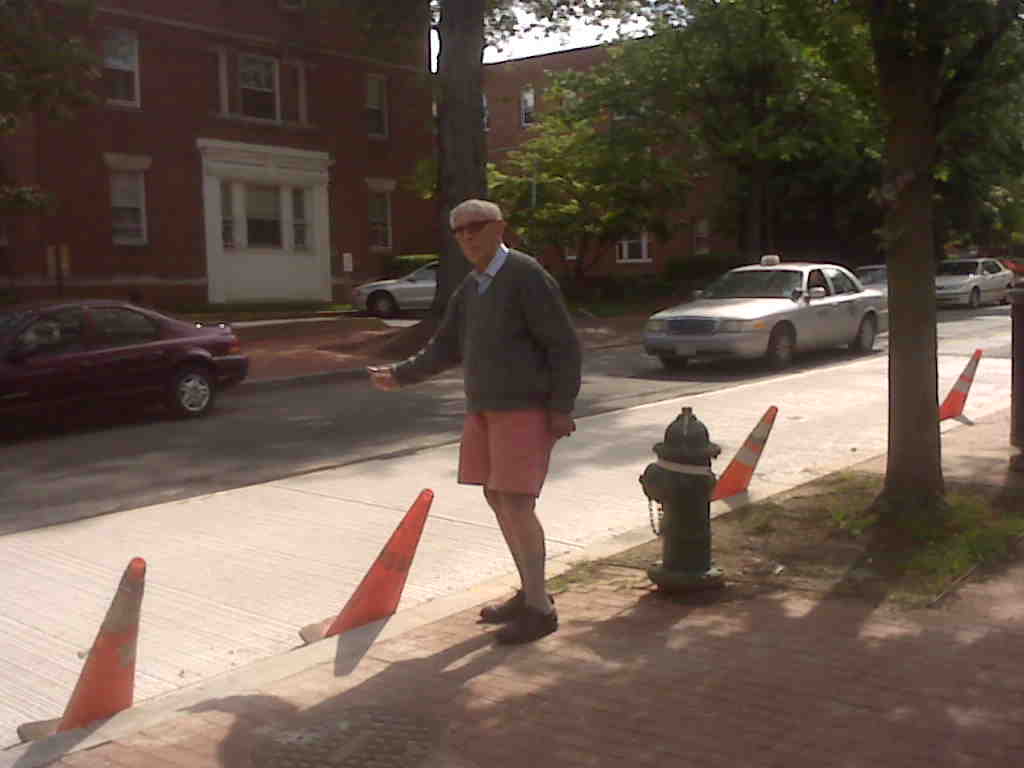
It’s not something I see everyday: a whistling old man sticking his thumb out for a ride. Pretty sure the first ride he will be offered (or would actually take) is the bus, but I imagine he will be happy with that.
I have no idea what was going on in his mind. Witnessing him made me hope that the older I get, the happier not only will I be, but will be my recollection of the past, however crazy I might appear to be.
Peace and light, E — Posted with WordPress for BlackBerry.