| |

What Does It Mean to Study War?

Martin Luther King, Jr. said:   “A true revolution of values will lay hand on the world order and say of war, “This way of settling differences is not just. …A nation that continues year after year to spend more money on military defense than on programs of social uplift is approaching spiritual death.” Still, the Pentagon suggests that Martin Luther King “might” have supported the war in Afghanistan.  Not sure on what basis.

Last night at the Willow Street Book Club, where we were reading Ram Dass’s Paths to God–Living the Bhagavad Gita, one of my fellows raised the question of how we could read as a spiritual guide a book whose context is war.  Another asked a similar question from the perspective of a feminist.  It was a fabulous, engaged, lively discussion, and I hope to see more next month.

It would be an injustice to the text and the historical context to read entirely out of the Bhagavad Gita the duty of a warrior to kill, a wife to practice suttee, and persons born into each caste to accept their lot in life in a society structured on the caste system.   There is much richness in the text, though, that can provide guidance for a feminist, pacifist, who believes that “all men are created equal.”

We have reread “men” in the Declaration of Independence to include women and those of all races (though we cannot manage to rewrite the Constitution to explicitly state that women are equal, but that’s a thought for another day).  Similarly, without doing injustice to the text, we can see that the ultimate teachings about living in accordance with duty (svadharma), love, devotion, and sacrifice in the Gita, like the concepts of “life, liberty, and the pursuit of happiness,” provide guidance and force for social action and spiritual devotion beyond a historical context that oppressed and bound on the worldly plane the very persons who are now seeking the deeper meanings in the text.  In fact, I believe that we can use the essential intent of the text to teach and transform the oppressors, to use the very text to show why the violence and oppression of the historical context is injust and needs to be changed so that the spiritual intent can be expanded and spread beyond the privileged.


Similar Posts

  • | |

    Good Information on Companion Planting

    In the plant world, we recognize that some plants get along more beneficially than others and some are better kept apart.  Hmmm.

    Here is some good information that I just saw on one of the list serves I read on “companion planting.”  I have been strategically planting marigolds, onions, and garlic for decades as natural pest control, but I hadn’t known that planting basil and tomatoes together improves flavor.

  • | |

    “Now Write in Your Journals…” (and What It Means to Be a Good Student) (DWTD)

    The first day of the advanced intensive this week, John Friend invited us to write in our journals about what we wanted to get out of the three days from both an energetic perspective and from the perspective of a particular asana that has challenged us. This was not long into the first session of the first day, but it was after he spent some time speaking about what he believes it takes to be a good student–of yoga and of life. Though he did not specifically relate the qualities to the Anusara principles or the mahabhutas (elements), based on what I have heard him teach before about studentship, which is a significant aspect of a committed yoga practice, the qualities of studentship he outlined are parallel to the principles of alignment.

    The first quality of studentship, he explained, is having a simultaneous sense of wonder and of humbleness (openness to the teaching and the teacher). This is about being spacious (akasha) and an application of the first and highest principle–opening to grace.

    The second is steadiness, which includes showing up, paying attention, being consistent, being diligent. This is being like the earth, being muscular and strong (muscular energy) in how one studies.

    The student also needs to be accommodating, to be able to be fluid (like water), to go with the flow of the teacher, the studies, and the class as a whole. This is similar to how the expanding action of inner spiral helps us make more space to grow in a pose.

    Third, the student should always do his or her best, to be on fire to learn and grow. Doing one’s best in this way is like the action of tucking the tail bone to engage fully outer (or contracting) spiral to draw into the inner power to shine.

    Finally, just as air reaches out in all directions and the Anusara yogi, in asana practice, uses organic energy to extend outward, a good student makes offering of all he or she is learning, to make studying an act of loving service (seva).

    When John asked us to take out our journals this week, I took mine out and wrote on what he asked. As I did so, I found myself remembering the first time he asked me to write in my journal, which was at an Inner Harmony retreat in 2003, when I was in the middle of my Anusara teacher training. I have been keeping a journal steadily since I was 11, and though I was on fire for studying yoga, being told what to write in my journal felt a little like an invasion of sacred and intimate personal space. I think others probably expected this; they had “yoga” notebooks with them and did not need to write in a personal journal when the received this instruction, but all I had was my regular journal.

    I am still in Miami; tomorrow I will be visiting a friend and then joining with others for the Mahashivaratri celebration, or I would pull out my journal entry from the week at Inner Harmony to see what I wrote. I know that I wrote as much about why it was hard for me to be told what to write in my journal as I wrote on whatever was the topic on which I had been directed to write. I know also that was the week I really decided how important it was to study with John. Finding the balance between knowing what was my own space and truly understanding where I would best learn by following completely the teacher, was a critical part of my yoga studies. Being a good student is not always easy, but it is an evolving part of the sadhana (practice) of relationship, which is the true yoga. This is why how to be a good student initiated the week’s teachings for a group of advanced students, most of whom were teachers themselves.

    This afternoon, at the end of the last session, John asked us to get out our journals (I am still using my regular journal as I am not much for taking notes and separate notebooks for yoga just get left behind mostly empty) and look at what we had written on the first day. Did we get out of the training what we had written that we wanted, he asked. For me, the answer was mostly yes, and in some profound and unexpected ways. Would I have gotten so much in that regard if I had not done what my teacher directed and thereby focused my intention for the training? I think probably not. And part of what I wanted, though I did not write it down that way, was to be yet still a better student of my teacher, the teachings, and the spirit.

  • | | | | |

    Still More Color (An Appreciation)

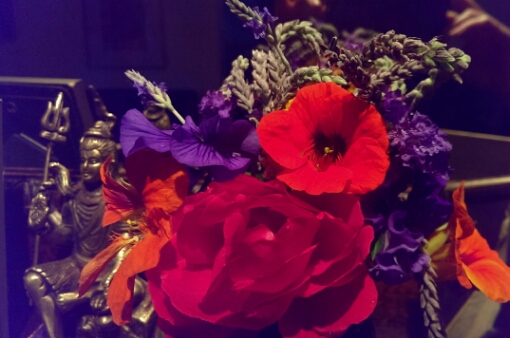
    Today, when I was thinking about that for which I am most grateful and taking a lunchtime walk through the neighborhood, I decided that my persistent appreciation for beauty is worthy of the highest gratitude. The ability always to be entranced by beauty has gotten me through many a moment of potential suffering.

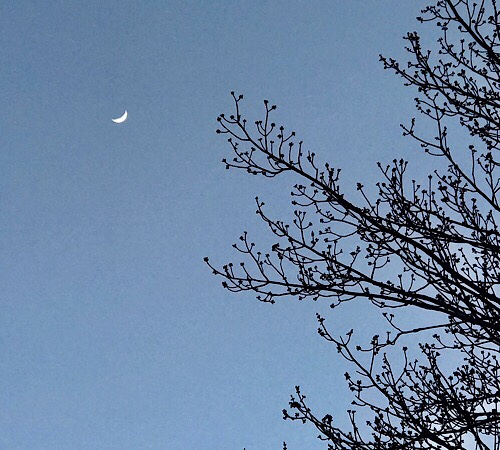
    Though many of the trees have lost their leaves, the spectacular color show continues.  Some of the trees are still sporting green leaves, so there is more to come.  And then will come the time to enjoy the exquisite architecture and shape of the branches themselves against the winter sky–it’s own kind of beauty.

    color 1a color 1b color 1c color 1e


3 Comments

  1. Elizabeth,

    I found our book club meeting engaging, too. Holding our concerns in one hand and the wisdom in the Gita in the other, we were respectful and honoring of both. I see this articulated clearly in your blog. How perfect that you wrote it on ML King’s day who demonstrated another way of dealing with conflict in his words and in his life.

Leave a Reply

Your email address will not be published. Required fields are marked *

This site uses Akismet to reduce spam. Learn how your comment data is processed.