Asana, Pranayama, and Yoga Practice | Community and Family | Food for the Mind (Yoga Philosophy, etc)
Found Exhortation
Arjuna’s project?
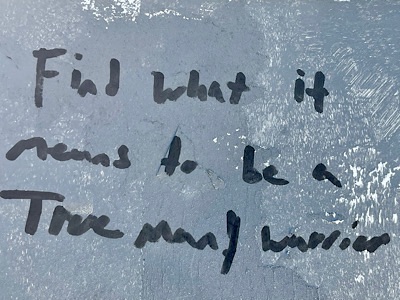
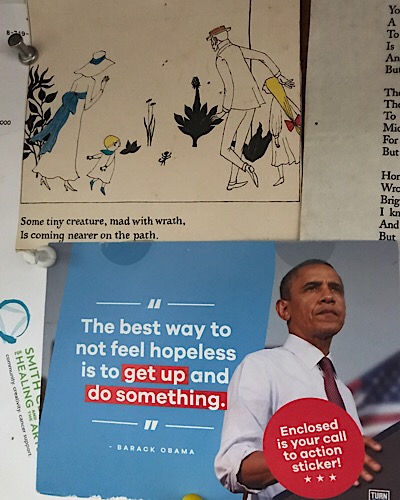
As one who has long been intimate with anxiety, my best remedy is to take Krishna’s advice to Arjuna to heart and get up and do something.
If you don’t get the hoped for results, at least you tried. If there’s success, you’ll be a part of it. If you do nothing, all you have is your anxiety.
Second batch of postcards about to arrive. I don’t know if it will get out enough of the vote, but it feels like it helps create positive momentum.
May you be happy, healthy, and inspired.
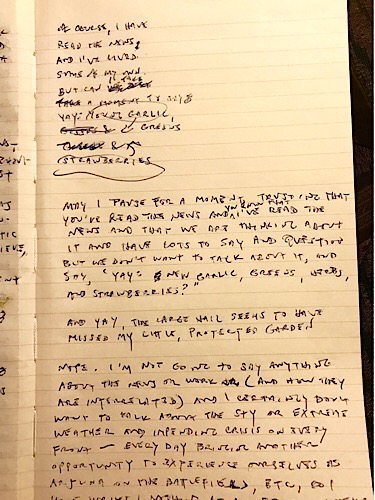
And remember to pause for beauty.

I’m spending the weekend via Zoom with Michelle Johnson, for a “Skill in Action” retreat, where she is creating and holding the space for exploring how we individually and collectively can act to bring more communal justice, through anti-racist action, in our own lives, in the yoga community, and in society. She has been doing anti-racism work for 20 years, and has been practicing yoga and teaching since 2009. She published “Skill in Action,” in 2018. I read it several months ago. She said that she was flooded with orders the weekend after George Floyd was murdered.
What changed? Was it the confluence with the pandemic? Will we engage enough to make this an opportunity for lasting change or will those who are least impacted get weary or bored? What can would be allies do to help make it the former and not the latter?
I’m up late writing this after having spent a couple of hours dancing around and getting ready for tomorrow and contemplating and, of course, playing with Maitri.
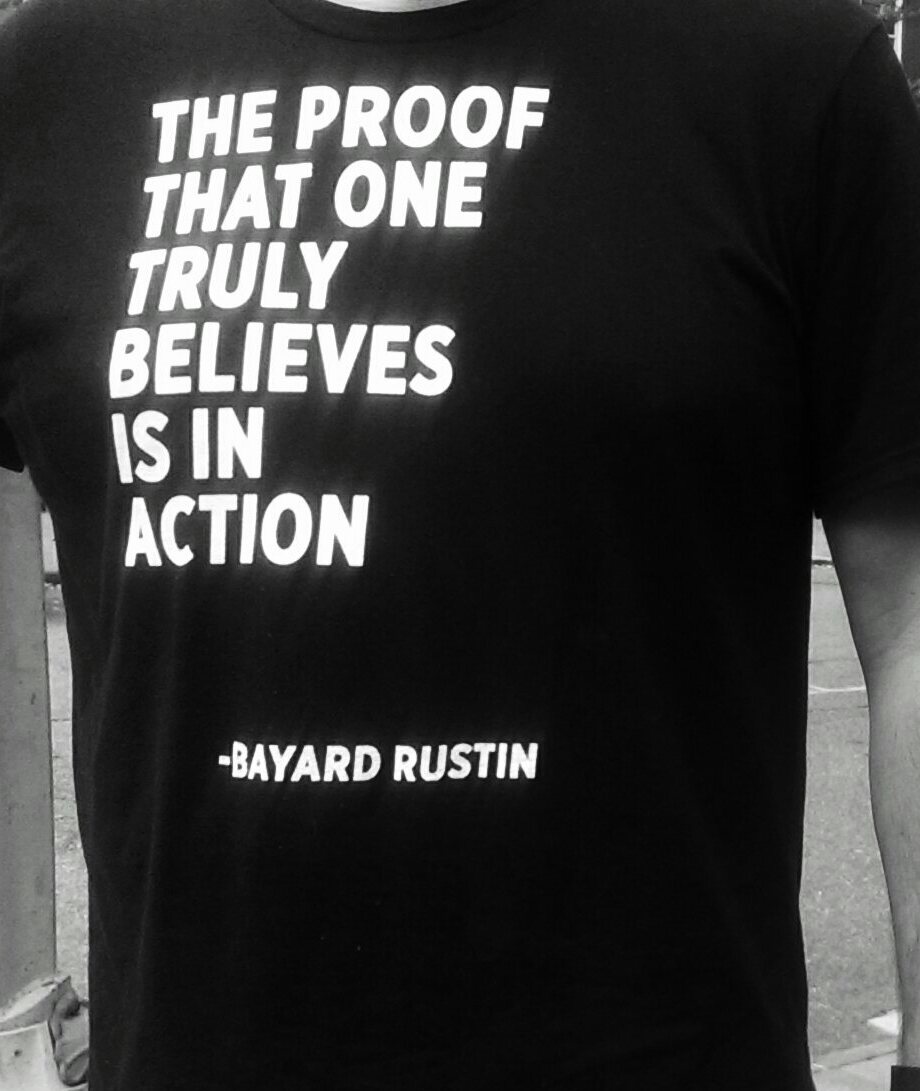
When I was out at lunchtime to run an errand, I crossed paths with the neighbor (or visitor) wearing this shirt. I asked if I could photograph him. He seemed a bit taken aback, but posed for me when I said that I would only photograph the quote. After all, anyone who would walk around Capitol Hill with a Bayard Ruskin quote on his chest would likely want to motivate as many people as possible to think about that quote and act accordingly.
Reading today’s article in the Washington Post, “Women Fight for Access to Sacred Places in India,” and appropo of my recent blog post on Ayyappa, reminded me of what led me to the law. I am conscious that relative to most of the billions of women on this planet, I have had extraordinary opportunities.
I think I have a responsibility to live to the fullest the opportunities I’ve been fortunate enough to have. And I think that part of that responsibility is to make my own contribution to eliminating injustice and to keep working with creativity and dedication and passion, while ultimately, like Arjuna in the Bhagavad Gita and his right action, letting go of the result, knowing I am not in control of any particular outcome or sequence of events.
What is your story? The opportunities explored? The barriers that need not have been there?
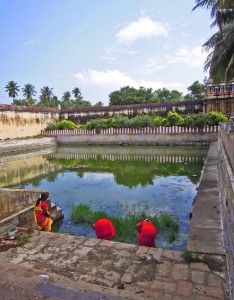
Shakti Pilgrims, Tamil Nadu, India, 12/11

I’m thinking that for karma to work well with “no matter what,” there better be some flexibility in “doing it right,” though not necessarily in doing it rightly.
Last week I took a lovely all-levels yoga class where the emphasis was on fully engaging in the practice rather than striving to achieve a particular outward notion of what the poses should look like.
Near the beginning of the class, but after the emphasis on not striving had already been discussed, the teacher said that the ideal form in uttanasana — standing forward fold — for classical hatha yoga is with the feet together. But, he said, however, he said, but not, the teacher explained, if your back is curved like a “c” in the pose, and your lumbar vertebrae are higher than your sacrum. In that case, you want to take your feet wider apart or you will strain or injure your low back.
As I was fully into the pose, I could see the rows of students behind me. At least two fellow students in my immediate line of sight, promptly put their feet together, even though they had tight hamstrings and bulging lumbar spines and were clearly pushing themselves hard to get their fingertips to the floor. As soon as the word “ideal” was uttered, they could not hear the caution or could or would not apply it to themselves.
The evident intent of the teacher in his exposition of the pose was to give an example where the “ideal” form is most certainly not ideal and will not further the reasons we practice asana. But for so many in this society, striving is such an ingrained way of being, that yoga class can become just another way to achieve.
It was useful for me to witness how carefully one must teach to high achievers this principle of the “ideal” being what suits and not what will win accolades. How do we teach (and learn) the practice of goalless goals, of enjoying working for fitness (of the mind, body, and emotions) without pushing and striving? I’m pretty sure that invoking the principle of actionless action from the Bhagavad Gita would not have made a difference here. It seems a shame to think that the only way to protect all the students’ backs is never to mention the classical form of the pose, and to have to tell all the students (especially in a big class) to have their feet apart (or some similar alignment rule)for protection of the few who do not (or are not yet ready) to hear the whole lesson.

Peace and light, E — Posted with WordPress for BlackBerry.