Bhagavad Gita

  • | | |

    How Do You React? (and Dharma)

    How do you react when you see signs of neglect, disinterest, disregard for the health and well-being of the earth and other beings?  Do you get stuck in a sense of helplessness or rage? Do you think we’re all screwed anyway and decide no effort to make things better is worth it?  Are you moved to political action?  Are you moved to take better care of self, family, and friends, even if you think you cannot make much of a greater impact beyond your intimate circle? Can you remain engaged and still find joy, whatever the apparent immediate results and how hard the battle seems to be?

    The Bhagavad Gita, says that to live a life of yoga, we must do the last of these.  The first teaching from the Bhagavad Gita on this point is that we must live in accordance with our  dharma (duty).  The second teaching, and more important for having peace of mind in a life of duty, is that of “actionless action.”  The true yoga is to live a life of action in accordance with dharma, but without attachment to the outcome (i.e., live in an orderly way, accepting the tendency of the universe to be chaotic). 

    Dharma in the Bhagavad Gita, of course, contemplated rigid roles in terms of livelihood and place in society.  In the paradigm of citizenship in a democracy that does not so narrowly circumscribe one’s livelihood or place in society, I wcould argue that it is all of our dharma to participate as a citizen, voting, speaking out for our beliefs, and otherwise using the freedom we have to live a life that best supports the twins of individual and common good, including not just human good, but the whole ecology in which we exist.  The actionless action part is to keep seeking (without despairing) to make things more in alignment even if the forces against healing, nurture, and alignment seem to conspire against positive results that we will see or actualize ourselves.

    Are you registered to vote?  Have you watered your trees?  Casey Trees reminds us that this week in DC is dry; trees need about 25 gallons of water or 1 1/2 inches.

  • | | |

    Meditate Only for Its Own Sake

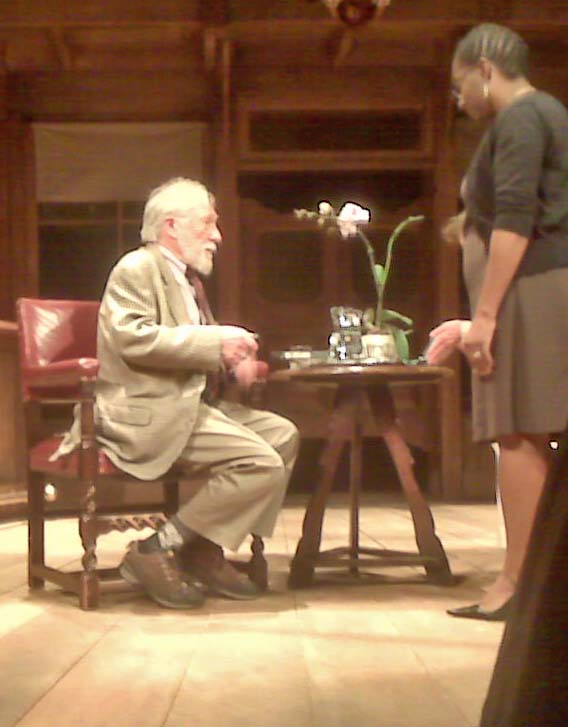
    Last night I had the singular pleasure of hearing Gary Snyder read his poetry at the Folger Shakespeare Library.  At the end of the reading, Mr. Snyder answered a few questions.  In response to one question about advice he gives to aspiring poets, he said:  “Don’t be journalists.  Do hard physical labor that leaves y0ur mind open.”  This is not surprising advice, coming from one who has chosen a life requiring regular manual labor.  “Meditate only for its own sake,” he added, in an apparent non sequitur and without elaboration.

    Gary Snyder’s poetry is evidently influenced by his dedicated study and practice of Buddhism.  The insight and clarity of his poetry surely reflects not only his intellectual study, but the deep wisdom of a dedicated, long-standing, and steady meditation practice.  The advice to “meditate for its own sake” seemed almost the offering of a koan by the master (poet) to his pupils.  Meditation, in my experience, definitely  enhances clarity, insight, creativity, and health.  Meditation is not meditation, though, unless when engaging in meditation that is all one is doing and without any goal (like the “actionless action” of the Bhagavad Gita).  It is the deepest of practices to engage fully, but not be doing except for the sake of doing itself (and in alignment with the deepest truths).

  • | |

    Signs Around Town

    What do you dream of creating?
    Do your dreams include influencing the dreams of others individually?
    What about influencing our collective dreams?
    Is it possible to seek change while simultaneously letting go of control? (An aspect of the “actionless action” that the Bhagavad Gita teaches as a primary goal of the yoga.)

    Peace and light, E — Posted with WordPress for BlackBerry.

  • | |

    Kate Swift, Inherent Sexism in Language, and the Bhagavad Gita

    When I read Kate Swift’s obituary yesterday, it lead me to think more deeply about a recent conversation I had about the Bhagavad Gita.  The Bhagavad Gita, not surprisingly, is required reading for most yoga teachers.  It is an integral part of the history and philosophy of yoga thought and practice.  It is, though, about a battle in the middle of war, in a time and place where a woman’s highest and best (and arguably only role in life) is to be obedient first to parents and then to husband.  Purity, obedience, and beauty (as decided by society) are the great virtues of women.  As a dialogue between a male warrior (Arjuna) and a male incarnation of the deity (Krishna), all of the spiritual and social teachings are presented in terms of men and males, right down to the pronouns.  The translation that was being discussed was that by Juan Mascaro.  As a mid-twentieth century translation by a Spaniard at Cambridge University who has lectured on “Literary and Spiritual Values in the Authorized Version of the Bible,” the translation no doubt perpetuates (without any specific or willful intention to do so) the inherent sexism that is also found in the English language and in the Bible and its notion of God.

    The question raised was how a book that perpetuates sexist stereotypes could be required reading to be a yoga teacher.  (See my previous blog entry on how we, as yoga teachers, can rely on a book that is primarily about war.)  How would it read, it was suggested, if all the pronouns in the Gita were changed from he to she?  The person raising the question said that making this change made the spiritual guidance more accessible to her.  For me, shifting the pronouns from male to female does not address the challenge because I do not believe in spirit that can be given gender.  I read the Gita and other yoga texts in two ways:  (1) as historical and literary/philosophical documents that are products of the author’s time and place in history; and (2) as a source of universal human truths.  The Gita, as a dialogue between a warrior and a male avatar of “God,” does not have much place in the ideals I hold dear.  Neither the caste system nor the roles for women espoused in the text support my own beliefs about equality, justice, fairness, or love.  The extraordinary teachings of yoga, though, transcend the history out of which they arose.  To do justice to the yoga texts — and not just the yoga texts, but the great teachings and texts that are an integral part of our social fabric — we must both recognize their historical context and be open to learning what has transcended history and cultural boundaries to make them living words.

    In attempting to make the shift to a modern interpretation that allows for “feminism,” I know many who try to address some of the challenge for modern readers by saying that we all have characteristics of the masculine and the feminine, and so we can read the guidance in the texts as being valid for both sexes.  The problem I have with that is Kate Swift’s point.  If we label various personality traits and characteristics as being elementally male or female, we are still perpetuating sexism through linguistic bias.  It is not enough for me to make the warrior female and allow her “male” characteristics.  What I think is that all human characteristics are gender neutral.  If the teachings are not to be biased when we as teachers transmit our reflections on the texts to our students (after recognizing how history has done it), then we need to say that all people can be assertive or passive, strong or sweet, rigorous or soft, etc, but not just say that some are masculine and some are feminine and that in having all of these traits to some degree, we are showing that we are both god and goddess, masculine and feminine.

    Or we could just not do any labeling at all, instead concentrating on the truly universal yoga teachings of right action, selfless service, and deep abiding love–none of which have anything to do with gender.

  • | | | |

    Satgurus and Upagurus, Teachers and Teachings

    In Paths to God, Ram Dass speaks of satgurus and upagurus.  A satguru is the true teacher.  The upaguru is anyone who teaches us something, which, when we are truly open to recognizing the good in all, is literally every one.

    The satguru may refer to that within us that is the power, or the essential pulsation, or the light, or the illuminative wisdom, or the heart unbound by space and time that leads us to know the true Self.  As such, the satguru unfolds the means to experience the love that the satguru is/experiences.  The very rarest of individuals do not have to make any effort either through the various yoga practices (yama, niyama, asana, pranayama, pratyahara, etc.) or practices in another spiritual tradition to experience the fullness of consciousness unbound by self, or time, or space.  The rest of us must engage in shifting our lives to align better with nature to experience the highest bliss of being.  For this, we need teachers and we receive, if we are paying attention, teachings.

    Sometimes a person will will recognize the satguru embodied in a particular human form, as Ram Dass has with Neem Karoli Baba.  Sometimes, the teachers illuminating our journey are acharyas, great spiritual teachers who illuminate pathways and practices for finding the satguru within ourselves and in others.  They are important teachers for many and a profound influence, but except to the extent that we are all the satguru, they are not “gurus,” nor do they hold themselves out as such.   I think of my primary teachers–those I have studied with personally and a couple, like Ram Dass and J. Krishnamurti, whose writings have deeply shifted me–as acharyas.  That they may have human foibles does not diminish the power of what I have learned from them and the joy I have experienced and shared from studying with them.

    Other people we meet — all of them — are upagurus; we can learn from everyone and anyone.  That is what Quakers are taught and seek to practice; that is what Ram Dass is offering for us to consider in both Paths to God and in more detail in Be Love Now. Sometimes we meet a stranger just for a moment, but the stranger in that moment exhibits such grace, that the stranger is one of our teachers for life.  It is by being open and spacious that we get the opportunity to recognize those who have just one perfect teaching for us.  When we are closed off, we can miss both teachers and teachings.

    If we are open enough to seeing the light in everyone, we will also find that even those that trouble us can help us better respond in the highest.  Those are the ones Ram Dass calls “teachings” instead of “teachers.”   And those who will trouble us will come.  We will meet someone and that person will push our buttons.  Perhaps the person demonstrates too strongly some behavior or trait we don’t like in ourselves.  What a great teaching that can be.  When I see such a reflection of myself, I know that when I respond or act in similar ways, I am out of alignment, and it is a great motivator to release the behavior or trait.

    Perhaps someone shows up to help us reenact an old emotional pattern that has not served.  That someone is the laboratory upaguru who has arrived to give us the opportunity to discover whether this time around we are able better able to embody the principles that we are studying.  In being faced with our old stuff, we are given an opportunity, by changing how we respond, to dissolve the old patterns (samskaras) that, if not dissolved by practice, commit us to perpetuate the suffering resulting from our past actions (karma).

    Sometimes the upagurus come from the past.  They are seeing you through the filter of their own past and have reappeared for something on their own journey.   In such people, we perhaps get a teaching that reminds us why we are seeking to better align, why we have sought to shift and change old patterns.  We might also meet in an upaguru who has been part of our past someone who has shifted and grown and inspires us to go further on the path, sharing it for a while.  Those who are parts of our life for a long time, I think generally serve as both teachers and teachings, and we are the same for them.

    With regard to everyone we meet, from an embodied satguru to the most troublesome, the more we are open, the more we hold all that we encounter in what John Friend calls “luminous spaciousness,” the more able we will be both to recognize the true teachers and to learn from the teachings.

  • | |

    What Does It Mean to Study War?

    Martin Luther King, Jr. said:   “A true revolution of values will lay hand on the world order and say of war, “This way of settling differences is not just. …A nation that continues year after year to spend more money on military defense than on programs of social uplift is approaching spiritual death.” Still, the Pentagon suggests that Martin Luther King “might” have supported the war in Afghanistan.  Not sure on what basis.

    Last night at the Willow Street Book Club, where we were reading Ram Dass’s Paths to God–Living the Bhagavad Gita, one of my fellows raised the question of how we could read as a spiritual guide a book whose context is war.  Another asked a similar question from the perspective of a feminist.  It was a fabulous, engaged, lively discussion, and I hope to see more next month.

    It would be an injustice to the text and the historical context to read entirely out of the Bhagavad Gita the duty of a warrior to kill, a wife to practice suttee, and persons born into each caste to accept their lot in life in a society structured on the caste system.   There is much richness in the text, though, that can provide guidance for a feminist, pacifist, who believes that “all men are created equal.”

    We have reread “men” in the Declaration of Independence to include women and those of all races (though we cannot manage to rewrite the Constitution to explicitly state that women are equal, but that’s a thought for another day).  Similarly, without doing injustice to the text, we can see that the ultimate teachings about living in accordance with duty (svadharma), love, devotion, and sacrifice in the Gita, like the concepts of “life, liberty, and the pursuit of happiness,” provide guidance and force for social action and spiritual devotion beyond a historical context that oppressed and bound on the worldly plane the very persons who are now seeking the deeper meanings in the text.  In fact, I believe that we can use the essential intent of the text to teach and transform the oppressors, to use the very text to show why the violence and oppression of the historical context is injust and needs to be changed so that the spiritual intent can be expanded and spread beyond the privileged.

  • | |

    Another Encroachment on Individual Liberties (and Arjuna’s dilemma)

    When I was waiting for the metro to go to Willow Street Yoga this Saturday morning to offer a free gentle/therapeutics class (new session starts for the class next Saturday, January 15th–all welcome), I heard a very disturbing announcement on Metro.  I only take Metro once or twice a week.  I am pretty certain I would have noticed it if I had heard it before; in rush hour, of course, it is hard to hear the announcements when the platforms are full.  What I heard was this:  “Metro police have advised that all passengers are subject to random searches of their carry ons.”  A reasonable person might want to know what is a “carry on” for these purposes.  My first question to myself was “don’t random searches of this type violate the Constitution?”  (Yes, the American Civil Liberties Union is actively engaged in the issue).

    I find random searches just for boarding the metro with a carry on an unfortunately not particularly shocking example of how far we have allowed the “war on terror” to be waged against all of us.  Perhaps there are readers of this blog who are not shocked or perhaps believe that these searches are warranted; I am open to listening to why.  I know that it was not front page news, and my friends have not been talking about it.  This was just another one of those awful things we have started taking for granted, which is something that I hope is getting progressively harder to do.

    My biggest question for myself was what I would do if the police asked to search my handbag.  The odds are slim to none that “random” would in practice include a reasonably well-dressed, clean, small, middle-aged, middle class, fairly evidently American-born, white woman.  But what if random was really random and I happened to be in the wrong place at the wrong time?  Would I refuse to let my bag be searched on principle?  Would I be willing to lose my job and possibly go to jail for my conviction that such a practice misses the mark completely for its intended purposes and tears at the very fabric of a free society and our individual liberties?  I find that I do not know the answer.  Partly it is attachment to my own security.  Partly it is that I do not know whether it would be better just to allow my bag to be searched and not engender conflict than to engage in conflict that will certainly harm me, severely limit my ability to give financial support for important fights and causes, and potentially could harm others around me, even if ultimately, with the help of many I am sure, I were to be a participant in reason prevailing and the practice ceasing.

    In thinking about how unsure I was of my ability to act if I were to be put to the test, I was reminded of the situation at the beginning of the Bhagavad Gita, where Arjuna is paralyzed by inability to act in the face of the hideous spector of violent death and destruction that would result from going to battle even to rectify an injustice.  Arjuna looks out on the battlefield where battle is enjoined because of the injustices that have been done (we’ll leave it for another day as to whether the violations of law in the Mahabharata are ones that a modern thinker might agree should give rise to the epic battle in the Bhagavad Gita.)  Krishna explains to Arjuna that it is his dharma to go to battle; he is a warrior and these wrongs must be rectified.  The general day to day principle that governs the life of a yogi — ahimsa or non-harming — is trumped by the greater need to rectify the societal injustice.  Arjuna must join in battle because leaving the injustice uncorrected will in result in greater harm to the order of society, even the cosmological order itself.  See Stephen Phillips, “Yoga, Karma, and Rebirth” (discussing the interrelationship between the individual practice of ahimsa and the need for cosmological order in Indian philosophy).

    I am not likely to be put to the test here, but that is part of the evil of the practice.  What can I do?  What should I be doing in the face of a direction in society that gives rise to policies like these and the gunning in Arizona yesterday?  It takes great discrimination (viveka), more perhaps than I have, to know how and when to act.  I do know that it is not right for me as a citizen or a yogi to stand aside.  I offer this very public statement of my beliefs and I gave a generous donation to the ACLU yesterday.  I am sure that is not enough, but it is a start.  As our society moves in the direction it is moving, more and more of us must contemplate, evaluate, and begin to expand how we act and participate to see a world where ahimsa is not just personal, but all persons and beings have the possibility of being free from suffering.

  • | |

    Thoughts on Democracy (and “Actionless Action”)

    My friend Dan posted some interesting thoughts about democracy on his blog.  He is writing in the context of the Unitarian Universalist community, but the thoughts are equally applicable to our lives as citizens.  The thoughts on democracy also for me highlighted what is really meant in the Bhagavad Gita about “actionless action.”  To embody our spiritual practice in the way we live our lives, we serve to our best ability out of love, out of delight in acting, out of a sincere joy in serving, but we do not get attached to a particular outcome.

  • | |

    Julie and Julia (and “actionless action”)

    I went to see Julie and Julia because I, like most other Americans of a certain age who like food, have a history with Julia Child.  Seeing the movie brought back an episode from junior high school.  By seventh grade, I was pretty competent cooking, cleaning, babysitting, and doing needlework.  Being a feminist in training, I wanted to take shop.  Mr. Murphy, my ancient (OK who knows how old he was, but he was gray and bald and had leathery skin, so he was likely over 50 at the time) guidance counselor refused:  “shop is for boys; home economics is for girls.”  I expected my mother to back me up, but for some reason she did not.

    I had no interest in making rice crispy treats, which was not the kind of thing we cooked at home and was the kind of thing they taught in home economics.  Part way through the year, when we were told to cook a whole dinner at home and then bring in a report, I decided to cook from Julia Child.  I am sure the meal was perfectly delightful, but the motive on my part was not to make a delicious dinner for the family, but to show my guidance counselor and parents that I should have been allowed to learn something that I did not know how to do and could not learn from a book (woodworking and other “shop” skills).

    I enjoyed the movie (it’s a pleasant couple of hours and Meryl Streep is wonderful), but the interesting after thought for me was the difference in the happiness of an individual depending on motivation in life choices.  Is something done for joy (with recognition being delightful, but somewhat incidental) or is it being done because one needs recognition and then feels satisfied on getting it?  From a yoga perspective, is it “actionless action” (see Bhagavad Gita)  or is it acting out of a need to fulfill the ego, which inevitably binds one in the fierce dichotomy and inner tug or war of the opposites of longing and gratification, pain and pleasure?

  • |

    Dreams (and Maya)

    In classical yoga systems, we are taught that all the world is an illusion (maya) and the only thing that is “real” is Atman (spirit, the One).  I do not subscribe to that belief, but I do believe in the principle that is espoused in the Bhagavad Gita of actionless action — working because it is my nature to work, but accepting that I ultimately am not in charge of the results.  I thus can be fully engaged in my work, but be freer of anxiety, disappointment, and frustration or overcharged attachment to pleasure and success.  From a tantric perspective, I believe it is all real and full and something to be experienced as part of the marvelous complexity of being.

    This principle carries over into my relationship to my dreams.  I have always had extremely vivid and present dreams most nights.  Sometimes, like last night, my dreams are full of convoluted challenges and difficulties that could be filled with anxiety.  I used to chew on dreams like that through the day.  Now I wake up and think:  what an amazingly inventive mind I have.  Isn’t the subconscious fascinating?  I pay attention to what lessons might be in the dream  and let them release the dreams from holding on to my day.  As I get more skilled with meditation and yoga, I often can find this place of simultaneous engagement/non-engagement even while I am still dreaming.  This makes it so the dreams have no more hold on my ability to sleep or act than would watching a movie that raises challenging issues.