| | |

The Great Game: Afghanistan

I am writing this from the terrace area of the Shakespeare Theater, in between parts two and three of “The Great Game: Afghanistan.”. It is a testament to the quality of the writing, acting, and production that we still feel ready for the third set of plays. What “The Game” emphasizes, whomever authored the segment or what moment in history is being emphasized is that we are all connected and that if we do not learn from our history, we are destined to repeat ourselves and so suffer.

I am certain that there is little that I can do as an individual to prevent history repeating itself in Afghanistan (though I write letters to President Obama on occasion). I can, however, pay attention to the lesson here with regard to my own, individual life. I can strive to unravel and dissolve old patterns from my history and to create new patterns that will better serve me. In asana practice, I seek therapeutically to realign the physical body and the energetic body so that old pains and struggles do not continue to interfere with my living as fully, joyously, and expansively as I can in my body. Through meditation, I seek to know the true joy of being and to have the light of consciousness illuminate how I respond to people and events. When I can do this, I have the choice not to create new hurts and problems that are just like the old ones.

What I know from my own practice and life is that not repeating history is hard, but it is what gives the possibility of living in true freedom. Is it enough to work on just my own self not repeating history? Do we need to try and bring shifts to larger patterns to truly be of service? I do not know the answer to the latter question, but I do know that the duty to try and shift myself is not just for me, but extends beyond me, like the ripples extending out from a pebble thrown into a pond.

Similar Posts

  • | | | |

    Signs Around Town (My First Time Out of the House in Two Weeks)

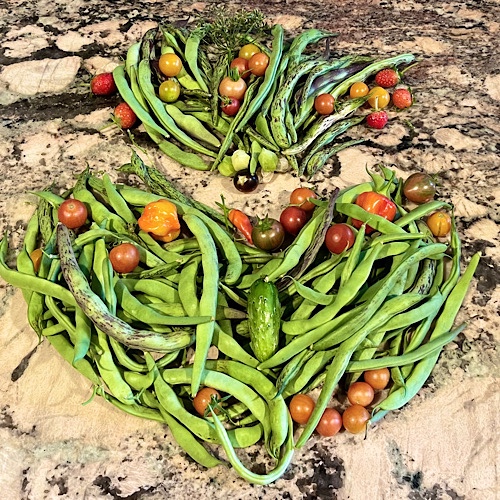
    Was to visit and get seedlings to fill out the garden at Cultivate the City (cultivatethecity.com, @cultivatethecity).

    What kind of society do want as we come through the pandemic (recognizing the privilege it is to be able to ask this question)?

  • |

    What Students Hear

    Last week I took a lovely all-levels yoga class where the emphasis was on fully engaging in the practice rather than striving to achieve a particular outward notion of what the poses should look like.

    Near the beginning of the class, but after the emphasis on not striving had already been discussed, the teacher said that the ideal form in uttanasana — standing forward fold — for classical hatha yoga is with the feet together. But, he said, however, he said, but not, the teacher explained, if your back is curved like a “c” in the pose, and your lumbar vertebrae are higher than your sacrum. In that case, you want to take your feet wider apart or you will strain or injure your low back.

    As I was fully into the pose, I could see the rows of students behind me. At least two fellow students in my immediate line of sight, promptly put their feet together, even though they had tight hamstrings and bulging lumbar spines and were clearly pushing themselves hard to get their fingertips to the floor. As soon as the word “ideal” was uttered, they could not hear the caution or could or would not apply it to themselves.

    The evident intent of the teacher in his exposition of the pose was to give an example where the “ideal” form is most certainly not ideal and will not further the reasons we practice asana. But for so many in this society, striving is such an ingrained way of being, that yoga class can become just another way to achieve.

    It was useful for me to witness how carefully one must teach to high achievers this principle of the “ideal” being what suits and not what will win accolades. How do we teach (and learn) the practice of goalless goals, of enjoying working for fitness (of the mind, body, and emotions) without pushing and striving? I’m pretty sure that invoking the principle of actionless action from the Bhagavad Gita would not have made a difference here. It seems a shame to think that the only way to protect all the students’ backs is never to mention the classical form of the pose, and to have to tell all the students (especially in a big class) to have their feet apart (or some similar alignment rule)for protection of the few who do not (or are not yet ready) to hear the whole lesson.

    Peace and light, E — Posted with WordPress for BlackBerry.

  • | | |

    Signs Around Town

    A friend emailed me today that her children will be home for rest of the week because their schools lost power from Sandy, and that she is counting her blessings because she and her family came through fine. My parents, who lost trees, including one that went through the roof of their house, are counting themselves well off because they witnessed how bad it could have been. In contrast, some others I know who didn’t experience any real inconvenience to themselves personally though in danger range have said they thought the storm had been “over-hyped.” (I know, being exposed to silly statements such as the latter is a peril of social media).

    Do we need to know hardship ourselves, at least a little, in order to have true sensitivity and compassion? Possibly.

    To all my friends and family challenged in the wake of Sandy or going through another challenge or hardship, please know that you are in my thoughts.

    Peace and light, E — Posted with WordPress for BlackBerry.

Leave a Reply

Your email address will not be published. Required fields are marked *

This site uses Akismet to reduce spam. Learn how your comment data is processed.