| | |

The Search Continues (based on some dreaming)

In 2000 or 2001, shortly before I started practicing Anusara yoga, a teacher who regularly played music in class, played for us a recording of Alice Coltrane singing a tantric chant to Siva and the Goddess Bhuvaneshvari.  I only heard the chant once while we were in savasana — corpse pose/final relaxation.  Although I only heard the chant once, for several months afterwards, I found myself having a recurring dream that I was wondering in a neighborhood that looked like the one where I grew up and went to high school and chanting the full chant.  At the time I merely found it curious that I seemed to have learned the sanskrit just by hearing the chant one time.  I have since learned that the recording may have been done right near my high school; that is where the Coltrane’s had a recording studio.  I also learned that the chant was a tantric chant.  At the time, my teachers were coming from a classical yoga perspective.  Did I actually learn the chant by osmosis?  Was having the very vibration of the chanting near where I lived and studied the catalyst for me, as a receptive being, discovering a path of tantric yoga?

I have found other recordings of the chant.  One is Atman’s “Dancing to the Goddess” on the Eternal Dance CD, which is an electronica version.  The other is Ragani’s “Om Mata” on the Best of Both Worlds, which is a very nice kirtan/pop version.  I have several of Alice Coltrane’s recordings, which are great jazz, if you aren’t familiar with Alice Coltrane as a fabulous musician in her own right.  Recently I searched again on the internet to see if the bootleg had become available.  There was nothing on YouTube (though some good Alice Coltrane things to watch).    I bought Alice Coltrane’s “Radha-Krsna Mana Sankirtana,” which was originally recorded in 1977 (when I was in high school) and reissued in 2005, as I thought that was a promising source.  It has some good things on it, but no luck finding the recording I wanted to hear.

The chant goes like this:

Samba sadasiva, samba sadasiva, samba sadasiva, samba shambo.

Om mata, om mata, om sri mata, jagade mata.

Om bhuvaneshvari, sri bhuvaneshvari, hari parashakti, devi bhuvaneshvari.

It is a chant to the benevolent, auspicious one within, the radiant goddess, the creatrix of the world.  Bhuvaneshvari is one of the ten wisdom goddesses.

Please advise if you have access to the Alice Coltrane or another recording of this beautiful chant.

Similar Posts

  • |

    Prop or Crutch

    “Liberty” is again encased in scaffolding, though it hasn’t been that long since she was taken down for a good cleaning. Seeing her thus supported while simultaneously blocked led me to think about the use of yoga props.

    I am a big fan of using props to discover places one thought out of reach, either because an injury is limiting range of movement or because intelligent or inspired use of a prop can teach where the next step could be in practice.

    Liberty’s scaffolding might be necessary for structural repairs or cleaning, but it is obscuring the view–her view out and our view in. We wouldn’t want her bound and stuck unless it was truly necessary for her full beauty and integrity to be maintained and revealed.

    So, too, with yoga props. As beneficial as they can be, we do not want to rely on them automatically without seeing whether we can open to and discover the full flourishing of ourselves in a pose without them by being open, sensitive, and discriminating about our physical boundaries; applying the alignment principles to the fullness of our knowledge; and using just the right amount of effort.

    By all means use props, but use them to find and witness new freedom (ultimately, svatantriya) not to bind or obscure it.

    Peace and light, E — Posted with WordPress for BlackBerry.

  • | | | |

    Another Self-Induced India Photo Flashback (Roadside Temples)

    Another self-induced India photo flashback after a long work day reading and writing at the computer with breaks only for shoveling snow and for eating and cleaning up.

    We were traveling on the bus when I saw the Durga temple (the fifth photo–the one with the white glare and flat sky, but an incredible Durga).  I suggested to my seatmate that he take a picture with his better camera.  I recall it quite reasonably and correctly being pointed out to me the flat, white heat of the midday, humid sky and the glare off of the window would make it impossible optimally to show the intricacy and vividness of the temple.

    I snapped a picture anyway.  I was seeing things at angles coming and going and with whatever the light was at the moment.  I likely wasn’t ever going to be there again and certainly not any time soon.

    Sometimes the bus would pause in just the right place for a perfectly composed shot, but mostly it didn’t.  In this, the act of taking these photos was much like other aspects of life and practice.  Our path is not always certain.  Sometimes it is hard to see because there is too little light or too much.  Sometimes we have something obscuring our vision.  Sometimes we are going too fast and only notice just before it would be too late for that turning.

    But even with vision turned or obscured, we are always experiencing something.  How can we make the best of each moment of experience?  For me, it is meditating and bringing the spacious awareness of meditation to what I am witnessing.  Taking photographs helps me witness in a certain way, too.

    roadside temple 1a roadside temple 1b roadside temple 1c roadside temple 1d roadside temple 1e roadside temple 1f roadside temple 1g roadside temple 1h roadside temple 1i roadside temple 1j roadside temple 1k roadside temple 1l

  • | |

    Happy, Overly Optimistic, or Just Plain Crazy?

    It’s not something I see everyday: a whistling old man sticking his thumb out for a ride. Pretty sure the first ride he will be offered (or would actually take) is the bus, but I imagine he will be happy with that.

    I have no idea what was going on in his mind. Witnessing him made me hope that the older I get, the happier not only will I be, but will be my recollection of the past, however crazy I might appear to be.

    Peace and light, E — Posted with WordPress for BlackBerry.

  • |

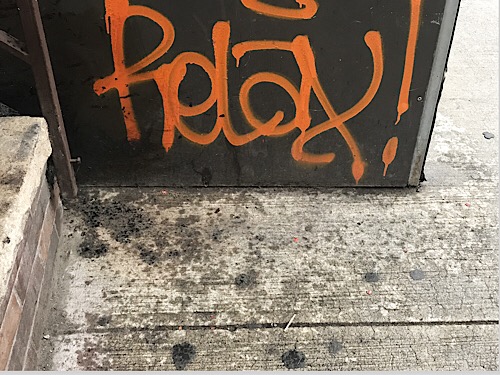
    “You Seem Pretty Mellow,”

    said the guy who is doing the exterior painting and repairs to me this morning, after we were talking about what needed to be done with the stairs, and we talked a little to the downstairs resident who was on his way out to work.  Then he paused, after thinking about what he had seen of my house and garden and added, “unless it is cultivated.”

    “Yes,” I replied, “it is cultivated.”  I will never be completely easy-going, but at the same time as some might wish me more easy going, one of my strengths is my attention to detail and my ability to create order.  I cultivate, though, an ease with necessary disorder — the disruptions that come hand-in-hand with construction, repairs, creation (art, kitchen, garden, home), growing relationships, and comfort where I am.  We may not be able to change our nature, but we can make shifts that ease our being.  Radical affirmation in yoga is accepting our tendencies, but then seeking shifts to make life even fuller.

One Comment

Leave a Reply

Your email address will not be published. Required fields are marked *

This site uses Akismet to reduce spam. Learn how your comment data is processed.