| |

State of the Garden

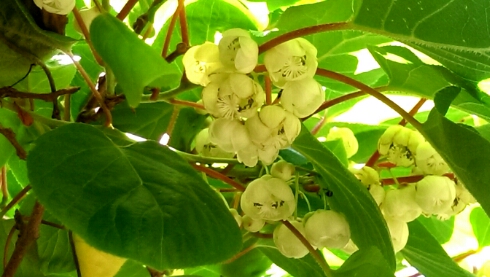
The polar vortices must have been good for the grape kiwi. After years of being barely productive, it is flourishing wildly. 

Sometimes it takes, as we can learn from mindfully practiced yoga asana, a stressor to stimulate growth or needed change. It isn’t stress that holds us back, but distress.

As for the kiwi vine, even if the birds get all the fruit, I still had the delightful scent of the flowers.

image

image

Similar Posts

  • | |

    Kvelling and Kvetching

    It started before yesterday’s Tuesday night class.  There was a piece of fuzz next to one of the students mats–a schmutz.  We then decided that the yoga outfit, especially the old raggedy one, was a schmata. Tonight, I was in an uncharacteristically silly mood.  With birds falling out of the sky, fish washing up on the shore, and the Republicans taking back “control” of the house, I could weep or I could find the laughter in small things.  Tonight, with a practice theme of the Anusara’s “first principle” — opening to grace — I spontaneously and giddily came to the latter.

    I mentioned the idea of yiddish for yogis, and the class took off.  We were all women tonight, so it was “yoga for yentas.”  The word one utters when going into the first forward bend of the practice, is of course, oy, which can be lengthened to oy vey is mir. When we are truly opening to grace, we are kvelling; when we are noticing our aches and pains and forgetting to move towards the good, we are then kvetching.

    Just FYI, I learned after doing a cautious internet search before posting this blog entry, that it turns out that the phrase “Yiddish Yoga” has been trademarked.  I am pretty certain we can still have fun talking about using yiddish vocabulary words in yoga class without violating any laws, though it has been over 20 years since I took class in copyright and trademark law.  So feel free to think of your favorite yiddish word and how it should be used in yoga class.  You never know how it will enhance your practice, for whom it will bring a smile or a laugh, and what other thoughts might arise.  I’m pretty sure that there isn’t a yiddish equivalent for satcitananda, any more than there is an English equivalent for weltanschauung or schadenfreude, or a French word for sandwich, but at least one student wants to give it a try.

  • | | | | |

    Observing Another Storm Pass without Raining (and a moment of truth)

    The third front in a row.  It is starting to be a long while not to rain in the summer.  It is a tough gardening year:  extreme drought conditions all winter, overly cool and wet spring, now no rain again.

    Watching how the erratic weather patterns are impacting my garden, I am reminded that I am not a purist about gardening or food or my impact on the earth.   As much as I enjoy tending my garden and eating its fruits, there is no hesitation in my mind that if my garden does not produce, I will buy more food at the farmers’ market.  If the pickings are slim at the farmers’ market because of local conditions, I am in no doubt that I will buy food from whatever source, even if I try to make sure it is first local, then humanely picked, then organic.

    When I write about gardening and eating and yoga, I am sharing what I enjoy, what makes me feel healthy.  I do not think of myself as trying to set an example.  In some senses, my yoga practice is similarly about what works for me personally and no more.  The yoga teachings are fairly clear that the design and purpose of aligning with the subtle energies, including living in a more peaceful, less destructive way, is for the enlightenment of the individual practitioner and not for “making the world a better place.”  If by seeking to live in a healthier, more aligned, more peaceful and compassionate way ourselves also brings more global benefits, that is a bonus.

    Looking at our lives from this perspective could cause discouragement.  I hear this question all the time:  “why should I change what I am doing [consuming/eating/driving]?  My behavior is not going to change the world when there are all of those billions not changing.”  In some senses, looking at shifting our behavior from a completely selfish perspective makes it more accessible and meaningful.  If we see our choices having the possibility of making ourselves healthier, happier, and more at peace with ourselves and the world around us, why would we not want to try to live more consciously?

Leave a Reply

Your email address will not be published. Required fields are marked *

This site uses Akismet to reduce spam. Learn how your comment data is processed.