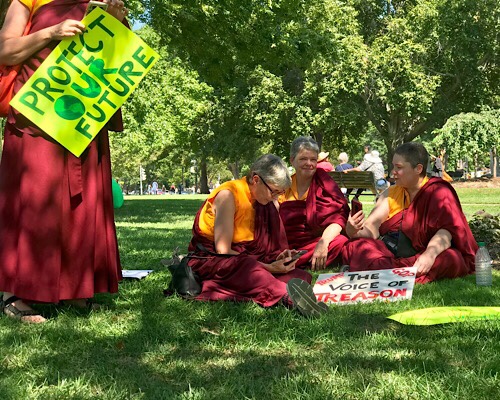
Nuns Practicing
During last night’s yoga practice, we were exploring how advanced yoga postures such as headstand drop-overs could have therapeutic applications. If the practitioner is able to do the poses preparatory to the pose (for headstand drop-over to be accessible in a healthy way, the yogi should be able to do dwi pada vipariti dandasana and, of course, sirsasana, in good, easeful, steady alignment), then the pose can be integrating and healing for the shoulders and strengthening for the neck. For those with little cervical curve, really working to lengthen the side body, integrate the shoulders, and radically melt the heart (which is what is necessary to get into the pose), can help develop the cervical curve. Done out of alignment, the headstand drop-over risks the shoulders and neck–the very parts of the body that would be healed and strengthened if the pose were done in alignment–are at risk of injury.
Four or five years ago, I was at an advanced intensive with John Friend where he likened advanced asana practice to digitalis. Digitalis, which is a beautiful flower, is one of the most poisonous plants in the garden. Taken the wrong way, it can make you very sick indeed. Properly distilled and administered in just the right dose, digitalis is one of the most powerful and curative heart medicines available.
When we approach asana, especially the more physically challenging postures, with great respect, care, and discernment, we can not only benefit from its extraordinary healing and life-expanding powers, but revel and delight in dancing in our bodies. If we approach asana without honoring ourselves and the power of the practice, however, we put ourselves at risk and we fail to realize the benefits that are possible.
I saw this beautiful roll of chicken wire in the Enid Haupt garden when I was walking back to the office after a quick visit to see the Gods of Angkor exhibit at the Sackler Gallery (sorry about the absence of links; blogging from the BB).
I was first introduced to the idea of “found poetry” in junior high school and have developed a life-long habit of photographing words to change, enhance, and/or question their meaning and hidden beauty by the act of extracting them from their original place and presenting them as a photograph. Marcel Duchamp and others did what poets and photographers were doing with words with ordinary objects by presenting them as sculpture.
Here, where I have photographed the chicken wire roll, is the art a sculpture (because I could treat it as such) of which I have taken a photograph–the photograph being mere documentation? Is the art the photograph of what I have seen to the extent I am offering it as a vision and a dialogue generated by what I saw? Or is the photograph merely a snapshot taken with a hand-held computer device documenting an object that happened to be sitting there–not art at all? If it were not for artists such as Duchamp, could I or would I even be able to ask this question?
I think that analogous types of questions have been and can be asked about the variety of religious and mystical experience. Is there a particular way they must be experienced? Do such experiences have to fit within a prescribed framework to be valid? When are such experiences madness or delusion and when are they the voice of the spirit? Who gets to decide? Does it depend on the era and the culture in which the experiencer lives? Does the answer to any of these questions matter if the experiences lead one to a more loving, compassionate, and beauty-filled life?

What do you first notice when you look at this photo? What do you notice next? Do you find yourself making aesthetic judgments or comparisons? What about moral judgments?
Is it possible truly to witness without judgment? To see the good (or at least the potential for good) in everything, even if it does not please us or fit in with how we would like the world to be?
Peace and light, E — Posted with WordPress for BlackBerry.
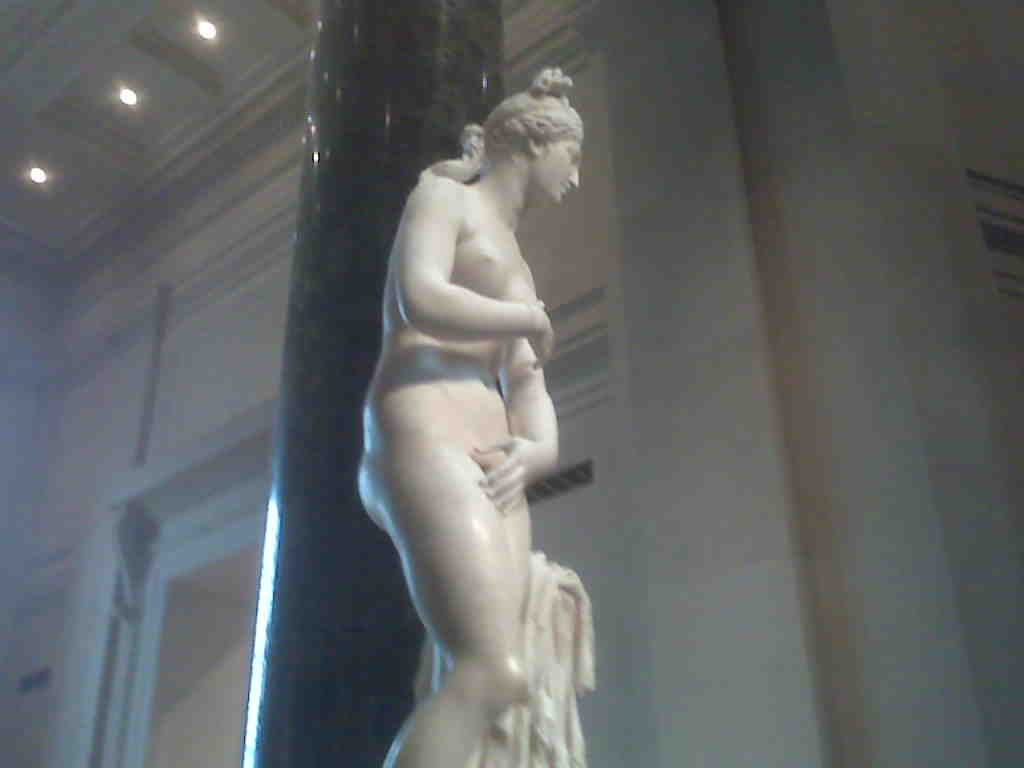
The Capitoline Venus arrived in DC last week from Rome–the first time this circa 200 CE sculpture has been out of Rome in nearly 200 years. What makes it especially beautiful is the apparent softness of flesh of the cool, carved marble, the seeming etherealness of the ancient solid stone.
Looking at the Venus made me think about how carving in stone can help us understand the concept of sruti. The hindu scriptures generally are classified as either sruti (revealed) or smriti (remembered) and until recent centuries were passed on through oral tradition. Those scriptures that are sruti are said to have been revealed by a divine source to the original listener. They were already there as part of the wholeness of the universe and then manifested to a particular enlightened being in a way that could be witnessed and passed on. The essence of the text was always already present, but not tangible, until it was revealed in the mind of a listener, who then passed it on.
Carving in marble takes both the emergence of idea and form in the mind/imagination of the artist and the revealing of that idea from the original stone by the craft of the artist. The sculptor has studied and practiced art and is always open to the emerging into consciousness of a particular image or idea, just as the great yogis continuously meditated and studied, open to what might be revealed.
As the sculptor may find the block of marble first or have the idea and then go looking for the right stone to express the idea, the yogi pulses between experiencing spirit and enhancing the experience through practice. It is not just an act of imagination that builds and creates something out of nothing. To some extent, the form of the final sculpture is already there in the stone. The work of the artist is to remove that part of the stone that is obscuring the witnessing and expression of the exquisite shape revealed from within by the educated and painstaking act of making art.
Peace and light, E — Posted with WordPress for BlackBerry.