| |

Questions Around Town

A yogi might consider whether wanting to answer “yes” to this question (no matter the circumstances of our dying death) is a major goal of a steady practice.
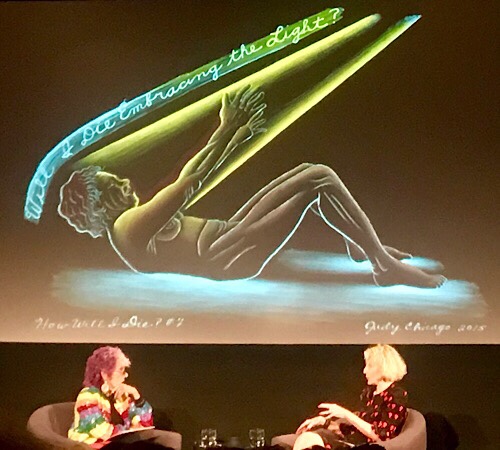
Judy Chicago and Martha Nussbaum, Fresh Talk, at the National Museum of Women in the Arts, 9/22/19

Similar Posts

  • | | | |

    February News–Bring on the Light (Web Version of E-Newsletter)

    Dear Friends,

    Brrr.  It’s cold out there.  And if it is seeming colder than usual, you are right.  There have only been five winters on record with fewer days above 50F in Washington, DC.  Perhaps, like me, you have noticed that you are feeling just a tad sensitive or edgy or maybe a little blue.  I recognize the symptoms; in my distant past, a therapist suggested that I might have “seasonal affective disorder.”  My prescription for myself when winter has me feeling down?  Do more yoga, keeping a focused intention on cultivating the light of inner awareness.

    The form of meditation I practice is intended to allow the practitioner to rest in the light of inner awareness.  One of the aspects of the Anusara principle of “opening to grace” for me is to open to the light in myself and others.  On a more physical level, backbends will open up your heart and make room for the light; core work will warm you up by stoking the agni, the inner fire; forward bends will help you go deep inside to find your own light.  There is a light-filled practice for every day of the week, every time of day, and every mood you are in.

    Avoid the temptation to huddle inside, eating too many carbs and hiding away.  When the sidewalks are passable, bundle up and take a long walk.  When you come back inside, do a good therapeutic and restorative practice–it’s as good as hot chocolate (and no one said you couldn’t have the hot chocolate, too).  Invite friends over for a potluck.  Cook bean soups.  Have hot cereal for breakfast and perhaps for dinner.  Balance the warm food with the freshest of fresh food by growing sprouts on the kitchen counter.

    Want to light up your yoga fire, sun, inner light with company?  Join me and your friends and neighbors at William Penn House classes on Tuesdays at 6:30.  Need a little R&R or found you have tweaked something shoveling or walking on the ice and snow?  Drop ins are always welcome at the gentle and therapeutics class at Willow Street, Takoma Park, Saturdays at noon.  Give yourself something to look forward to by signing up in advance for the second “Relaxing Into Optimal Alignment with Anusara Restoratives” workshop at Willow Street on Saturday, February 26th.

    And plan for Spring with “Yoga for Gardeners,” the weekend of the Spring Equinox–yes, it is only weeks away.  As has been my practice in previous years, my profits will go to support the Youth Garden at the National Arboretum.

    Looking forward to sharing, expanding, and delighting in the light with you soon.
    Peace and light,

    Elizabeth

  • |

    Mahabhutas (the great elements)

    The mahabhutas are the grossest, most physical of the 36 tattvas described in Kashmir Shaivism.  They are:  prithivi — earth or solidity; ap (or jala) — water or liquidity,  agni (or tejas) — fire or formativity; vayu — air;  akasha — space.  When we practice asana, we can focus our practice on discovering one of the elements in our bodies and how we move.  As we get more skillful, we can choose which element seems out of balance and emphasize one or the other to bring ourselves more into balance.  This week, for example, I have noticed that my mind has been scattered and distracted because of all of the excitement of the Inauguration.  After being blown about by the cold and the wind and all the excitement, I had gotten to airy (which is my tendency anyway).  It is a good time, therefore, to explore prithivi (earth) in my practice.  By emphasizing a strong foundation coupled with the Anusara principle of muscular energy, I can literally bring myself to a more solid, stable, and grounded state.

    We can work with the tattvas as described above, to realign our energies so that our physical and mental state is more balanced.  We can also explore the more concrete tattvas as we embody them to understand better how they are manifestations of the subtler tattvas — the tattvas that the great yogis who have described them would call more real and we dwelling in our bodies and minds might think of as observably less real.  Where we can best appreciate and experience the relationship between the gross and the subtle elements is in meditation, and our asana practice can help lead us there.

    Look forward this week to working with the earth element in your bodies and minds, practicing strong standing poses and shaping your physical and energetic bodies like clay.  Use your earth nature to sculpt the art of your intention.

    For suggested readings see my earlier post on the tattvas.

Leave a Reply

Your email address will not be published. Required fields are marked *

This site uses Akismet to reduce spam. Learn how your comment data is processed.