Signs Around Town
Walk quietly and meditatively to the National Gallery’s East Wing right away if you have not yet seen the Rothko in the Tower exhibit and you are in town. Exquisite. I have been many times while it has been open (one of the best things about my job is its proximity to the National Gallery, allowing me to go visit a painting or two at lunch), but have left if more than a couple of people are in the exhibit with me. Sometimes it is others who appreciate the subtleties and then we get the joy of communal appreciation and connection. More often with a group of visitors climbing the steps to the Tower gallery space, it is tourists who come up, see that the paintings are mostly black and loudly exclaim that they don’t get it. The act of not getting it without effort tends to make them louder and more inclined to just chat about whatever and not look at the art. When I find an art exhibit that is not to my taste, it is my practice (as I was taught) to make an effort to appreciate the technique and intention, if not the aesthetics, and then move on with some insight gained for the broader art world–knowing there is another opportunity just down the hall or the street for me to find deeper delight and inspiration.
The nuns were out practicing again.
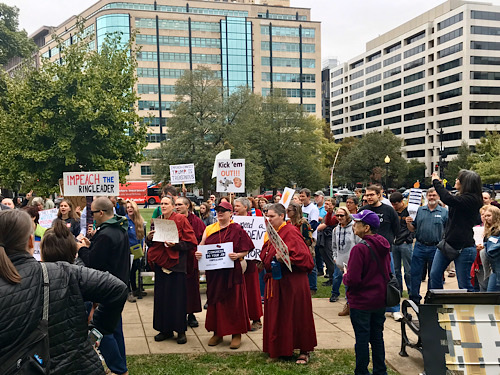

What seems brightest, or biggest, or most important is a matter of perspective and degree of understanding (or lack thereof).
Last night I was feeling deeply sad not having Becky with me any more. The first week, I was telling myself how lucky I was to have had her for so long, that she lived a long, happy, well-loved life, and that it was truly time. Then I threw myself into work, errands, the garden, etc. This week, I have been filled with a deep sense of grief and loss.
Classical yoga would have us try to transcend the pair of opposites — pleasure and pain. Tantra would have us experience the full range deeply, knowing it is all part of the play of being manifest in human form. I have been thinking about my teacher, John Friend, who often talks of the intensity of grieving for loved ones who have died, because of having loved truly and fully.
Thinking about Becky, this chant started repeating itself in my head (I have it recorded by Dave Stringer): “sukha hara, dukha hara, hara, hara Shankara.” “Hara” is an epithet of Shiva, from the root word to bear away or destroy. “Sukha” means ease; “dukha” pain. “Shankara” is another epithet of Shiva in benevolent form. I think of this chant not so much a call to have Shiva energy destroy or remove both pleasure and pain, but rather a reminder that both pleasure and pain are integral parts of our experience of being. Recognizing that grief and loss are as much part of our own humanity as love and pleasure, helps remind me of my own connection to spirit. It ultimately inspires me to try and live in a way that is more benevolent and generous, and to respond with the most light, whatever I face. (This of course is a life work).
I would not give up the full and wonderful years of companionship I had with Becky and her sister Henrietta (and others who I have loved) just to avoid the grief of loss.
This week I drafted, and today signed along with two witnesses, a living will. It has been on my “to do” list for a good 20 years, and I have been carrying in my wallet a card from the Society for the Right to Die (which no longer appears to exist) saying that I have a living will in my possession. Two things led me to get it done at this time. The first is my deeply held belief that privileging hospice is an important and mostly missing element of the health care debate. The second was witnessing a dear friend have the last few months of her life being attached to machines and receiving ever more painful medical intervention even with end stage cancer. I know that is not what I want.
This society gives you the medical care, though, whether you want it or not, if you do not say something loudly, clearly, and with technically the right jargon. I could not wait any longer. I did the research, drafted the document, spoke to my family and friends, and finally did it. It is hard to do. I am still anxious that I did not do it right or that in the end, should it come where the living will would be necessary, my wishes will not be honored. It is hard to think about death, illness, and accident. It is scary to approach legal documents that are so fraught with political and religious weight (a friend cautioned me to make sure I have lots of copies because of his experience of a nurse, who because of her religious doctrine, repeatedly “lost” copies of his mother’s directives when she was dying from advanced Altzheimer’s.)
The yoga helps me think about these things with some measure of equanimity. I have even heard teachers say that the whole reason for a steady practice is to be prepared for death and dying, so that we can go peacefully, comfortable with both our life and our death. Part of the yoga off the mat, in this regard, is recognizing how society is likely to behave, and what we need to do to be healthy within the confines of society.
