| | |

The Capitoline Venus (and Sruti)

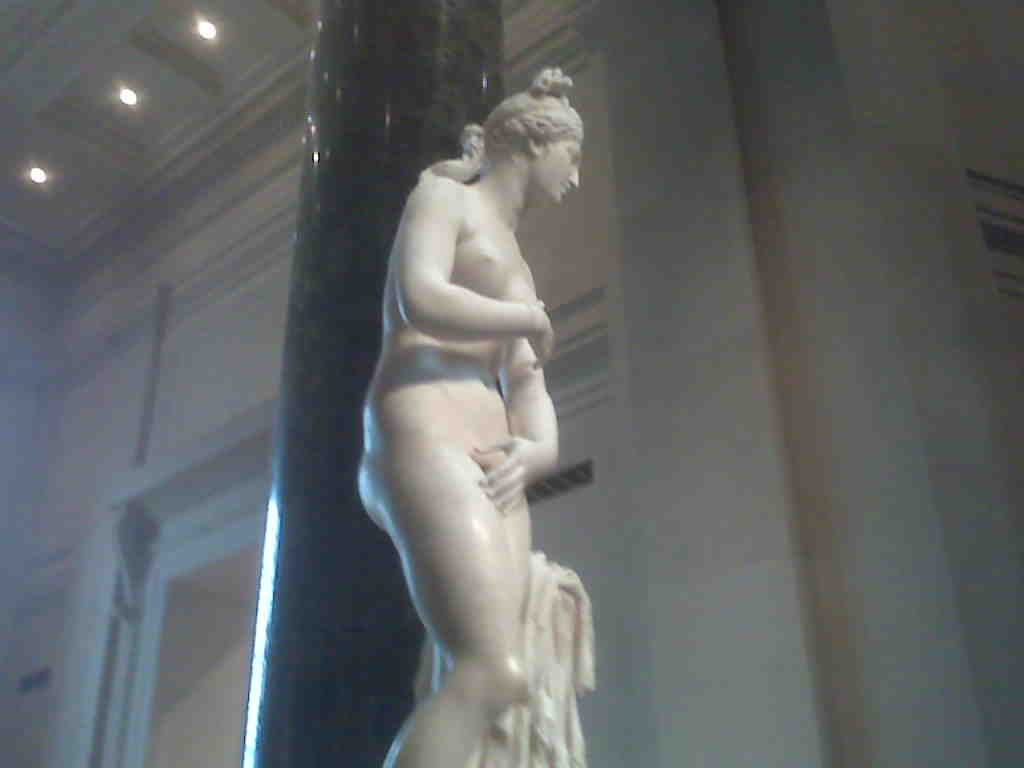
The Capitoline Venus arrived in DC last week from Rome–the first time this circa 200 CE sculpture has been out of Rome in nearly 200 years. What makes it especially beautiful is the apparent softness of flesh of the cool, carved marble, the seeming etherealness of the ancient solid stone.

Looking at the Venus made me think about how carving in stone can help us understand the concept of sruti. The hindu scriptures generally are classified as either sruti (revealed) or smriti (remembered) and until recent centuries were passed on through oral tradition. Those scriptures that are sruti are said to have been revealed by a divine source to the original listener. They were already there as part of the wholeness of the universe and then manifested to a particular enlightened being in a way that could be witnessed and passed on. The essence of the text was always already present, but not tangible, until it was revealed in the mind of a listener, who then passed it on.

Carving in marble takes both the emergence of idea and form in the mind/imagination of the artist and the revealing of that idea from the original stone by the craft of the artist. The sculptor has studied and practiced art and is always open to the emerging into consciousness of a particular image or idea, just as the great yogis continuously meditated and studied, open to what might be revealed.

As the sculptor may find the block of marble first or have the idea and then go looking for the right stone to express the idea, the yogi pulses between experiencing spirit and enhancing the experience through practice. It is not just an act of imagination that builds and creates something out of nothing. To some extent, the form of the final sculpture is already there in the stone. The work of the artist is to remove that part of the stone that is obscuring the witnessing and expression of the exquisite shape revealed from within by the educated and painstaking act of making art.
Peace and light, E — Posted with WordPress for BlackBerry.

Similar Posts

  • | | |

    Afternoon Walk

    After eating homemade popsicles.  This week’s variation:  lemon, lime, with white nectarine.  The liquid was an chilled tisane with herbs from the garden; the sweetener, local honey.  The farmers at the market were packing to go home.  Tomatoes and peaches only $1 a pound.  Tonight–cucumber and tomato salad with the second cucumber of the year from my own garden.  The salad to accompany whole wheat pasta tossed with garden greens, herb pesto (basil, parsley, arugula; garlic in the pesto from a friend’s garden), and white beans.  Later in the week when it gets cooler, slow-cooked tomato sauce and white peaches poached in wine (perhaps turned into popsicles).

  • | | |

    My New Next Door Neighbor (And Thoughts on Moksha)

    My adorable new neighbor appears in the photo to be outside looking in with me taking a picture from inside looking out.  From the perspective of who was in the house and who was standing on the sidewalk, it was of course the was the opposite.

    The paradoxical illusion in the photo led me to think about moksha — the yoga concept of liberation.

    What I get from the various teachings for my own living practice is that to experience freedom in this embodiment we need to be able simultaneously to be on the inside looking out–from our individual embodiment appreciating a sense of universal connection–and also be on the outside looking in–bringing back to particularized embodied action what spaciousness we learn from practice and study.

    image

  • |

    Baksheesh and Brahman

    I spent a few hours this weekend reading Joseph Campbell’s  Baksheesh and Brahman, which is Campbell’s journals from a year in India from 1954-55 (I’m now about a third of the way through).  Campbell writes that he went to India to find Brahman and instead found politics.  He approached his visit from the perspective of a mythologist.  In contrast to Allen Ginsberg and the Beats, who went to India to find God, Joseph Campbell went to observe religious practices.  Although the journals evidence his own perspective and prejudices, he makes cogent observations on the difference between religiosity and spirituality (not all that dissimilar to the distinctions made in the Bhagavad Gita about the difference between rigidly practicing ritual and truly believing).  He also makes very interesting and still timely and cogent comparisons between the relationship of Hinduism and to the then rather new Indian nationalism and American Protestantism to democracy.

    Ultimately, though, it is evident that this year was important for Campbell’s life path and work, as it was for the Beats, and has been for many of my friends who have gone, though not for all.  I think about going to India.  It will be when I have several weeks and don’t have a venerable and ancient cat who cannot be left behind for a long stretch of time.  In the meantime, reading of such journeys can stimulate thought and can be applied to other aspects of my life, though reading and studying (especially in the yoga tradition), is never a substitute for experience.  Just reading of spiritual experiences, but not doing the practices to open the door to one’s own experience is like reading cooking or gardening books, but never going into the kitchen or the garden.


Leave a Reply

Your email address will not be published. Required fields are marked *

This site uses Akismet to reduce spam. Learn how your comment data is processed.