State of the Garden
A snow pea, five strawberries, and lots of greens.
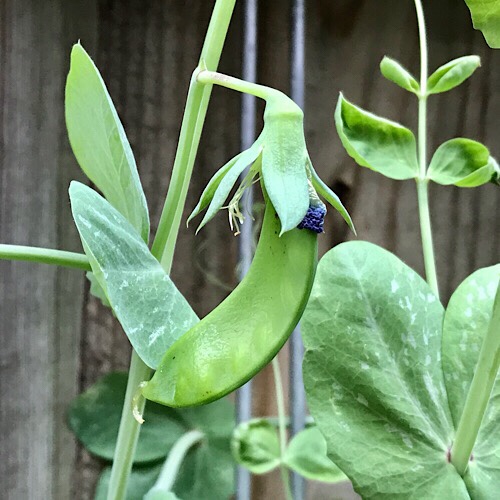
A snow pea, five strawberries, and lots of greens.
 Here’s a picture of the chard I harvested last Wednesday. I don’t usually harvest that much at a time just to feed myself, but it was harvest Wednesday or let it die back. I have most of my chard plants in a large rectangular container on my very sunny back deck (not really a deck, but a platform to which the patio stairs are attached). There’s room for my bay tree to go outside in the warm months and to have a few containers, maybe a chair. Barely that really. All it takes, though, is a few containers and a little mindfulness to be eating some fresh greens 10-12 months of the year in our hardiness zone. It looks like the plants survived the bitter cold last week and will go into leaf again when the temperatures are back in the mid-40s, but I’m not certain of it. I’ll be patient and observe what happens so in future years I’ll have a more refined gauge of what works and what doesn’t work for different shifts in the weather patterns. The weather will do what it will; but I can act to adapt in a way that tries not to fight what is. Dan — how is that chard patch of your in New Bedford?
This morning my harvest was from my refrigerator and cupboard by way of the TPPS, Yes Organic, Farmer’s Market, Whole Foods, and Giant by way of all sorts of places — and this is supposed to be the good, healthy eating. I took the basic proportions from the back of a box to make muffins that had spelt flour, multi-grain flakes, wheat germ, hemp seeds, currents, flax seed meal, walnuts, chopped fresh apple (it all started with needing to cook the apple), ginger, vegetable oil, baking powder, salt, dehydrated cane (unprocessed sugar), and spices. No eggs, no dairy even on the back of the box of currents. By the times I was done transforming them, though I would have enjoyed the original, I’d ended up with the kind of muffin the Vermont-granola-style restaurants name “power” muffins, or “energy” muffins, or maybe “everything” muffins because it is too hard to be descriptive of this many ingredients. I think they will be good food to carry in pockets when out in the cold for extended periods of time.
I have in my library books in which just one phrase or just the very beginning is most resonant. It is this time of summer, when the light seems endless, and the heat just setting in as if on a permanent basis, that my thoughts turn to watermelon in food, and again in literature. I think of watermelon differently each summer from the perspective of having lived another year, and the same in having experienced the taste and the thoughts of the taste so many times before. When it comes the time of year when thoughts of watermelon spontaneously arise, I revisit these words:
“In watermelon sugar the deeds were done and done again as my life is done in watermelon sugar. I’ll tell you about it because I am here and you are distant. Wherever you are, we must do the best we can. It is so far to travel, and we have nothing here to travel, except watermelon sugar.” (R. Brautigan, In Watermelon Sugar).
Refreshed, I put the book back on the shelf, look forward to eating watermelon from the fresh farm market, and set the intention to start each day with open, receptive, and unjaundiced eyes, ready to learn and experience the same old things as glorious new ones, and to do the best I can.
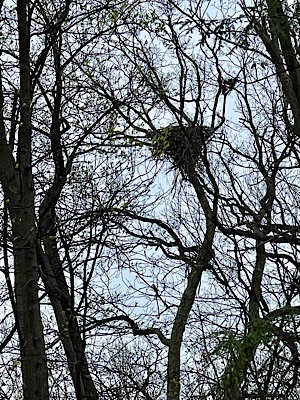
Soon the leaves will be out and the nest will be completely obscured from view.
This will be my 20th season in my garden. I know that my back garden — where I grow my herbs, flowers, and vegetables — is easily 4-5 weeks earlier than the gardens of my friends’ in Potomac and Silver Spring and the outer suburbs. It is even almost that much earlier than my front garden. I have a brilliantly sunny, south-facing, protected back garden with a brick patio that is against an unpainted brick house and a densely shaded, north-facing front garden. Not only is the back garden sheltered from the wind by the house on one side and the fence on three sides, but the bricks retain enough heat to change the temperature by a a couple of degrees. I have a special micro-climate. My climbing rosebush (pictured in the header) is already in leaf.
What does this mean? While my friends in the suburbs or those with east/west facing houses are starting seedlings for kale and spinach indoors, I can put seeds into outdoor containers in the next week or two without compunction. The seedlings I would need to start (if I don’t instead choose to purchase them from the organic farmers at the market) are peppers and tomatoes for planting in mid-April. If I start with strong 8″-12″ plants in mid to late-April (depending on the 15-day forecast), I can have and have had for at least 10 of the past 20 years, cherry tomatoes in May and peppers in early June. My greens, obviously, bolt earlier. I’ve figured out that certain varieties of chard do better in these conditions, and that spinach and lettuce do better sheltered by the fence where they get afternoon shade, so that I can have them farther into the season.
This kind of knowing by combining general book and teaching knowledge with personal observation of my little space, is much like the yoga practice of svadyaya (self-knowledge), which is the fourth niyama of Patanjali’s yoga sutras. Svadyaya is literally study of the self through the scriptures. Implicit in that is the guidance of a teacher or guru. Ultimately, though, self-knowledge or awareness must be experiential. We make the effort to study and we listen to our teacher, but then we practice. We soften and open to who we (or our garden) truly are — another way of practicing and experiencing the Anusara principle of opening to grace — and then in the context of the teachings, accept who we are. As gardeners, that means accepting what zone we are in, how much shade, water, space, and sun we have. As yogins, it means accepting our strengths and our limitations. We can shift our zone by treating certain plants as indoor/outdoor or as annuals rather than perennials; we can enhance our water flow by storing it in rain barrels, but that is merely expanding the edge rather than making a complete change. We can expand the edge of our practice, but still need to accept the bodies with which we were born.