Stages of Life
What is optimal with our diet, exercise, and practice, depends on where we are in life.

What is optimal with our diet, exercise, and practice, depends on where we are in life.
For the past week, I have been contemplating, practicing with, and teaching the axiomatic sequenced alignment principle of Anusara yoga “stabilize the periphery; move from the core.” It means exactly what it says. We stabilize the outer edges of the pose (feet, hands, head) and move from our core to get into the full expression of the pose. For example, have you noticed how often the yoga teacher will have you put your hand on your hip when you are first in a standing pose and working the alignment of the foundation and core body? Only when the central alignment has been reached, do you extend the arm and hand to complete the full form of the pose. The reason Anusara teachers are taught to use this technique is that it stabilizes the periphery, so that the students can concentrate on the major alignment and then move from the core.
Off the mat, this principle means to me that we start with our overall goals and needs and the essential principle of trying to move from and respond in the highest before getting distracted by the details of whatever is going on. As I contemplated and taught the principle this week, I found myself thinking and talking about lots of different examples on and off the mat. The central idea was there, and then as the classes progressed, depending on the level and the students, I wove in illustrative examples that made sense with what was happening in the classes.
I found myself struggling, though, to write about this principle. I had too many different things I wanted to explain about how it helps in yoga asana both as an important therapeutic practice and as a way to expand one’s core abilities. A plethora of examples of how it works off the mat came to mind. To write coherently when one has limited space/attention span of reader/number of words, one has to first stop getting into the details and start with the central theme. Then it is necessary to flesh out the central theme with very select details that enhance the understanding of the central premise. The writer chooses not to scatter the central theme into so many details that the central point is obscured or lost in the details. My struggle to write about this principle served then as a perfect example to myself about the very principle about which I was choosing to write. I needed to “stabilize” the details, so that I could express coherently the core principle.
Do you have good examples of how applying this principle has helped you on or off the mat?
At the weekend workshop in Bryn Athyn yesterday, John Friend reminded us of the scientific fact that our energy flows to where we put our mind. As a physical matter, if we think about our little toe or our tailbone, for example, we will be better able to access it.
As a mental matter, if we think about something we just did or need to do or think we should do, our energy will be diverted to that place.
There are even more profound implications with respect to where we let our mind dwell when we are practicing. Our practice deepens and helps us embody intention (sankalpa). If we dwell on something that is making us angry or suffer while we are practicing, we will actually etch those emotions more deeply into ourselves.
This is not to say that we should not practice when we are suffering or in conflict. Nor does it mean that we should beat ourselves up when “negative” emotions or thoughts arise during our practice. Rather, the awareness of the repercussions of dwelling on and feeding what does not serve is a reminder of the benefits of turning our minds towards the good — perhaps a yearning to be at peace or free from suffering or other positive intention while we are practicing when we are feeling challenged. We use the practice not just to release what does not serve, but choose to refocus our minds so that through the practice we can embody a state of mind and body that better serves us and helps us to respond from a higher place to those things that are painful or hurtful. Ideally, we turn towards what is light, nourishing, and balanced (sattvic), not out of compunction, but because it is more delightful.
In the middle of the day today , I took formal leave to bear witness at the march against gun violence on the Capitol grounds.

Having brought myself face to face with this many mothers of murdered sons, what could I do but offer respect, see what I can do to help from my own well-being.

In recognition of Durga Ashtami.
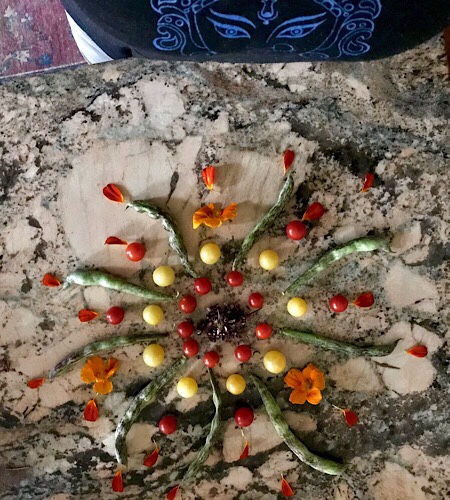

The strawberries were very nearly mashed into juice by the hot walk from the Penn Quarter Fresh Farm Market Home, but no matter. I had intended to make them into popsicles. I couldn’t resist the bouquet from one of the farmers.