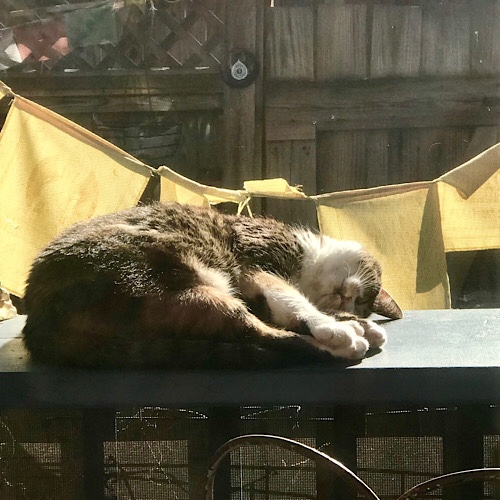
Cat Nap
In the middle of this chaos. She reveals my privilege. Self care is not adequate without community care.
In the middle of this chaos. She reveals my privilege. Self care is not adequate without community care.

When I think about the Anusara alignment principles in the context of the tattvas (see earlier posts), I think about “opening to grace” appearing in two places on the tier. As “first principle” it is the first among a larger sequence about how we come to the mat, rather than just the first of the physical principles. “First principle” not only starts the practice and the dialogue, but is already there. It is, in this sense, so fundamental that it is not part of the sequence, but is sequenceless (akrama). If you are fully conscious of “grace” and can embody it in all aspects of your physical, energetic, and mental day to day existence without further instruction, study, or practice, then there is no need for other practice or instruction (this I think is a very rare being, and certainly I’m not such a being).
The next set of tattvas — suddha vidya, ishvara, saddha shiva, and shiva-shakti (see link above), correspond to the Anusara alignment principles of “attitude, alignment, and action,” which although they are themselves described in sequence, are fundamentally sequenceless as they happen all at the same time and are more elemental than the practice of the physical/energetic alignment principles in sequenced practice.
In this way of understanding the play between the sequenceless and sequenced, we have a universal “first principle” that embodies the purpose of all we do on and off the mat. It is followed by how we want to practice, described in a way that becomes less of just a concept (which as a universal concept is akrama) and more of a practical understanding (which applies when we are in space and time and therefore in the krama of embodied existence). As we dance in this play between the sequenceless and the sequenced, we come to practice (or to do any activity) with the “attitude” of wanting to live the “first principle,” to know and experience what is fully present and not bound by time and space. We then (because we must) study and practice specific “alignment” to try and express this attitude with our “actions.”
The physical/energetic alignment principles then come in as a the way of better refining, studying, and practicing the desire to recognize with mind and body the “first principle.” The sequence of “open to grace, muscular energy, inner spiral, outer spiral, organic energy” comes then at the level of physical and mental practice to return us back to “first principle.” “Open to grace” is first in this sequence, too, but as “first principle,” for me, it is something more than the first of the alignment principles. “First principle” is not just the start of how we practice when we practice Anusara yoga, but the whole reason for practice. It is the universal, overarching, blissful element of being that draws us to the practice because of our yearning to know it.
It’s an idiosyncratic grouping, but it is my weaving of stories for the moment.
I believe the brass dish under the cactus on the left was a wedding present, though I am not absolutely certain of that. It was a long time ago.
The cloth with the tassels came from a shaman in Peru; I was there for 9/11.
I bought the gray scarf when I was in Costa Rica on a retreat with John Friend from a world-traveling fellow yoga practitioner who had brought an array of beautiful scarves to Costa Rica from Thailand.
Other things were brought home from India–mostly by me, but one a treasured gift from a friend.
The porcupine quills were also an inspired and loving gift.
The square of marble under the cactus on the right I found on the street in the neighborhood. The cactii came from a yard sale over a decade ago. They were being sold for only blooming once a year.
The bit of mother of pearl comes from Centerport beach on Long Island. I went there last fall the day before my father’s memorial service.
Other things came from vendors at Eastern Market and one from New York City.
The chestnut is from Stanton Park. I picked it up on my way to work one beautiful day last year.
The heart-shaped stone came from Arizona when I was on a meditation retreat some time late in the last decade. I’ve been to some really lovely places on this planet.
The mala Kuan Yin is wearing I strung and designed: rudraksha beads from my first meditation mala (which had broken), labradorite, and emeralds on silk thread.
The jet beads belonged to my grandmother Rose.
There’s a story about the lump of black and red rock behind Ganesha, but I think I’ll leave that for another day.
I took a Zoom asana class this morning, because I like to see how others are leading practices these days. It was a sweet and gentle class. At the beginning, the person leading acknowledged that it was Valentines Day, and then said instead of talking about love, let’s talk about suffering. It was suggested that the attention we bring through the yoga practices to our suffering, can help us ease it. That would be an act of love, wouldn’t you agree?

I hope you are practicing something that helps you hold and heal yourself. I wish for you, as I wish and work for myself, some joy and equanimity amidst the global and climatic upheaval and whatever challenges you may be facing personally.
Do not turn away from suffering and also appreciate moments of beauty.


Earlier this week I was talking to a long-time friend of the family (my father has known him and his wife for over 60 years; they have known me since I was riding around in the womb). My parents had sent me an email while I was on the meditation intensive with Paul Muller-Ortega last month, to tell me that our friend was in intensive care recovering from an operation. I waited until I knew he was home to call because it can be so tricky to get the right time at the hospital. When we spoke, I told him that my father had said that his intrepid cheerfulness was a complete inspiration. “What choice do I have,” he asked, “what can you do when you wake up in intensive care on your 82nd birthday, but look for the gift it will have to bring?”
In the past several weeks, a number of other friends and family members have been seriously ill or lost loved ones or home or work or more than one of these. The outrageous suffering from a seemingly relentless series of natural disasters and war and the financial crisis is a staple in the news. In trying to stay present for my friends and community, while still taking care of my own needs and emotions, I found myself led to practice bhavana on (deeply contemplate) the first sutra in Patanjali’s Yoga Sutras: atha yoganusasanam–now begins the practice of yoga and how it relates to the Anusara first principle of “opening to grace.”
Teachers and commenters say of the Yoga Sutras that it was not meant for beginners, but was meant for students who have already established a practice and reached a level of initiation (diksha) that established they were ready to be given the teachings. I have also often heard said that one is drawn to the practices because of other experiences in this or a previous life; in some sense, the first time we show up, we are not a beginner and are ready for the teachings. Whatever knowledge and skill we bring to our studies and practice on any given day, they start new. They are starting “now.”
Now begins the practice of yoga (yug)–of uniting ourselves with each other and with spirit and linking our mind and body one-pointedly to the fullness of the teachings. The teachings are methods for knowing and experiencing this perfect union. In that regard, I think that an essential element of the teaching conveyed by the Anusara first principle of “opening to grace,” is this now, this beginning anew both to know what already is in our hearts and to learn how the practices can make it ever more accessible, whether we are beginners to what we understand to be yoga or meditation or have been practicing seriously for years. We want this “now” in every moment. As we get more skilled, and part of developing our skills is challenging ourselves deeply in the controlled environment of class and our own practice so that we will spontaneously open to grace in the moment when, as my friend said, there is no viable choice but to be cheerful (to “open to grace”).
The “now” of Patanjali, the practice of “opening to grace” in Anusara yoga, is a way to teach those of us (like me) who do not otherwise learn or intuit from living itself that there is no viable choice other than cheerfulness in the face of the most difficult of challenges. The “now” conveys that it is now time to go deep, time to expand understanding and practice, time to discover truly how the practices can connect us to spirit and alleviate suffering. Now is the time to be and to learn better how to stay grounded in and connected to the flow of energies, not just so that you can face what you yourself might be experiencing, but also to have ever more space for love, compassion, support, and service for others who are in need. Now is the time to open to grace.
Photo from exhibit in San Francisco on the 10,000 year clock project.