Community, Connection, Action
Have you let your elected officials know how important it is to fund the United States Postal Service
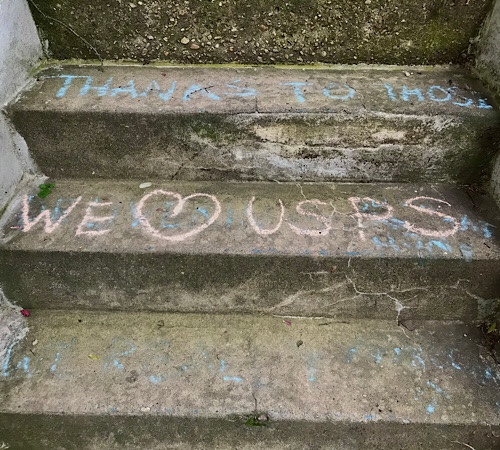
Have you let your elected officials know how important it is to fund the United States Postal Service
When we are on our mats, being open to grace — the first Anusara alignment principle — includes being open to the teachings so that we can receive and act on them in a healing and loving way. Adding to that muscular energy by lovingly embracing skin to muscle to bone in a conscious embrace, drawing into our center to recognize our inner spirit, and drawing from periphery to the focal point brings us into optimal balance. This pulsation serves as a way off the mat to open, inspire, and engage us in progressively more intentional and uplifting ways of living.
Being open to inspiration from friends and about town, open to learning new ways to be kind to the earth and to ourselves, is a way of bring the principle of “opening to grace” off the mat. Actually keeping the intention and acting on it has the attentive embrace of muscular energy, which draws us onto our inner light in a loving embrace so that we can better serve.
I was thinking about Anusara principles off the mat, yesterday when I went visit a friend in NW one of whose roommates fosters cats. There is a community garden in the back and the house is warm and friendly. In the bathtub were two buckets filled with water leftover from showers. Instead of using fresh, potable water to flush the toilet, when it is time to flush (honoring the drought axiom about yellow mellowing, etc), the house residents fill the tank with the gray water from the shower.
Find it too complicated an idea to shower with a bucket in the bathtub with you? You can still save water by filling your watering can or bucket when you run the water to warm up enough to get into the shower. That will save a few gallons. Not up to using the water to flush the toilet? Use it to water houseplants or for cleaning floors, etc. Or take it outside to water potted plants.
First step is opening and witnessing the possibilities and understanding where you are ready to expand. The second step is to try to more consistently live your inspiration. I know when I see people living with such intention I take better care to move in that direction, even if I am not ready to go as far.
Afghanistan Lebanon Dreamers Haiti
Wildfires Hurricanes Earthquakes
Ebola Plague Delta-Variant
Vaccine Refusers
Etc
As long as I am well fed in my comfortable home, far better, when I am not actively working/serving, to garden and meditate and study and try to create some joy than to wallow in hopelessness. And make a little art to remind myself of beauty.
When I googled (that should not be a verb) “holiday madness” this morning, I got one million three hundred thousand hits. Yikes! Most relevant websites are about surviving shopping, over-eating, family, and travel. Madness in such a situation is a choice. We can choose what to consume, how much, when, and with whom. It is a choice whether “celebration” requires consumption beyond what our financial, physical, and emotional means permit.
The yamas and niyamas as revealed by Patanjali provide beautiful structure for thinking about the holidays.
Yamas:
Ahimsa–non-harming. Don’t consume more than is harmful to yourself, those who have created what you are consuming, and the earth.
Satya — truthfulness. Be honest with yourself about what is right for you to celebrate and observe and what brings meaning to you as a holiday celebration.
Asteya — non-stealing. Consuming beyond your means, especially financially, is a form of stealing (look at what generated the recession).
Brahmacharya — moderation (aligning with Brahma). Enjoy the offerings of the earth in a way that uplifts rather than sickens or detracts from spirit and self.
Aparigraha — non-greediness; non-covetousness. Enjoy what you have without coveting or trying in a detrimental way to have what others have and you do not.
Niyamas
Sauca — cleanliness, purity. Consume in a way that is healthy for yourself and the planet, that does not create illness, refuse, and waste.
Samtosha — contentment. Wherever you are, whatever you have, whatever is going on in your work and family life, think of that for which you are grateful, that which brings you happiness, and focus on what you have. Contentment is a practice.
Tapas — fire, ardor. Be on fire to practice, to shift, to make this a life-fulfilling year of generosity and compassion.
Svadyaya — study of text, self-study. Take the holidays as an opportunity to deepen your understanding of yourself, society, and your spiritual beliefs and how they interrelate.
Ishvara pranadhana — surrender, recognition of the spirit. Let go a little. Surrender to a sense of fullness. Allow the abundance and recognize it as a wondrous gift. Remember the word “holiday” is really two words: “holy day.” Make this time holy, whether or not you observe a particular religious tradition at this time of year or any other.