Be Here Now (Var.)


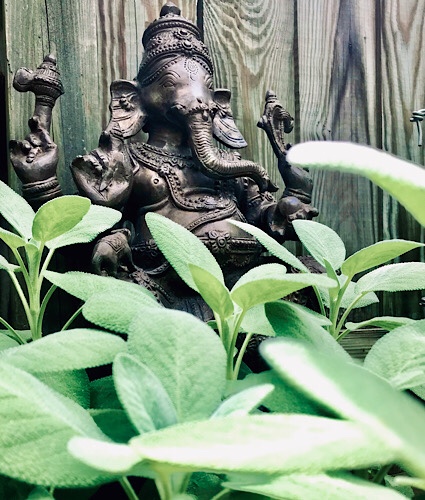
In Hindu philosophy, the powers of creation (Brahma), sustaining or preserving (Vishnu), and destruction (Shiva) are all given equal weight in the balance of the universe. Without destruction, there is no place for new creation. Each aspect of this triad is an essential part of the elemental unity of being.
I think that a repeal of the health care act, if it only were to open the path to a single payor system that actually provided health care for most, would be a good human level demonstration of the need for destruction to allow for creative flowering. Alas, I don’t think that is what the would-be destroyers have in mind.
I remember at these times that I am not in charge, and I cannot see the biggest of the big pictures, but somehow, that is not always of much comfort.
Let’s face it. When we are on travel and staying at someone else’s house or in a hotel and doing all the running around that comes with visiting or working or sightseeing out of town, we can get out of balance. This disruption of routine can upset our sleep and our digestion. You don’t need the exact collection of pillow shown in these photos. The point is that you can use whatever pillows and blankets (or even towels or your own coat or sweater to make the shapes of yoga bolsters and blankets) to do a nourishing and balancing restorative practice. I like to travel with a hot water bottle in the colder months; there is little more comforting than yoga restoratives with a hot water bottle.
1. Legs up the headboard (sometimes there isn’t enough room on the floor to do any yoga even to do vipariti karani (legs up the wall pose)). Here, pillows are stacked against the head of the bed because it otherwise would be uncomfortable (and risky for the art over the bed). I suggest this pose first to surrender to being turned upside down, to undo the effects of gravity and too much walking around and carrying things, to relieve the legs and feet and to allow more energy to recenter itself in the heart. Stay for 10 minutes, or even longer.
2. Supported twist. Start with your left thigh against the pillow stack, so that the energy follows the natural direction of the large colon, thereby helping relieve the impact of travel disruption to the digestion. The gentle twist also wrings the adrenals, allowing them to release the toxicity of travel and disrupted diet. After 7-10 minutes, switch to the other side with the right thigh perfectly parallel to the pillows before bowing forward.
3. Balasana. Place a pillow or two between your heels and your seat. With your toes touching and knees wide apart, bring a couple of pillows, or folded blankets between your knees back to mid-thigh and then bow forward over the support, adjusting your makeshift props as needed to feel at ease in the pose. The pose invites a fullness in the back body, letting the adrenals rejuvenate after the cleansing action of the twists. This is good. Stay for 10-12 minutes or so, remembering to turn your head to the other side half way through.
4. Supported supta badha konasana (bound angle pose). After you’ve relieved the feet and legs, nurtured the digestion and the adrenals, now is the moment to surrender to bliss (ananda) and open the heart to being right where you are–wherever that might be. Key for this pose is to make sure that the support under your back is right up against your sacrum. Shown by the fabulous yogini model are three possible ways to use the hot water bottle. I wouldn’t have thought to put it on my face, but she delighted in that idea, and I can see how it would be good for sinuses stressed by travel.
As with any physical practice, you should approach even gentle poses such as these with appropriate awareness, honoring your own body’s limits. If you want to learn how to practice yoga asana safely and optimally, it is best to take classes to supplement a personal practice.
Those of you who have been attending my classes for the past couple of weeks already know that my overall theme for the fall session is cultivating a sense of wonder (abhuta). Feeling wonder is one aspect of the Anusara principle of “opening to grace.” It is seeing who we are and what we are within space and time with a sense of amazement at the limitations and the foibles, as well as the strengths and delights.
This week I was thinking about abhuta in the context of samskara — the markings or grooves or scars in our being from how we have lived our lives (and perhaps past lives, if those were also lived by us — personally not sure about that). I had a dialogue earlier this week that resulted from over 110 years of combined history that was not optimal. Reflecting on the precipitating factors, though, and marveling at the web of history, environment, education, and action that combined to give rise to the conversation led me to a sense of wonder indeed. It is by cultivating the ability to step back and appreciate the wondrousness of the dance that we learn from a steady practice that, I think, can help make it possible to shift in how we behave and react to things.
From a physical perspective, most of our challenges and difficulties are based on what we have done with and in our bodies over the course of our lives. We use the yoga alignment principles to create new grooves and to shift from the old repetitive patterns, so that we can not only alleviate pain and misalignment, but to expand the possibility of discovering ever more joy and wonder in and through our bodies and senses. Both the physical and meditation practices help us shift similar patterns (dissolve and transform samscaras and their impact), so that instead of deepening old grooves, we erase or dissolve them and create new life-enhancing ones.
It may seem odd to marvel at our stuff, especially when it does not appear to be serving us, but keep in mind that both the awesome and the awful, being both all about awe, can give rise to a recognition of the great and exquisite mysteries of being.