Similar Posts

  • | |

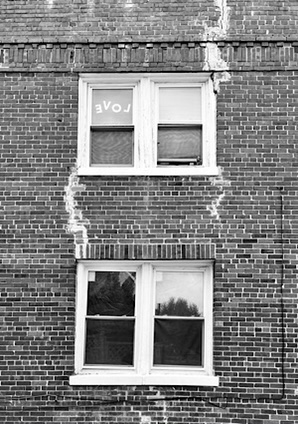
    Negation, Affirmation (and a new yard sign)

    I went to a delightful brunch yesterday hosted by friend and neighbor K, who lives on the other side of the Hill.  A number of the guests turned out to live within a couple of blocks of me on the Northeast side.  In describing my house to those who lived farther from the Capitol than I (knowing my block was part of their usual walking path), I said, “mine is the one with the ‘War is not the answer‘” yard sign.  “Oh yes, I know which one it is,” was the uniform response.

    K said she did not have the yard sign because she did not want a negative message in her front yard.  It served its purpose for a time, she claimed, but she wanted a more positive message.  I replied that if the sign said “peace is the answer” it would not have the same p0litical meaning.  People would just think, “yes, peace is nice, but whatever,” and keep walking.  We all agreed that was likely, but I left still thinking about the conversation.

    One of the reasons K gave for wishing to turn the sign on its head, was she did not want something renunciatory, and she referenced the principle of “negation” in Buddhism.  I knew what she meant.  Advaita vedanta has a phrase, “neti, neti” or “not this, not this” which means extinguishment of the individual self and a life of the senses and mind to unite with the ultimate Spirit.  The Buddhist “nirvana”  literally means “void.”  I did not engage the conversation in such a way as to bring it to tantra lest I go too far in the direction of yoga geekiness, but the conversation certainly led me to think in that direction.  Tantra seeks to do exactly what K was seeking:  to turn the phrase, “not this, not this” into an embrace that will reveal truth and light by means of affirmation rather than negation.

    Interestingly, though, I think a possible inspiration for K’s yard sign dilemma could come from from Buddhism:  metta meditation (note:  I have been offered this meditation in various settings and have practiced it many times, but it is not my regular meditation practice, so I hope I am not misinterpreting or mischaracterizing it here).  The theory behind metta meditation is to distance one from anger to cultivate calm.  In this creation of calm comes a general demeanor of loving kindness and compassion.  I personally become calmer by embracing and aligning with all my emotions, including grief and anger, but still find the languaging of the metta practice beautifully inspiring.

    In that spirit, I suggest as a possible rewording of the yard sign that still serves the political message, the call to serve:   “may all beings be free from war.”

    Or maybe FCNL should make a sign with the query:  “what do I do in my life to remove the causes of war?” Is that still a negative, if we are calling for positive actions to remove causes?

  • |

    Sthira-Cara (of the stationary and moving living beings)

    A number of years ago, I attended a week-long workshop with Rod Stryker.  He invited us to meditate on absolute stillness — cara sthira — meditation.  Sitting comfortably, still the skin, the muscles, the bones.  Draw the attention to stillness.  The breath and heart will still move, but the concentration is on stillness rather than on any movement.  Rod Stryker discussed the next day the challenges of this meditation, especially for those who are intellectual, who enjoy being active in the mind.  I found it difficult at the time and even dreamed about the issues the meditation brought up for me.  Meditating on stillness can be very challenging in a way that meditating on a mantra or the breath would not necessarily be.

    I believe the origin of the meditation comes from the principle of sthira being  the absolute unmovable, the essence of being (not dissimilar to Kant’s unmoved mover).  We invoke pure stillness, pure potential out of which movement comes because that is part of our essence and a place where we can rest our spirit.  See, for example, the Srimadbhagavatam.

    I discovered absolute joy in this meditation a couple of years after I learned it.  I was suffering from a severe sinus infection and bronchitis simultaneously; I joked that I was fine as long as I didn’t breath through either my mouth or my nose.  In the midst of my suffering, I remembered the teaching.  For a few days I stayed in the meditation for hours at a time.  I found the place where I did not really need the breath.  Enough came to survive, but I forgot about wondering how to breath or finding a place for it or my struggles with it.  In the stillness, there was space and peace and supreme bliss.  Ever since then, I have chosen this form of meditation when I have a cold, a sinus infection, or other challenges with breathing.  Meditating on the breath, obviously, will not be soothing when breathing is a struggle.  But when even breathing is a struggle, peace can be found in complete stillness.

Leave a Reply

Your email address will not be published. Required fields are marked *

This site uses Akismet to reduce spam. Learn how your comment data is processed.