| |

I Was Browsing Looking for a Poem

I was browsing; I was looking for a poem to read to a friend because I was not ready to write one myself.  I found several that were right for me to read, but not to share, and this one I wanted to share more widely because of the delight it is bringing me to read it:

Karma Repair Kit:  Items 1-4

1.  Get enough food to eat,

and eat it.

2.  Find a place to sleep where it is quiet and sleep there.

3.  Reduce intellectual and emotional noise

until you arrive at the silence of yourself,

and listen to it.

4.

Richard Brautigan, The Pill v. the Springhill Mine Disaster

I had a real fondness for Brautigan when I was a teenager.  Every once and a while, I will pick up one of his books and remember why.  If you enjoyed reading this poem, please go buy a book by Brautigan to thank him.

Similar Posts

  • | | |

    Blogging by Blackberry (after thoughts on discipline and freedom)

    When I pause to think about it–something I try to do consistently with the fruits of technology–it is an extraordinary marvel that I can be telling stories to the world from a little device I am holding in my hand, one that also has let me speak and exchange notes while I am away from home with friends, colleagues, and business connections.

    What I cannot do (more likely because I haven’t yet learned how than it is not possible) is to be my usual careful self when posting entries. I have not done hyperlinks to attrbute my sources, nor have I spell-checked. At home, I would not hit the “publish” button without doing those things.

    Under the circumstances of being away from my regular computer, my library, the ability to check my references, and to provide proper citation, but being brimful with enthusiasm for being with my teachers, colleagues, friends, and the practices while I am at the teachers’ gathering, it seems better to post than not, using the means at hand. I sacrifice some of my usual discipline to share the joy.

    All of life is like that. We may have ideals of what is proper, what are our standards for appearance, for work, for sharing a meal or our homes. When circumstances limit our ability to meet our own standards, it is part of the yoga to see whether the standards are binding us or serving to help us better connect. I believe that we should always strive to be more precise, more technically accomplished, better able to convey a sense of grace and beauty. But that effort should not cut us off, bring us to a halt, disempower us, prevent accomplishment of things. Most of all, it should not deaden a sense of spontaneity of gesture–the part of art and relationship that reveals our true spark.

  • |

    What Students Hear

    Last week I took a lovely all-levels yoga class where the emphasis was on fully engaging in the practice rather than striving to achieve a particular outward notion of what the poses should look like.

    Near the beginning of the class, but after the emphasis on not striving had already been discussed, the teacher said that the ideal form in uttanasana — standing forward fold — for classical hatha yoga is with the feet together. But, he said, however, he said, but not, the teacher explained, if your back is curved like a “c” in the pose, and your lumbar vertebrae are higher than your sacrum. In that case, you want to take your feet wider apart or you will strain or injure your low back.

    As I was fully into the pose, I could see the rows of students behind me. At least two fellow students in my immediate line of sight, promptly put their feet together, even though they had tight hamstrings and bulging lumbar spines and were clearly pushing themselves hard to get their fingertips to the floor. As soon as the word “ideal” was uttered, they could not hear the caution or could or would not apply it to themselves.

    The evident intent of the teacher in his exposition of the pose was to give an example where the “ideal” form is most certainly not ideal and will not further the reasons we practice asana. But for so many in this society, striving is such an ingrained way of being, that yoga class can become just another way to achieve.

    It was useful for me to witness how carefully one must teach to high achievers this principle of the “ideal” being what suits and not what will win accolades. How do we teach (and learn) the practice of goalless goals, of enjoying working for fitness (of the mind, body, and emotions) without pushing and striving? I’m pretty sure that invoking the principle of actionless action from the Bhagavad Gita would not have made a difference here. It seems a shame to think that the only way to protect all the students’ backs is never to mention the classical form of the pose, and to have to tell all the students (especially in a big class) to have their feet apart (or some similar alignment rule)for protection of the few who do not (or are not yet ready) to hear the whole lesson.

    Peace and light, E — Posted with WordPress for BlackBerry.
  • | | | |

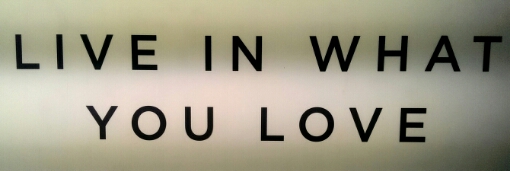
    Found Quotations

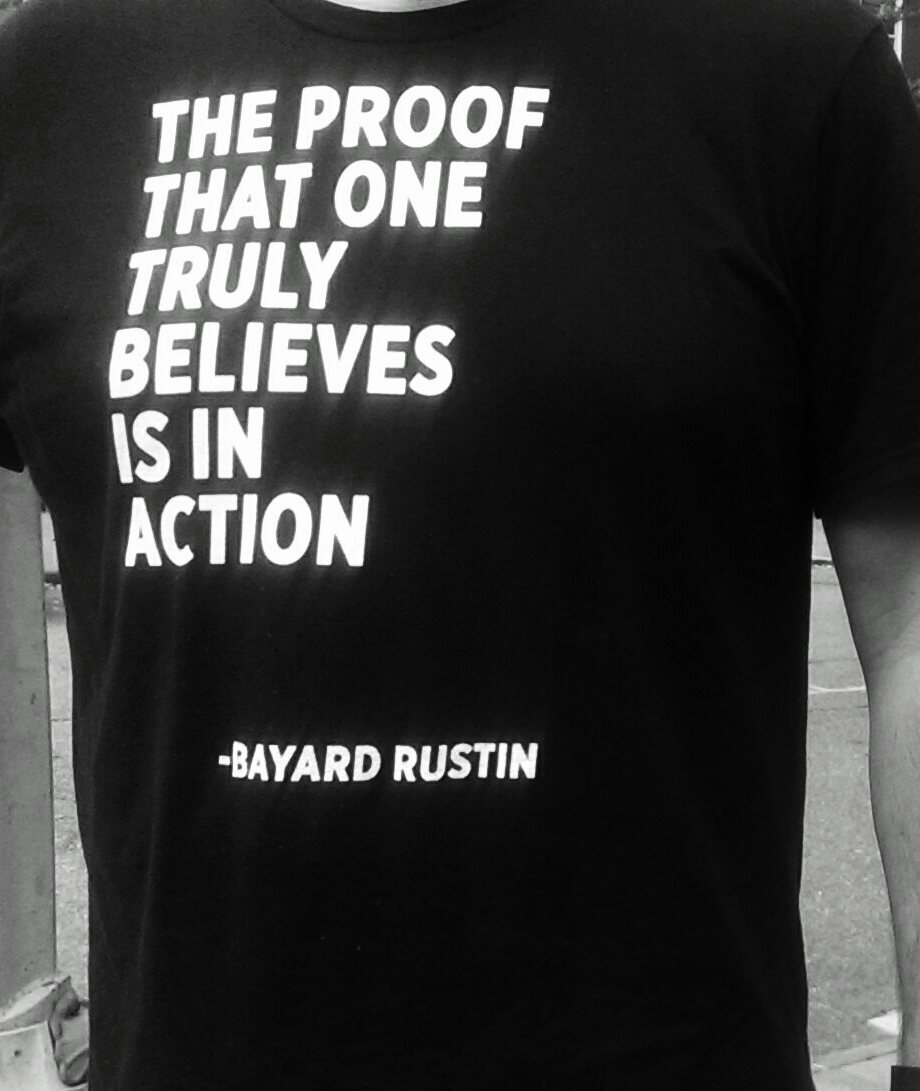
    When I was out at lunchtime to run an errand, I crossed paths with the neighbor (or visitor) wearing this shirt. I asked if I could photograph him. He seemed a bit taken aback, but posed for me when I said that I would only photograph the quote. After all, anyone who would walk around Capitol Hill with a Bayard Ruskin quote on his chest would likely want to motivate as many people as possible to think about that quote and act accordingly.

Leave a Reply

Your email address will not be published. Required fields are marked *

This site uses Akismet to reduce spam. Learn how your comment data is processed.