Purna

A nyaya is literally a recursion, something which leads back to an essential principle. In my recent studies of meditation, we have been taught various nyayas that help to explicate the experience of meditation and the whys and benefits of steady practice.
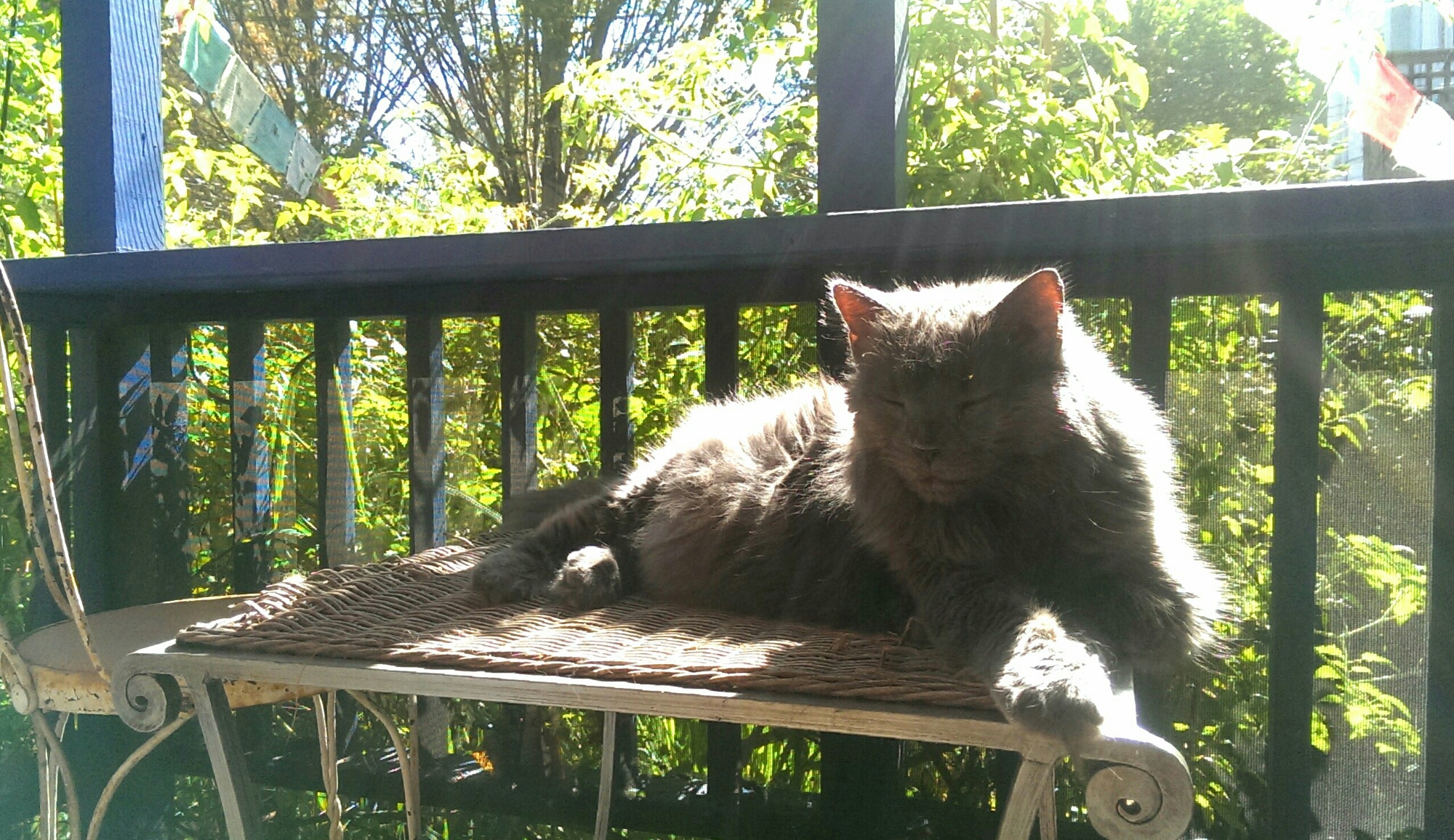
At the place where we have been staying for our meditation and study retreats with Paul Muller-Ortega, there is a wonderful cat named Oberon. I first met him last summer when I was walking the labyrinth just before dawn. I’d heard a meow off in the distance. Lonely for cat company since my Becky had so recently left her body, I called to the cat. He came running to me and walked the labyrinth with me. Each time I have visited, I have had some special moments with Oberon, who lives fully up to his name — Oberon being the King of the Faeries.
Oberon loves the meditation hall and often tries to get in. He also brings offerings. Last winter, he brought us a mostly dead bird. As well intended as it might have been on Oberon’s part, it was not particularly welcomed in the meditation hall. On the final night of our retreat this time, we were reveling in the good fortune of having fellow students (and my sometimes teachers and the creators of many CDs in my music collection) Heather and Benjy Wertheimer lead us in kirtan. At one point, I left my place to go to the facilities. A fellow student, stopped me, “Elizabeth, the cat has a really big mouse.” I went to look. Oberon did not have a mouse; he had a young bunny. “It’s a bunny I said.” The other students who were outside were horrified.
Without thinking, I went to him, “Oberon, drop it!” I said, as if it were appropriate to speak to the King of the Faeries as if he were an obedient dog. He listened though and dropped the bunny, which remained frozen. I held Oberon by the scruff of the neck. “Go bunny; bunny run,” I said, but the bunny did not move. I then tapped the bunny on his back at the tail. The bunny remained frozen, though it did not appear yet to be injured. I let go of Oberon and went to get a towel or something to pick up the bunny. Then Oberon tapped the bunny just where I had touched it. Off ran the bunny through the shoes neatly piled outside the meditation hall. I caught Oberon and picked him up. The bunny again froze, looking back at us. At this point I was completely oblivious to anything other than the cat and the bunny. “Bunny run; go now.” Oberon squirmed, but did not scratch me, letting me continue to hold him. Finally, the bunny ran off into the scrub and disappeared. I put down Oberon. He sniffed the trail, but then came back to me for a petting when I called. “Thank you for the offering Oberon; I know it was well intentioned, but we are not so keen on bringing dead baby animals into the meditation hall.” He sniffed, lifted his regal head, and sat down to wash.
Leaving aside what my actions may have done to the fabric of the world order and the pondering I could do about the interrelationship between destiny and free will, I felt that I had been given a wonderful lesson about life and practice. Practice can bring us great freedom if we stay steady on the path. Like the bunny, though, we can stay frozen in fear and old patterns, even when we are given a glimpse of the freedom of self we can get from practice. As dire as things may be (or perhaps even when they are at their worst), we return to the familiar, regardless of whether we are unhappy with it, regardless of how old patterns are limiting our ability to grow. Sometimes it is dissatisfaction with and pain from the old patterns themselves (revealed more clearly by practice already begun) that push us to go further, just as it took Oberon getting the bunny to run again for me to realize he was sufficiently healthy to be able to run off. And just as I stayed with Oberon and the bunny until the bunny finally took his chance at freedom, the practice and the truths and freedom practice can reveal will always be there. No matter how many times we forget or return to the stuck and the familiar, the opportunity for growth and freedom continues to await.
When I am feeling stuck, when I am finding myself returning to patterns that do not serve, I will think about my own personal nyaya of the cat and the bunny. I hope it will serve to keep me moving forward, less stuck, less attached to the familiar that no longer serves.
My boss with whom I’ve worked for over 20 years and who has an unfortunate tendency to get agitated (gentle understatement here) at the workplace has just discovered Thich Nhat Hanh. My boss was intrigued by Thich Nhat Hanh’s suggestion that when you find yourself getting angry, “don’t.” Knowing that he is still going to have to take action in response to the things that tick him off (and, as I would add, that not getting angry is distinct from disengaging, failing to act, or being apathetic), my boss still invited us to say to him when we see him getting worked up, “remember Thich Nhat Hanh.” I liked that. I like that he recognizes a need to change and grow and is starting to take steps after years of appearing not to be aware of the impact of his tendencies on himself and his co-workers.
One of the best ways I know to shift our reactiveness is to develop a steady meditation practice. If you don’t already have one, I invite you to begin to develop a daily meditation practice, which could include conscious breathing or visualizations. If your practice is only sporadic, notice how much better it is when your meditation is part of your daily routine.
When I came out of my afternoon asana practice and meditation, I picked up the John Friend Teacher Training Manual to look up one of my favorite passages. In describing the “attitude” that brings us to our deepest practice, John Friend writes that there are two reasons to practice yoga: “1. Co-create in the art of life. 2. Realize and awaken to our divine nature.” John Friend, Anusara Yoga Teacher Training Manual (9th Ed., Anusara Press 2006). He explains that sometimes we come to our mat because we are happy and we want to celebrate. Other times, we are sad or confused and we want to remember our essentially divine, blissful nature. This particular teaching has continues to resonate for me. I find great comfort in it because it recognizes that we do forget; we will not always act perfectly. All life, though, is part of our practice, and we can keep trying to co-create and remember the light in all beings in our daily lifes just as we keep can coming to the mat.