Similar Posts
Savasana
When I first started teaching, one of the things I found most inspiring was seeing my students in savasana. It is such a rare and precious things to see a group of people deeply relaxed, especially for someone who came to yoga essentially restless and who inhabits a workplace that is, so to speak, rather caffeinated. For me, the practice of savasana has been transforming. After 10 years of steady practice, my sleep has deepened and become more consistently restful, which has enhanced my ability to come from a yogic place off the mat.
Savasana is in some sense for me always the so-called “pinnacle pose” of practice. The pinnacle pose is not necessarily the most physically challenging pose in terms of combined strength and flexibility, although it is an essential component of the sequencing of any good practice to have the poses gradually open all the parts of the body needed to do the most physically challenging pose.
When thinking about any practice and determining whether a cooling or heating, expanding or inward-going, playful or serious practice would be most appropriate, I ask whether the practice will lead to a place where is will be possible to be completely free and relaxed for 10-15 minutes? Will the practice enable the body feel open and released, strengthened and supported, integrated and aligned, so that lying on a hard floor will seem like being on the finest bedding? Will the focus of the practice help simultaneously free the mind of thought and burden and yet keep it focused and alert so that body and mind can surrender to the full, blissful of conscious being in the moment? Will the practice serve to align the koshas (or sheaths) so that the outer body is soft and relaxed, the energy body full and bright, and the mind and intuitive bodies one with the anandamaya kosha (the bliss body)?
Some teachers have said that savasana is one of the most advanced of yoga poses. I would agree.
- Asana, Pranayama, and Yoga Practice | Community and Family | Food for the Mind (Yoga Philosophy, etc) | Meditation
Signs Around Town (Temporary)
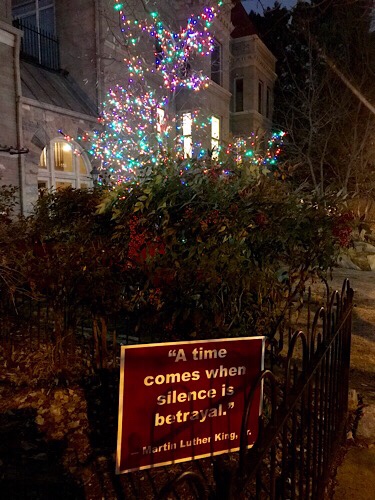
The sign may be temporary, but this is a state that I would want to be as long-lasting as possible. Yoga, well-practiced and studied, provides us with ever more resilience–one hopes a lifetime’s worth– to handle the wild vagaries of existence with as much grace as is possible.
Peace and light, E — Posted with WordPress for BlackBerry.
I Wanted to Be Near the Water
When I finished practicing this morning, all I wanted was to be near the water. I walked to the tidal basin–about seven miles round trip. Some of the museums were open. After the crowds in New York, even the Natural History Museum for a rest stop did not seem too, too terrible. The day was almost balmy, no need for a scarf or hat even with the wind off of the water. Appreciating the contrast between walking around in DC and NY, I found myself remembering why I had first decided to come to DC from New York to go to law school, based on an initial visit in February: the snow was melted and the museums were free.
- Art and Culture | Asana, Pranayama, and Yoga Practice | Community and Family | Food for the Mind (Yoga Philosophy, etc)
Nataraja (and dancing blissfully in life)
A work colleague of mine graciously said to me that he did not know how I got through certain meetings without yelling, he did not know if he could do it. I replied that lots of yoga helped. “Maybe I should get back to transcendental meditation,” he said, “but I found it did not really help; I should find something, though.”
I said that I tried to think of the challenges at work as just part of the dance that yields such rich abundance for me. The discussion carried on, and we not only resolved the minor problem that had led to the phone call, but also felt a deeper connection that will make it easier in the future to resolve work issues that we mutually encounter.
What I like best about the myth of Nataraja is that the dance is not for the purpose of creating the world or with any particular design, but for the sheer bliss of dancing — anantatandava. The dance makes possible both destruction and creation, but it is not its reason. When we engage in the dance of our own lives, yoga invites us just to dance fully with wonder at the rich diversity of experience. We make choices and seek to be more aligned, but ultimately we are just dancing.