Shadow and Light
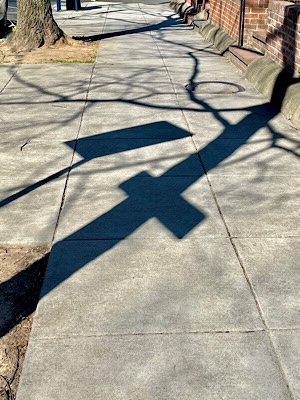
Last night, at his workshop at Willow Street Yoga, Todd Norian discussed the niyama samtosha — contentment. “Perfect,” I thought, because I had been contemplating the practice of samtosha all day. When I had sat to meditate in the morning yesterday, it was hard for me to stay with my mantra or any sense of peacefulness, light, or delight. Thoughts of the horrendous repercussions of the Supreme Court’s decision on campaign finance kept arising. Time to get back to the foundations of practicing! As I began walking to work (past the Capitol), I brought myself back to the practice of samtosha, which I find one of the most useful practices for me.
Samtosha is the second of the niyamas set forth in Patanjali’s Yoga Sutras. The yamas and niyamas are ethical precepts for living and for practicing. In Patanjali’s eight-limbed, dualistic path of raja yoga, they precede the practices of asana (the physical postures), pranayama (breathing), and the various stages of meditation, which culminate in samadhi (equinimity or bliss). When I am struggling with what I witness in the outside world, I always come back to the practice of samtosha. Some people may be naturally lighter-hearted than others, but contentment is indeed a practice, and it is a foundational practice.
When I practice contentment, I remember to be grateful for all that I have. When I fully practice contentment, instead of becoming bleak and cynical (it is easy enough for me), I not only feel more naturally cheerful, but find I have have more strength to continue acting in accordance with my beliefs, even when I am confused, alarmed, outraged, and disgusted by what is going on outside. When practicing contentment, I try to find my own light, I seek the love and company of friends, I join with like-minded persons to be moved to work for change, even if I do not trust it will make any visible change to anyone other than me.
FYI, Todd Norian will be at Willow Street Yoga Center all weekend. If you are local and reading this in time, try to come for some of the weekend. He is wonderful.
Last week, I used as a theme sukha — ease, comfort, happiness. I was inspired by Lorin Roche’s discussion of translating in his “version” of the Vijnana Bhairava, which he entitles “The Radiance Sutras.” In it he notes that “[e]ven more literally, sukha is (according to some etymologies) composed of su, good + kha, space. A good space.” At first blush, teaching about sukha might seem to be off-topic from my session theme of sequencing principles. The whole purpose, though, of seeking to understand, practice, and optimize our sequencing in time and space on and off the mat is to find just that. It is to be in a “good space,” to feel at ease, whether we are being challenged or delighted.
I found myself contemplating sukha yet further this week (it is a recurring practice and contemplation theme for me — I love Patanjali’s sutra “sthiram sukham asanam”), as I have been observing and helping the foster cats make mine their new home. When we are uprooted or out of alignment, we are not in a good space. It is a struggle to feel happy or at ease. When we find our rhythm again, then ease unfolds.
There is a set of principles that generally works for taking uprooted animals (or people) and helping them feel at home. Part of making them at home is their new person holding him/herself in a “good space” for the newcomers, which indeed helps them find their own, which is its own yoga.
The blessing of yoga for us, and why we take ourselves to challenging difficult places on the mat, is so that we can, by use of intelligent sequencing of practices, techniques, and mindsets, discover how to feel connected to our own spirit wherever we are in time and space — the essence of ease in this body and mind. The more we can do this for ourselves, the more we can do it for others.
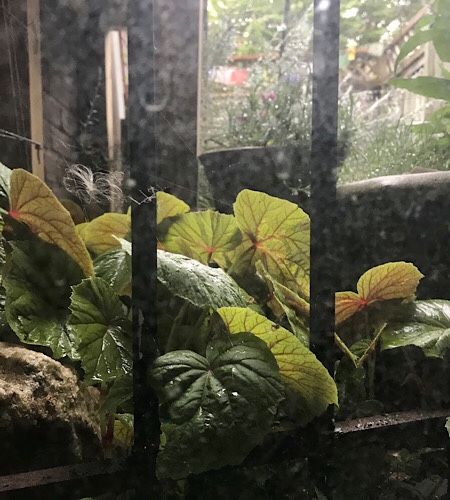
A view from inside of volunteer begonias in the rain.
is catsitting. Hmmm.

Peace and light, E — Posted with WordPress for BlackBerry.