Signs Around Town

 Last week, when I said to a colleague, “see you Tuesday,” she replied, “where are you going?” It was as if simply to enjoy where I live or rest or quietly take care of house and garden was not within the range of possibility. Is it that I am somehow not worthy if I have not planned to do something I could talk about when I returned to the office? Or is it that pervasive societal sense that happiness lies only in finding new and more experience?
I think that it is important to have episodic time away from doing. I used to get sick when I’d been running around non-stop with work and errands and exploration, etc. Now I try to take some quiet time at decent intervals. It does not need to be a full day. Just a couple of solid hours without engaging in a planned activity every couple of weeks makes all the difference in my mood, my health, and the quality of my work.
The other day, I went to see the Louise Bourgeois retrospective at the Hirshhorn. The works are a combination of exquisite technique and in-your-face, challenging emotions. I had a friend who raged at me once because I had created a piece that was radically, polemically feminist. “That’s not art; art is only meant to be beautiful and aesthetic, not to be political,” said my friend. Although he could not have questioned Bourgeois as an artist — her technique is too good — he might still have raged at it. (The high school group being shown art on a field trip, while I was at the exhibit, was scurried through a room or two, much to my amusement).
Seeing the exhibit led me to think of the purported purpose of left-handed tantric practices, which are meant to challenge us, turn us upside-down and inside out, and question what we recognize as the divine.
The other day I was doing a computer search on contact improv jams in the Bay Area to see if it was possible to fit one in during my upcoming vacation in San Francisco.
The website for one of the jams said for a class that preceded the weekly jam that beginners and advanced practitioners with a beginner’s mind were welcome. I loved that statement.
The idea of beginner’s mind is one that is mentioned often in the yoga world and was taught as an integral part of the principle of “opening to grace” in the Anusara system.
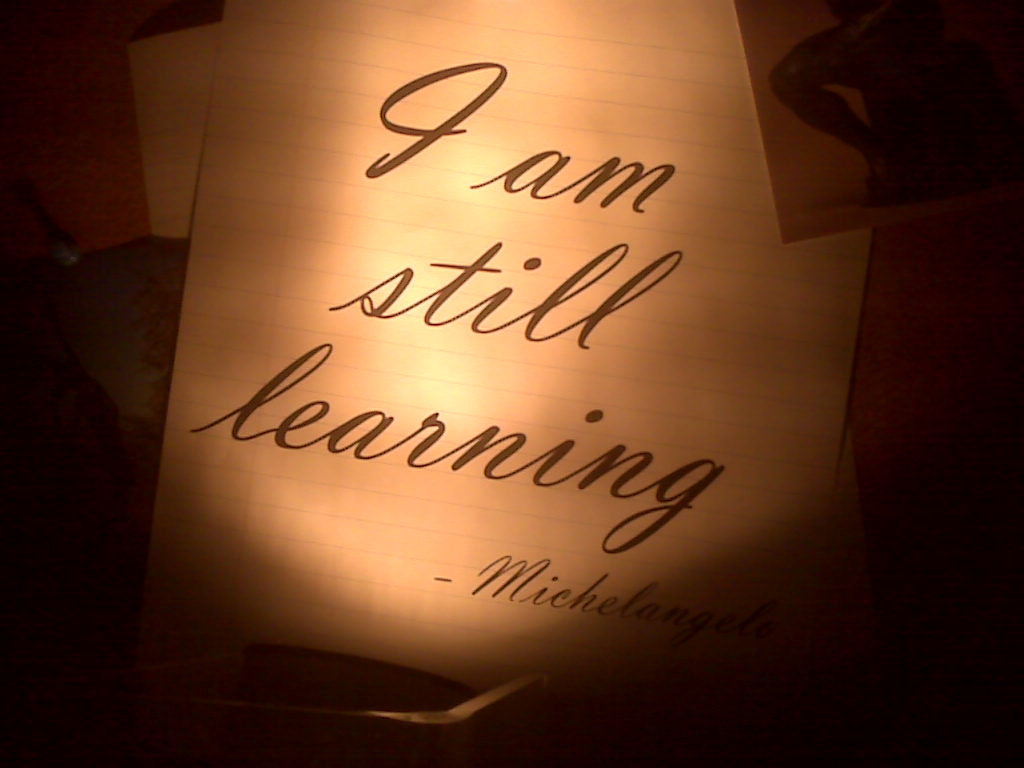
What I think is meant by practicing or bringing to the mat or to the dance a beginner’s mind is approaching each practice, every step, every pose, every aspect of alignment and technique with wonder, openness, and an ever-growing willingness to learn.
When we are new to a practice or a style, discovering our own capacity to express and experience the form is exciting, as is a growing mastery of body and mind in the language of the form.
Being advanced, though, is not just about physical or intellectual prowess. It is about developing a nuanced relationship between ourselves, the practices, and our fellow practitioners. Being freshly open to new insight and learning even from beginners helps us deepen our practice and experience ever greater enjoyment (bhoga).
Peace and light, E — Posted with WordPress for BlackBerry.
We tend to think of giving our lives in terms of willingness to die, but is not any life lived in accordance with dharma a life dedicated to the service of what is greater, one in which we abandon gratification for aligning with a higher purpose?

Peace and light, E — Posted with WordPress for BlackBerry.
After teaching my classes this morning at Willow Street, I will be studying with Paul Muller-Ortega, who is leading a workshop on tantric philosophy and meditation today and tomorrow. It will be good to study, to learn, to meditate with direction. To be able to teach, it is essential for me to study.